


Fractionation and purification of bioactive compounds obtained from a brewery waste stream
- PMID: 23762844
- PMCID: PMC3665171
- DOI: 10.1155/2013/408491
Fractionation and purification of bioactive compounds obtained from a brewery waste stream
Abstract
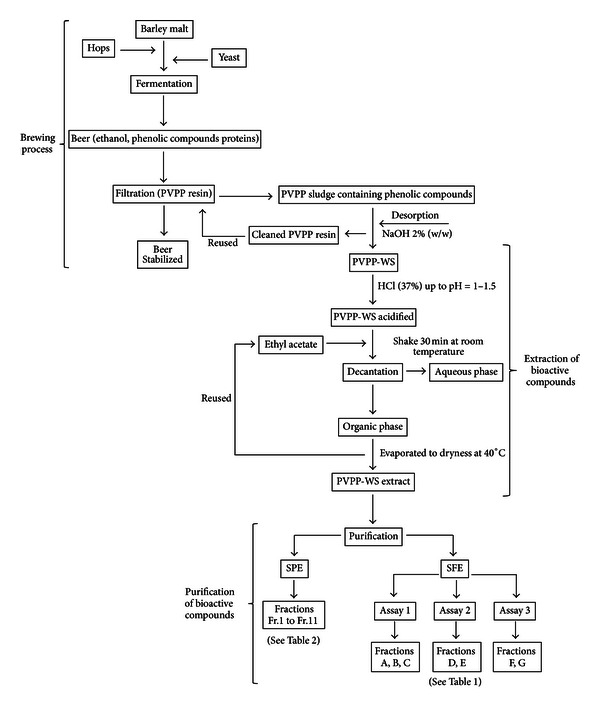
The brewery industry generates waste that could be used to yield a natural extract containing bioactive phenolic compounds. We compared two methods of purifying the crude extract-solid-phase extraction (SPE) and supercritical fluid extraction (SFE)--with the aim of improving the quality of the final extract for potential use as safe food additive, functional food ingredient, or nutraceutical. The predominant fractions yielded by SPE were the most active, and the fraction eluted with 30% (v/v) of methanol displayed the highest antioxidant activity (0.20 g L(-1)), similar to that of BHA. The most active fraction yielded by SFE (EC50 of 0.23 g L(-1)) was obtained under the following conditions: temperature 40 °C, pressure 140 bar, extraction time 30 minutes, ethanol (6%) as a modifier, and modifier flow 0.2 mL min(-1). Finally, we found that SFE is the most suitable procedure for purifying the crude extracts and improves the organoleptic characteristics of the product: the final extract was odourless, did not contain solvent residues, and was not strongly coloured. Therefore, natural extracts obtained from the residual stream and purified by SFE can be used as natural antioxidants with potential applications in the food, cosmetic, and pharmaceutical industries.
Figures
References
-
- Scalbert A, Williamson G. Dietary intake and bioavailability of polyphenols. Journal of Nutrition. 2000;130(8):2073S–2085S. - PubMed
-
- Martins S, Mussatto SI, Martínez-Avila G, Montañez-Saenz J, Aguilar CN, Teixeira JA. Bioactive phenolic compounds: production and extraction by solid-state fermentation. A review. Biotechnology Advances. 2011;29(3):365–373. - PubMed
-
- Scalbert A, Manach C, Morand C, Rémésy C, Jiménez L. Dietary polyphenols and the prevention of diseases. Critical Reviews in Food Science and Nutrition. 2005;45(4):287–306. - PubMed
-
- Balasundram N, Sundram K, Samman S. Phenolic compounds in plants and agri-industrial by-products: antioxidant activity, occurrence, and potential uses. Food Chemistry. 2006;99(1):191–203.
-
- Regulation (EC) No 1333/2008 of The European Parliament and of the Council of 16 December 2008 on food additives. Official Journal of the European Union. 2008;354:16–33.
Publication types
MeSH terms
Substances
LinkOut - more resources
Full Text Sources
Other Literature Sources
Miscellaneous
