. 2013 Sep;170(2):341-51.
doi: 10.1111/bph.12277.

Fasudil, a rho kinase inhibitor, limits motor neuron loss in experimental models of amyotrophic lateral sclerosis

Affiliations

Fasudil, a rho kinase inhibitor, limits motor neuron loss in experimental models of amyotrophic lateral sclerosis

M Takata et al. Br J Pharmacol. 2013 Sep.

Abstract

Background and purpose: Amyotrophic lateral sclerosis (ALS) is a fatal neurodegenerative disorder with no effective treatment. Fasudil hydrochloride (fasudil), a potent rho kinase (ROCK) inhibitor, is useful for the treatment of ischaemic diseases. In previous reports, fasudil improved pathology in mouse models of Alzheimer's disease and spinal muscular atrophy, but there is no evidence in that it can affect ALS. We therefore investigated its effects on experimental models of ALS.

Experimental approach: In mice motor neuron (NSC34) cells, the neuroprotective effect of hydroxyfasudil (M3), an active metabolite of fasudil, and its mechanism were evaluated. Moreover, the effects of fasudil, 30 and 100 mg·kg(-1), administered via drinking water to mutant superoxide dismutase 1 (SOD1(G93A)) mice were tested by measuring motor performance, survival time and histological changes, and its mechanism investigated.

Key results: M3 prevented motor neuron cell death induced by SOD1(G93A). Furthermore, M3 suppressed both the increase in ROCK activity and phosphorylated phosphatase and tensin homologue deleted on chromosome 10 (PTEN), and the reduction in phosphorylated Akt induced by SOD1(G93A). These effects of M3 were attenuated by treatment with a PI3K inhibitor (LY294002). Moreover, fasudil slowed disease progression, increased survival time and reduced motor neuron loss, in SOD1(G93A) mice. Fasudil also attenuated the increase in ROCK activity and PTEN, and the reduction in Akt in SOD1(G93A) mice.

Conclusions and implications: These findings indicate that fasudil may be effective at suppressing motor neuron degeneration and symptom progression in ALS. Hence, fasudil may have potential as a therapeutic agent for ALS treatment.

Keywords: PTEN/Akt pathway; amyotrophic lateral sclerosis; fasudil hydrochloride; motor neuron degeneration; rho kinase (ROCK).


Figures

Figure 1
Figure 1
M3 protected motor neurons against the cell death resulting from mutant SOD1G93A-induced neurotoxicity. (A) Representative fluorescence microscopic images of Hoechst 33342 (blue) and PI (red) staining, 27 h after serum deprivation, of NSC34 cells transfected with enhanced GFP-tagged (green), WT SOD1 (SOD1WT) or SOD1G93A. Scale bar represents 50 μm. (B) Quantitative analysis of Hoechst- and PI-positive NSC34 cells expressing SOD1WT or SOD1G93A after 27 h of serum deprivation. Each column represents the mean ± SEM (n = 6). $$P < 0.01 versus SOD1G93A (Student's t-test), *P < 0.05, **P < 0.01 versus vehicle (Dunnett's test).
Figure 2
Figure 2
M3 attenuated the elevated ROCK activity associated with SOD1G93A-induced neurotoxicity. (A, B) NSC34 cells were lysed after transfection with Myc-tagged mock, SOD1WT or SOD1G93A for 48 h, then treated with PBS or M3 (30 nM) for 27 h. (A) Expressions of ROCK1 and ROCK2 were examined by immunoblotting. (B) The protein levels of ROCK1 and ROCK2 were quantified relative to the β-actin level. Each column represents the mean ± SEM (n = 4). (C) ROCK activity was measured in NSC34 cells expressing mock, SOD1WT or SOD1G93A at 48 h after transfection and after 27 h subsequent treatment with or without M3 (30 nM). Each column represents the mean ± SEM (n = 4). ##P < 0.01 versus mock (Student's t-test), *P < 0.05 versus SOD1G93A (Student's t-test). N.S., not significant.
Figure 3
Figure 3
M3 regulated the phosphorylation levels of Akt and PTEN. (A–C) NSC34 cells were lysed at 48 h after transfection with Myc-tagged mock, SOD1WT or SOD1G93A, then treated with PBS or M3 (30 nM) for 12 or 27 h. (A) Expressions of Akt and PTEN were examined by immunoblotting. The protein levels of phosphorylated Akt (B) and phosphorylated PTEN (C) were quantified relative to the total Akt and total PTEN levels respectively. Each column represents the mean ± SEM (n = 4). #P < 0.05, ##P < 0.01 versus mock + PBS (Student's t-test), *P < 0.05 versus SOD1G93A + PBS (Student's t-test).
Figure 4
Figure 4
Akt inhibition eliminated the neuroprotective effects of M3 against SOD1G93A-induced neurotoxicity. (A) Representative fluorescence microscopic images of Hoechst 33342 (blue) and PI (red) staining after 27 h serum deprivation in NSC34 cells transfected for 48 h with enhanced GFP-tagged (green) SOD1G93A. Scale bar represents 50 μm. (B) Quantitative analysis of Hoechst- and PI-positive NSC34 cells expressing SOD1WT or SOD1G93A after 27 h serum deprivation. Each column represents the mean ± SEM (n = 6). $$P < 0.01 versus SOD1G93A (Student's t-test), ##P < 0.01 versus vehicle (Student's t-test), **P < 0.01 versus SOD1G93A + serum deprivation + M3 (30 nM; Dunnett's test).
Figure 5
Figure 5
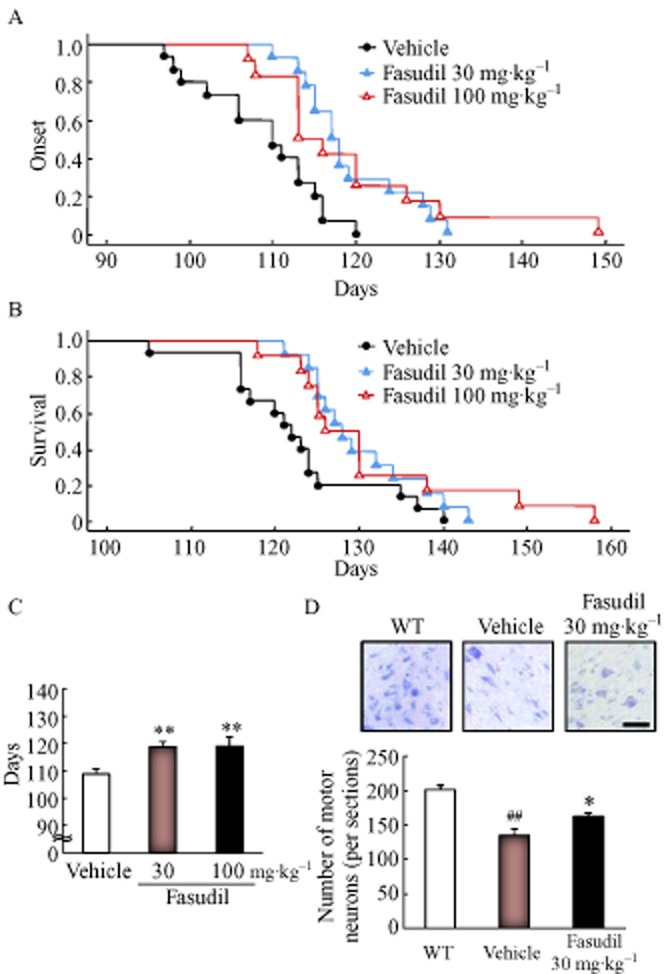
Fasudil hydrochloride (fasudil) delayed the disease onset and prolonged the survival time, and suppressed motor neuron loss, in SOD1G93A mice. The effects of fasudil at 30 and 100 mg·kg−1 were examined by evaluating (A) motor performance in the rotarod test, (B) survival time and (C) the number of days before the beginning of an observable motor deficit in vehicle-, fasudil 30 or 100 mg·kg−1-treated SOD1G93A mice. Each column represents the mean ± SEM (vehicle, n = 15; fasudil 30 mg·kg−1, n = 13; fasudil 100 mg·kg−1, n = 12). **P < 0.01 versus vehicle (Student's t-test). (D) The numbers of motor neurons in WT, vehicle- or fasudil 30 mg·kg−1-treated SOD1G93A mice were evaluated using cresyl violet staining. Scale bar represents 50 μm. Each column represents the mean ± SEM (WT, n = 4; vehicle, n = 3; fasudil 30 mg·kg−1, n = 4). ##P < 0.01 versus WT (Student's t-test), *P < 0.05 versus vehicle (Student's t-test).
Figure 6
Figure 6
Fasudil attenuated the elevated ROCK activity in SOD1G93A mice. (A) Expressions of ROCK1 and ROCK2 were examined by immunoblotting. (B, C) The protein levels of ROCK1 and ROCK2 were quantified relative to the β-actin level. Each column represents the mean ± SEM (n = 4). (D, E) ROCK activity was measured by the phosphorylation of adducin level in WT, vehicle- or fasudil 30 mg·kg−1-treated mice. (D) Expressions of adducin were examined by immunoblotting. (E) The protein levels of phosphorylation of adducin were quantified relative to the α-adducin level. Each column represents the mean ± SEM (n = 4). ##P < 0.01 versus WT (Student's t-test), *P < 0.05 versus vehicle (Student's t-test). N.S., not significant.
Figure 7
Figure 7
Fasudil regulated the phosphorylation levels of Akt and PTEN in SOD1G93A mice. (A) Expressions of Akt and PTEN were examined by immunoblotting. The protein levels of phosphorylated Akt (B) and phosphorylated PTEN (C) were quantified relative to the total Akt and total PTEN levels respectively. Each column represents the mean ± SEM (n = 4). #P < 0.05 versus WT (Student's t-test), *P < 0.05 versus vehicle (Student's t-test).
Figure 8
Figure 8
The putative mechanism underlying the protective effect of fasudil on ALS. ROCK activity is increased by the neurotoxic action of SOD1G93A. The activated ROCK suppresses phosphorylation of Akt through phosphorylation of PTEN. Fasudil attenuates the elevated ROCK activity and thereby attenuates the increased phosphorylation of PTEN, resulting in survival of neuronal cells via an increase in phosphorylated Akt.

References

    1. Boillee S, Vande Velde C, Cleveland DW. ALS: a disease of motor neurons and their nonneuronal neighbors. Neuron. 2006;52:39–59. - PubMed
    1. Bowerman M, Murray LM, Boyer JG, Anderson CL, Kothary R. Fasudil improves survival and promotes skeletal muscle development in a mouse model of spinal muscular atrophy. BMC Med. 2012;10:24. - PMC - PubMed
    1. Coleman ML, Sahai EA, Yeo M, Bosch M, Dewar A, Olson MF. Membrane blebbing during apoptosis results from caspase-mediated activation of ROCK I. Nat Cell Biol. 2001;3:339–345. - PubMed
    1. Dewil M, Lambrechts D, Sciot R, Shaw PJ, Ince PG, Robberecht W, et al. Vascular endothelial growth factor counteracts the loss of phospho-Akt preceding motor neurone degeneration in amyotrophic lateral sclerosis. Neuropathol Appl Neurobiol. 2007;33:499–509. - PubMed
    1. Gurney ME. The use of transgenic mouse models of amyotrophic lateral sclerosis in preclinical drug studies. J Neurol Sci. 1997;152(Suppl. 1):S67–S73. - PubMed

Publication types

MeSH terms