


Bacilliform DNA-containing plant viruses in the tropics: commonalities within a genetically diverse group
- PMID: 23763585
- PMCID: PMC6638767
- DOI: 10.1111/mpp.12046
Bacilliform DNA-containing plant viruses in the tropics: commonalities within a genetically diverse group
Abstract
Plant viruses, possessing a bacilliform shape and containing double-stranded DNA, are emerging as important pathogens in a number of agricultural and horticultural crops in the tropics. They have been reported from a large number of countries in African and Asian continents, as well as from islands from the Pacific region. The viruses, belonging to two genera, Badnavirus and Tungrovirus, within the family Caulimoviridae, have genomes displaying a common plan, yet are highly variable, sometimes even between isolates of the same virus. In this article, we summarize the current knowledge with a view to revealing the common features embedded within the genetic diversity of this group of viruses.
Taxonomy: Virus; order Unassigned; family Caulimoviridae; genera Badnavirus and Tungrovirus; species Banana streak viruses, Bougainvillea spectabilis chlorotic vein banding virus, Cacao swollen shoot virus, Citrus yellow mosaic badnavirus, Dioscorea bacilliform viruses, Rice tungro bacilliform virus, Sugarcane bacilliform viruses and Taro bacilliform virus.
Microbiological properties: Bacilliform in shape; length, 60-900 nm; width, 35-50 nm; circular double-stranded DNA of approximately 7.5 kbp with one or more single-stranded discontinuities.
Host range: Each virus generally limited to its own host, including banana, bougainvillea, black pepper, cacao, citrus species, Dioscorea alata, rice, sugarcane and taro.
Disease symptoms: Foliar streaking in banana and sugarcane, swelling of shoots in cacao, yellow mosaic in leaves and stems in citrus, brown spot in the tubers in yam and yellow-orange discoloration and stunting in rice.
Useful websites: http://www.dpvweb.net.
2013 BSPP and JOHN WILEY & SONS LTD
Figures
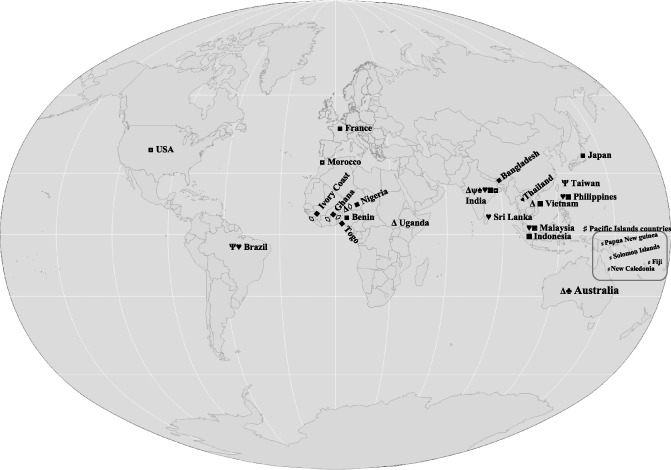
 , Rice tungro bacilliform virus;
  , Sugarcane bacilliform virus; ♯, Taro bacilliform virus; ■, Dioscorea bacilliform virus.
References
-
- Adegbola, M.O.K. (1971) Advances in the study of cacao swollen shoot virus disease in Nigeria In: Progress in Tree Crop Research In Nigeria (Cocoa Research Institute of Nigeria , ed.), pp. 134–143. Ibadan: Cocoa Research Institute of ; Nigeria.
-
- Adejumo, T.O. (2005) Crop protection strategies for major diseases of cocoa, coffee and cashew in Nigeria. Afr. J. Biotechnol. 4, 143–150.
-
- Afolami, S.O. (1980) Nematode survey of cocoa fields and nurseries in major growing areas of Nigeria and GES plots In: Annual Report Cocoa Research Institute of Nigeria (Cocoa Research Institute of Nigeria , ed.), pp. 49–51. Ibadan: Cocoa Research Institute of ; Nigeria.
-
- Ahlawat, Y.S. (1997) Viruses, greening bacterium and viroids associated with Citrus (Citrus species) decline in India. Indian J. Agr. Sci. 67, 51–57.
-
- Ahlawat, Y.S. , Chenulu, V.V. , Viswanath, S.M. , Pandey, P.K. and Bhagawati, K.N. (1985) Mosaic disease of citrus in India. Curr. Sci. 54, 873–874.
Publication types
MeSH terms
LinkOut - more resources
Full Text Sources
Other Literature Sources
