


Ecological validity and neuroanatomical correlates of the NIH EXAMINER executive composite score
- PMID: 23764015
- PMCID: PMC4059410
- DOI: 10.1017/S1355617713000611
Ecological validity and neuroanatomical correlates of the NIH EXAMINER executive composite score
Abstract
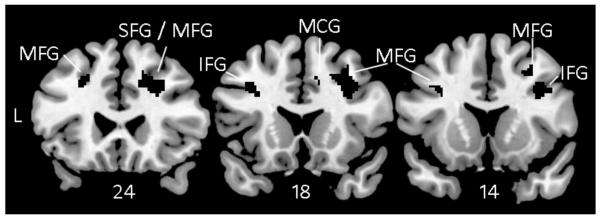
Executive functions refer to a constellation of higher-level cognitive abilities that enable goal-oriented behavior. The NIH EXAMINER battery was designed to assess executive functions comprehensively and efficiently. Performance can be summarized by a single score, the "Executive Composite," which combines measures of inhibition, set-shifting, fluency, and working memory. We evaluated the ecological validity of the Executive Composite in a sample of 225 mixed neurological patients and controls using the Frontal Systems Behavior Scale (FrSBe), an informant-based measure of real-world executive behavior. In addition, we investigated the neuroanatomical correlates of the Executive Composite using voxel-based morphometry in a sample of 37 participants diagnosed with dementia, mild cognitive impairment, or as neurologically healthy. The Executive Composite accounted for 28% of the variance in Frontal Systems Behavior Scale scores beyond age. Even after including two widely used executive function tests (Trails B and Stroop) as covariates, the Executive Composite remained a significant predictor of real-world behavior. Anatomically, poorer scores on the Executive Composite were associated with smaller right and left dorsolateral prefrontal volumes, brain regions critical for good executive control. Taken together, these results suggest that the Executive Composite measures important aspects of executive function not captured by standard measures and reflects the integrity of frontal systems.
Figures
References
-
- Ashburner J. A fast diffeomorphic image registration algorithm. Neuroimage. 2007;38(1):95–113. - PubMed
-
- Ashburner J, Friston KJ. Unified segmentation. Neuroimage. 2005;26(3):839–851. - PubMed
-
- Bates E, Wilson SM, Saygin AP, Dick F, Sereno MI, Knight RT, Dronkers NF. Voxel-based lesion-symptom mapping. Nature Neuroscience. 2003;6(5):448–450. - PubMed
Publication types
MeSH terms
Grants and funding
LinkOut - more resources
Full Text Sources
Other Literature Sources
