


Development and validation of a new patient-reported outcome measure for patients with pressure ulcers: the PU-QOL instrument
- PMID: 23764247
- PMCID: PMC3698102
- DOI: 10.1186/1477-7525-11-95
Development and validation of a new patient-reported outcome measure for patients with pressure ulcers: the PU-QOL instrument
Abstract
Background: Patient-reported outcome (PRO) data are integral to patient care, policy decision making and healthcare delivery. PRO assessment in pressure ulcers is in its infancy, with few studies including PROs as study outcomes. Further, there are no pressure ulcer PRO instruments available.
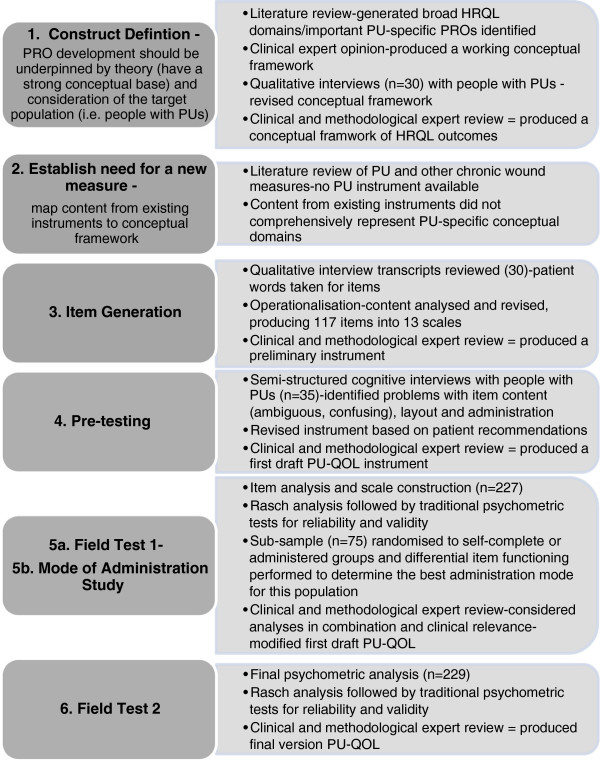
Methods: We used gold-standard methods to develop and evaluate a new PRO instrument for people with pressure ulcers (the PU-QOL instrument). Firstly a conceptual framework was developed forming the basis of PU-QOL scales. Next an exhaustive item pool was used to produce a draft instrument that was pretested using mixed methods (cognitive interviews and Rasch Measurement Theory). Finally, we undertook psychometric evaluation in two parts. This first part was item reduction, using PU-QOL data from 227 patients. The second part was reliability and validity evaluation of the item-reduced version using both Traditional and Rasch methods, on PU-QOL data from 229 patients.
Results: The final PU-QOL contains 10 scales for measuring symptoms, physical functioning, psychological well-being and social participation specific to pressure ulcers. It is intended for administration and patients rate the amount of "bother" attributed during the past week on a 3-point response scale. Scale scores are generated by summing items, with lower scores indicating better outcome. The PU-QOL instrument was found to be acceptable, reliable (Cronbach's alpha values ranging 0.89-0.97) and valid (hypothesised correlations between PU-QOL and SF-12 scores (r>0.30) and PU-QOL scales and sociodemographic variables (r<0.30) were consistent with predictions).
Conclusions: The PU-QOL instrument provides a standardised method for assessing PROs, reflecting the domains in a pressure ulcer-specific conceptual framework. It is intended for evaluating patient orientated differences between interventions and in particular the impact from the perspective of patients.
Figures
References
-
- National Pressure Ulcer Advisory Panel and the European Pressure Ulcer Advisory Panel (NPUAP/EPUAP) Prevention and Treatment of Pressure Ulcers: Clinical Practice Guideline. Washington CD: NPUAP; 2009. pp. 16–20.
-
- Bridel J. The epidemiology of pressure sores. Nurs Stand. 1993;7:25–30. - PubMed
-
- Kaltenthaler E, Whitfield MD, Walters SJ, Akehurst RL, Paisley S. UK, USA and Canada: how do their pressure ulcer prevalence and incidence data compare? J Wound Care. 2001;10:530–535. - PubMed
-
- Thomas DR, Goode PS, Tarquine PH, Allman RM. Hospital-acquired pressure ulcers and risk of death. J Am Geriatr Soc. 1996;44:1435–1440. - PubMed
Publication types
MeSH terms
Grants and funding
LinkOut - more resources
Full Text Sources
Other Literature Sources
Medical
Miscellaneous
