


Clinical outcomes of minimally invasive versus open approach for one-level transforaminal lumbar interbody fusion at the 3- to 4-year follow-up
- PMID: 23764765
- PMCID: PMC3843777
- DOI: 10.1007/s00586-013-2853-y
Clinical outcomes of minimally invasive versus open approach for one-level transforaminal lumbar interbody fusion at the 3- to 4-year follow-up
Abstract
Purpose: Supporters of minimally invasive approaches for transforaminal lumbar interbody fusion (TLIF) have reported short-term advantages associated with a reduced soft tissue trauma. Nevertheless, mid- and long-term outcomes and specifically those involving physical activities have not been adequately studied. The aim of this study was to compare the clinical outcomes of mini-open versus classic open surgery for one-level TLIF, with an individualized evaluation of the variables used for the clinical assessment.
Methods: A prospective cohort study was conducted of 41 individuals with degenerative disc disease who underwent a one-level TLIF from January 2007 to June 2008. Patients were randomized into two groups depending on the type of surgery performed: classic open (CL-TLIF) group and mini-open approach (MO-TLIF) group. The visual analog scale (VAS), North American Spine Society (NASS) Low Back Pain Outcome instrument, Oswestry Disability Index (ODI) and the Short Form 36 Health Survey (SF-36) were used for clinical assessment in a minimum 3-year follow-up (36-54 months).
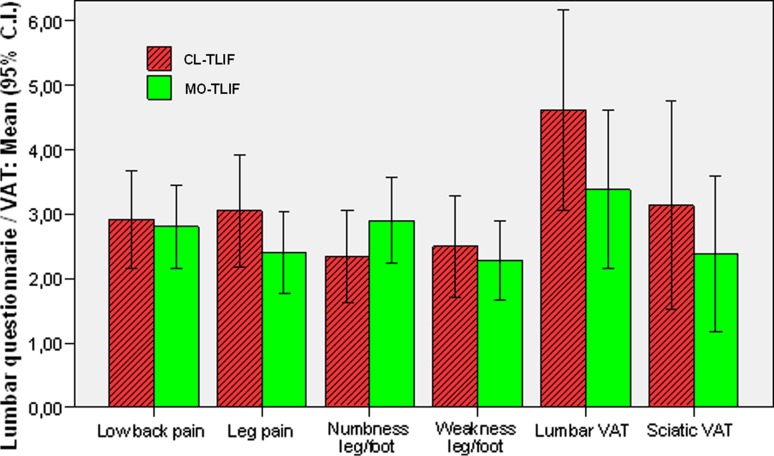
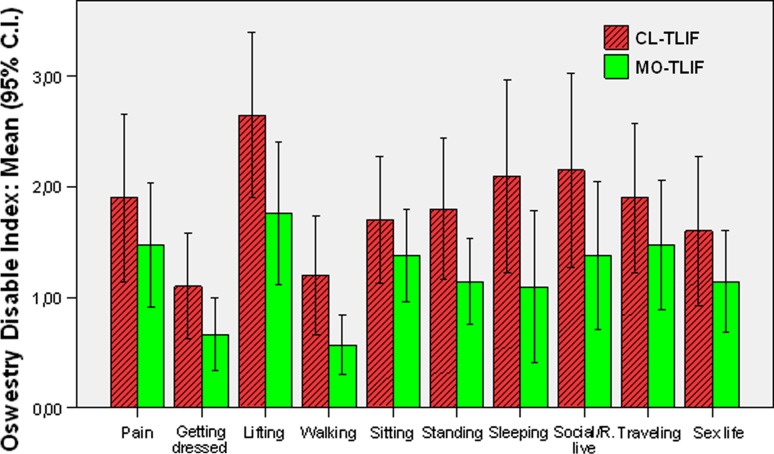
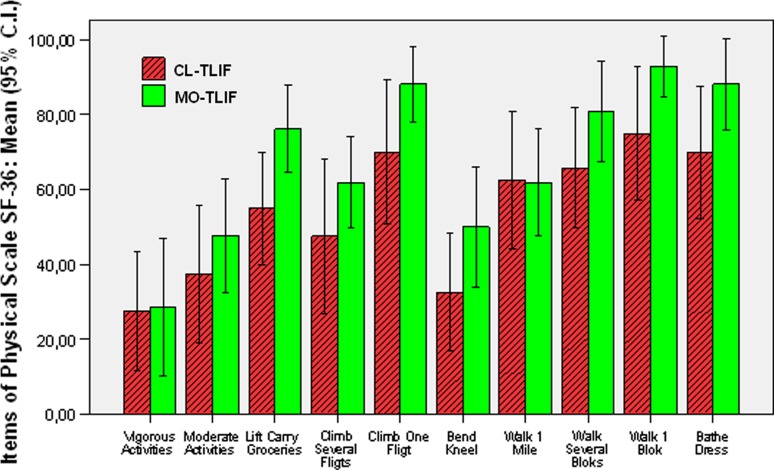
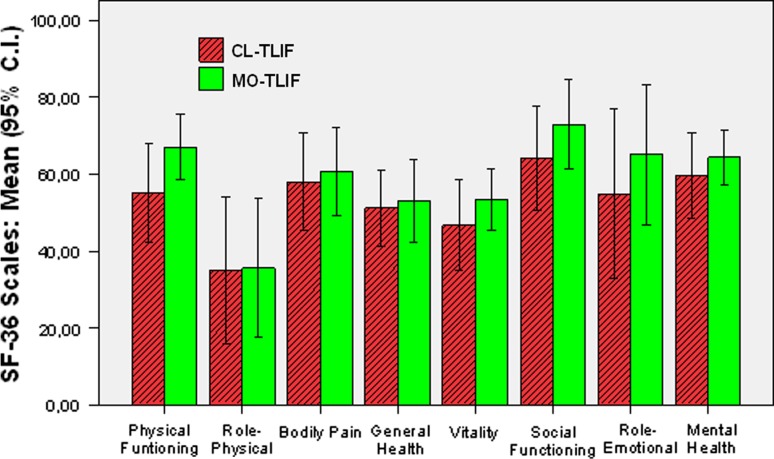
Results: Patients of the MO-TLIF group presented lower rates of lumbar (p = 0.194) and sciatic pain (p = 0.427) and performed better in daily life activities, especially in those requiring mild efforts: lifting slight weights (p = 0.081), standing (p = 0.097), carrying groceries (p = 0.033), walking (p = 0.069) and dressing (p = 0.074). Nevertheless, the global scores of the clinical questionnaires showed no statistical differences between the CL-TLIF and the MO-TLIF groups.
Conclusions: Despite an improved functional status of MO-TLIF patients in the short term, the clinical outcomes of mini-open TLIF at the 3- to 4-year follow-up showed no clinically relevant differences to those obtained with open TLIF.
Figures
References
-
- Tsutsumimoto T, Shimogata M, Ohta H, Misawa H. Mini-open versus conventional open posterior lumbar interbody fusion for the treatment of lumbar degenerative spondylolisthesis: comparison of paraspinal muscle damage and slip reduction. Spine. 2009;34:1923–1928. doi: 10.1097/BRS.0b013e3181a9d28e. - DOI - PubMed
Publication types
MeSH terms
LinkOut - more resources
Full Text Sources
Other Literature Sources
