. 2013 Sep;30(9):2099-112.
doi: 10.1093/molbev/mst109. Epub 2013 Jun 12.

The skeletal proteome of the coral Acropora millepora: the evolution of calcification by co-option and domain shuffling

Affiliations

The skeletal proteome of the coral Acropora millepora: the evolution of calcification by co-option and domain shuffling

Paula Ramos-Silva et al. Mol Biol Evol. 2013 Sep.

Abstract

In corals, biocalcification is a major function that may be drastically affected by ocean acidification (OA). Scleractinian corals grow by building up aragonitic exoskeletons that provide support and protection for soft tissues. Although this process has been extensively studied, the molecular basis of biocalcification is poorly understood. Notably lacking is a comprehensive catalog of the skeleton-occluded proteins-the skeletal organic matrix proteins (SOMPs) that are thought to regulate the mineral deposition. Using a combination of proteomics and transcriptomics, we report the first survey of such proteins in the staghorn coral Acropora millepora. The organic matrix (OM) extracted from the coral skeleton was analyzed by mass spectrometry and bioinformatics, enabling the identification of 36 SOMPs. These results provide novel insights into the molecular basis of coral calcification and the macroevolution of metazoan calcifying systems, whereas establishing a platform for studying the impact of OA at molecular level. Besides secreted proteins, extracellular regions of transmembrane proteins are also present, suggesting a close control of aragonite deposition by the calicoblastic epithelium. In addition to the expected SOMPs (Asp/Glu-rich, galaxins), the skeletal repertoire included several proteins containing known extracellular matrix domains. From an evolutionary perspective, the number of coral-specific proteins is low, many SOMPs having counterparts in the noncalcifying cnidarians. Extending the comparison with the skeletal OM proteomes of other metazoans allowed the identification of a pool of functional domains shared between phyla. These data suggest that co-option and domain shuffling may be general mechanisms by which the trait of calcification has evolved.

Keywords: biomineralization; calcium carbonate skeleton; evolution; proteomics; scleractinian.


Figures
F<sc>ig</sc>. 1.
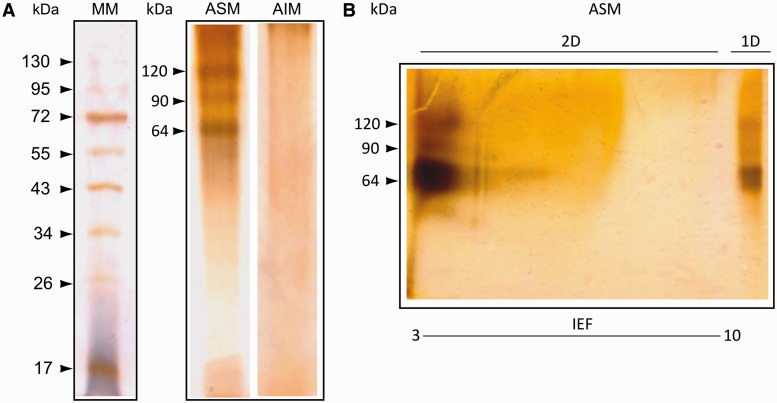
Fig. 1.
Electrophoretic analysis of the ASM and AIM after AgNO3 staining on (A) 12% poly-acrylamide SDS-polyacrylamide gel electrophoresis (PAGE) gel; (B) 4–10% precast poly-acrylamide gel using an IPG (3–10) strip in the first dimension, under denaturing conditions.
F<sc>ig</sc>. 2.
Fig. 2.
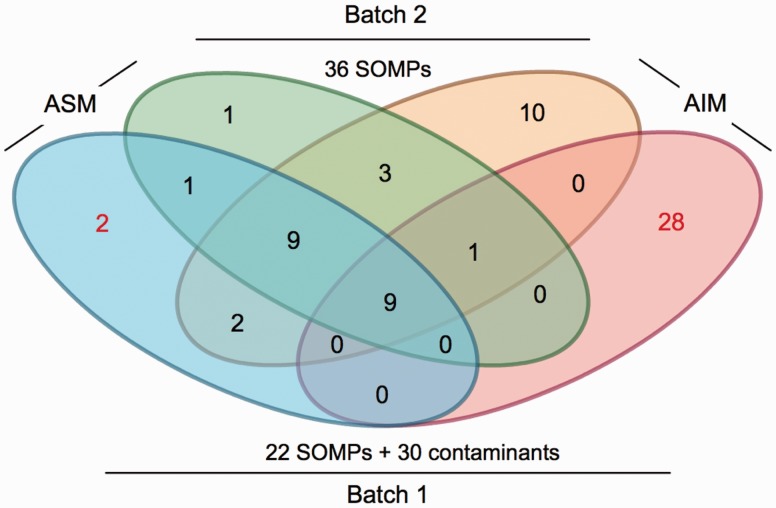
Comparison of the proteins identified by proteomics on the ASM and AIM in two different conditions, batch 1 and batch 2. Batch 1 consisted of treating the skeletal fragments with sodium hypochlorite once, whereas batch 2 consisted of batch 1 followed by a subsequent similar treatment on the skeletal-sieved powder (<200 µm). Extracts from batch 1 showed evidence of contamination with the identification of specific intracellular proteins from Acropora millepora (tubulins, histones, ATP-synthase) and proteins from zooxanthellae: 2 contaminants of 23 identifications in the ASM and 28 contaminants of 38 identifications in the AIM. In contrast, no contaminants were identified in batch 2, indicating that a second bleach treatment on powder is effective in removing potential sources of contamination and is required for obtaining exclusively SOMPs. The 22 SOMPs identified in batch 1 were also present in batch 2.
F<sc>ig</sc>. 3.
Fig. 3.
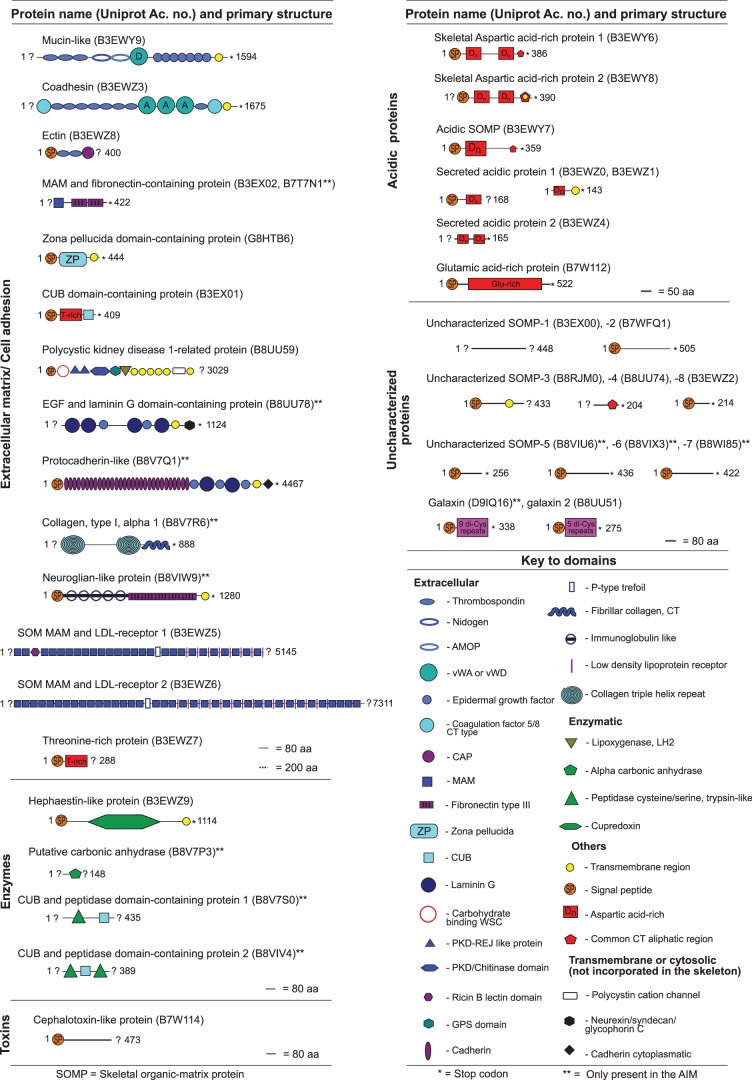
List of SOMPs identified by proteomics in the acid soluble and insoluble matrices extracted from Acropora millepora skeleton. Proteins were named according to the characterization of their primary structure.
F<sc>ig</sc>. 4.
Fig. 4.
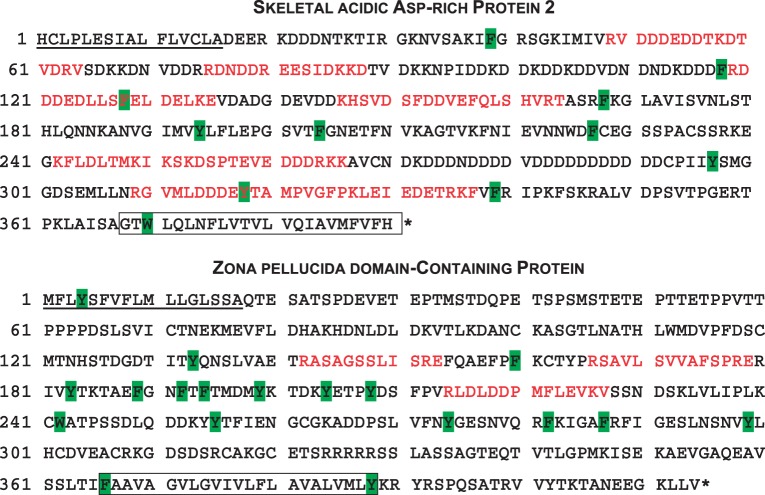
Primary structures of TM SAARP2 and zona pellucida domain-containing protein, including: putative peptide signals (underlined), codon stop (*), TM domains (□), peptides identified by MSMS (red) and chymotrypsin high specificity cleavage sites (residues [FYW] not before P highlighted in green) with more than 80% of cleavage probability.
F<sc>ig</sc>. 5.
Fig. 5.
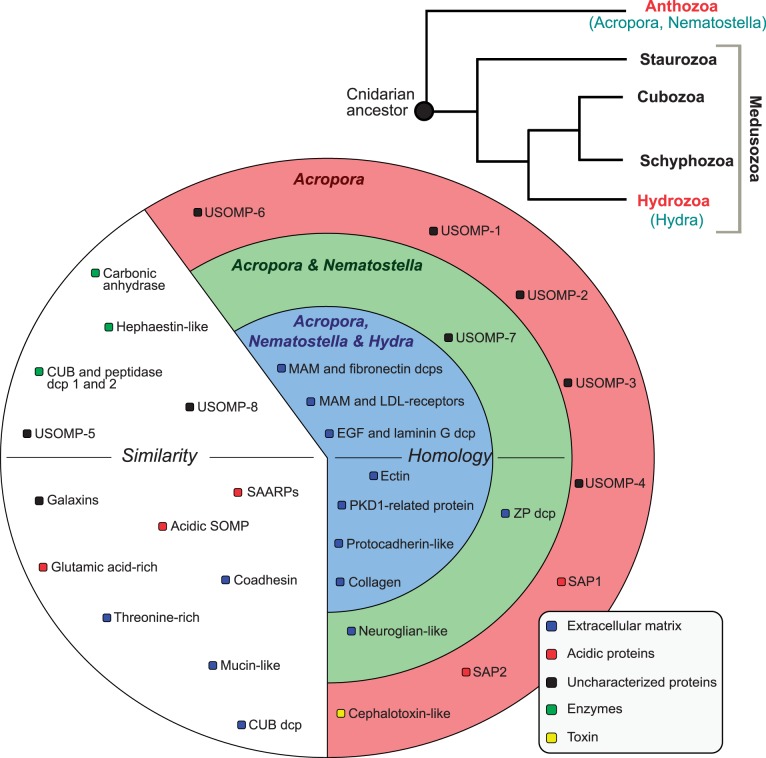
Resume of the results of similarity searches with BLAST and homology detection (by global alignment, domain architecture comparison and the NC method) using the 36 SOMPs (and corresponding transcripts) from Acropora millepora and the genomes of A. digitifera, Nematostella vectensis, and Hydra magnipapillata. Proteins in the outer circle (red) do not have similarities (and homologs) in the predicted proteins of Nematostella or Hydra. Proteins in the middle circle (green) have homologs in Acropora and Nematostella. Proteins from the inner circle (blue) have homologs in Acropora, Nematostella, and Hydra. SOMPs in the white region of the circle show considerable similarity with proteins from Nematostella and Hydra but their homology is not certain. The phylogenetic tree on the upright side represents the relationships previously purposed between Cnidaria (Collins et al. 2006); dcp, domain containing protein.

References

    1. Addadi L, Moradian J, Shay E, Maroudas NG, Weiner S. A chemical model for the cooperation of sulfates and carboxylates in calcite crystal nucleation: relevance to biomineralization. Proc Natl Acad Sci U S A. 1987;84:2732–2736. - PMC - PubMed
    1. Allemand D, Tambutté É, Zoccola D, Tambutté S. Coral calcification, cells to reefs. In: Dubinsky Z, Stambler N, editors. Coral reefs: an ecosystem in transition. Dordrecht (The Netherlands): Springer; 2011. pp. 119–150.
    1. Altschul SF, Gish W, Miller W, Myers EW, Lipman DJ. Basic local alignment search tool. J Mol Biol. 1990;215:403–410. - PubMed
    1. Ball EE, Hayward DC, Saint R, Miller DJ. A simple plan—cnidarians and the origins of developmental mechanisms. Nat Rev Genet. 2004;5:567–577. - PubMed
    1. Bayer T, Aranda M, Sunagawa S, Yum LK, Desalvo MK, Lindquist E, Coffroth MA, Voolstra CR, Medina M. Symbiodinium transcriptomes: genome insights into the dinoflagellate symbionts of reef-building corals. PloS One. 2012;7:e35269. - PMC - PubMed

Publication types

MeSH terms

LinkOut - more resources