


Control of bone remodeling by the peripheral sympathetic nervous system
- PMID: 23765388
- PMCID: PMC3883940
- DOI: 10.1007/s00223-013-9752-4
Control of bone remodeling by the peripheral sympathetic nervous system
Abstract
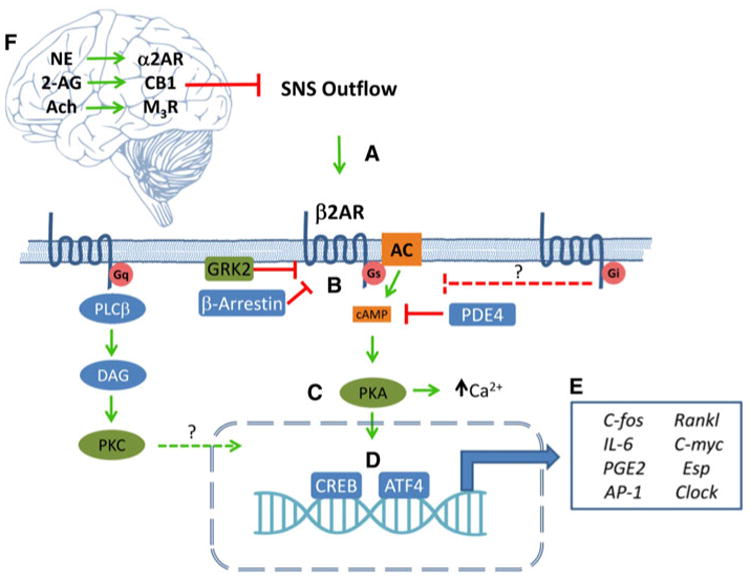
The skeleton is no longer seen as a static, isolated, and mostly structural organ. Over the last two decades, a more complete picture of the multiple functions of the skeleton has emerged, and its interactions with a growing number of apparently unrelated organs have become evident. The skeleton not only reacts to mechanical loading and inflammatory, hormonal, and mineral challenges, but also acts of its own accord by secreting factors controlling the function of other tissues, including the kidney and possibly the pancreas and gonads. It is thus becoming widely recognized that it is by nature an endocrine organ, in addition to a structural organ and site of mineral storage and hematopoiesis. Consequently and by definition, bone homeostasis must be tightly regulated and integrated with the biology of other organs to maintain whole body homeostasis, and data uncovering the involvement of the central nervous system (CNS) in the control of bone remodeling support this concept. The sympathetic nervous system (SNS) represents one of the main links between the CNS and the skeleton, based on a number of anatomic, pharmacologic, and genetic studies focused on β-adrenergic receptor (βAR) signaling in bone cells. The goal of this report was to review the data supporting the role of the SNS and βAR signaling in the regulation of skeletal homeostasis.
Conflict of interest statement
The authors report that they have no conflict of interest.
Figures
References
-
- Ebell BB. The Paprus Ebers: the greatest Egyptian medical document. Oxford University Press; London: 1937.
-
- Gros M. La Disposition des nerfs des os. Bull Soc Anat Paris. 1846;21:369–372.
-
- Hayat M. Factors affecting antigen retrieval. In: Hayat MA, editor. Microscopy, immunohistochemistry, and antigen retrieval methods for light and electron microscopy. Springer; 2002. pp. 53–69.
-
- Shi SR, Key ME, Kalra KL. Antigen retrieval in formalin-fixed, paraffin-embedded tissues: an enhancement method for immunohistochemical staining based on microwave oven heating of tissue sections. J Histochem Cytochem. 1991;39:741–748. - PubMed
-
- de Castro F. Quelques observations sur l'intervention du syste`me nerveux autonome dans l'ossification. Innervation du tissu osseux et de la moelle osseuse. T. Travaux du Lab Rec Biol Univ Madrid. 1929;26:215.
Publication types
MeSH terms
Grants and funding
LinkOut - more resources
Full Text Sources
Other Literature Sources
