


Maternal obesity and risk of postcesarean wound complications
- PMID: 23765707
- PMCID: PMC3796045
- DOI: 10.1055/s-0033-1348402
Maternal obesity and risk of postcesarean wound complications
Abstract
Objective: To estimate the effect of increasing severity of obesity on postcesarean wound complications and surgical characteristics.
Study design: We performed a retrospective cohort study of consecutive cesarean deliveries at a tertiary care facility from 2004 to 2008. Four comparison groups were defined by body mass index (BMI; kg/cm2): < 30 (n = 728), 30 to 39.9 (n = 1,087), 40 to 49.9 (n = 428), or ≥ 50 (n = 201). The primary outcome was wound complication, defined as wound disruption or infection within 6 weeks postoperatively. Surgical characteristics were compared between groups including administration of preoperative antibiotics, type of skin incision, estimated blood loss (EBL), operative time, and type of skin closure.
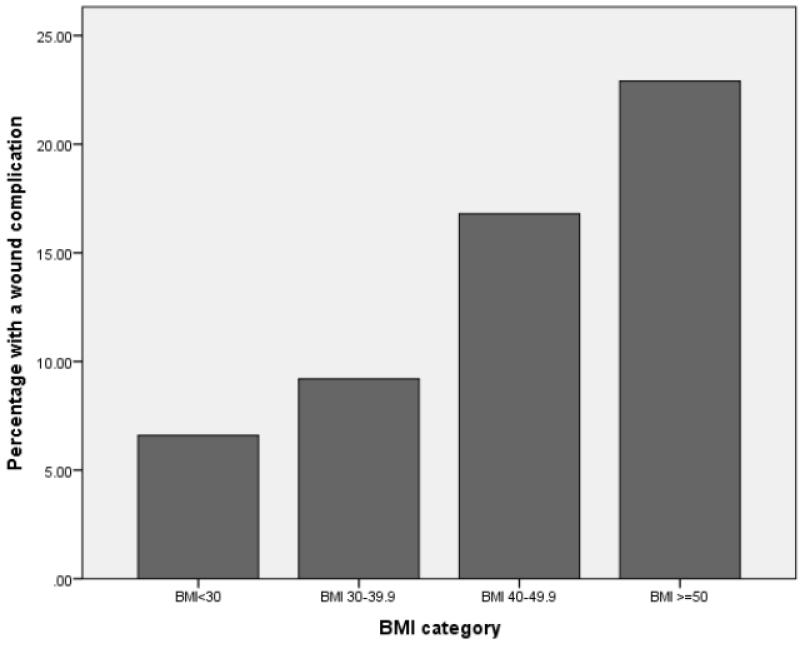
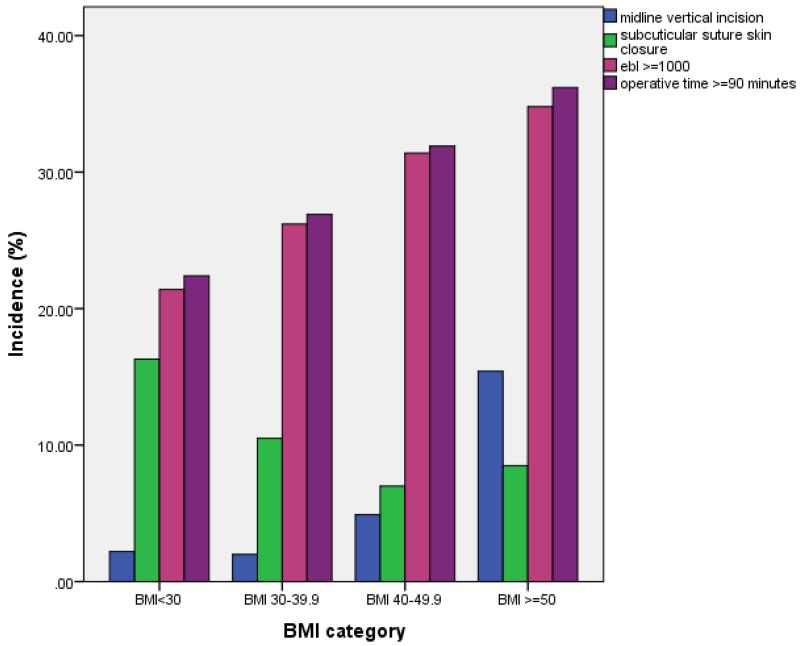
Results: Of the 2,444 women with complete follow-up data, 266 (10.9%) developed a wound complication. Compared with nonobese women (6.6%), increasing BMI was associated with an increased risk of wound complications: BMI 30.0 to 39.9, 9.2%, adjusted odds ratio (aOR) 1.4 (95% confidence interval [CI] 0.99 to 2.0); BMI 40.0 to 49.9, 16.8%, aOR 2.6 (95% CI 1.7 to 3.8); BMI ≥ 50, 22.9%, aOR 3.0 (95% CI 1.9 to 4.9). Increasing BMI was also associated with increased rates of midline vertical incision, longer operative time, higher EBL, and lower rates of subcuticular skin closure.
Conclusion: A dose-response relationship exists between increasing BMI and risk of postcesarean wound complications. Increasing obesity also significantly influences operative outcomes.
Thieme Medical Publishers 333 Seventh Avenue, New York, NY 10001, USA.
Figures
References
-
- Menacker F, Hamilton BE. Recent trends in cesarean delivery in the United States. NCHS data brief. 2010 Mar;(35):1–8. - PubMed
-
- Ogden CL, Carroll MD, Kit BK, Flegal KM. Prevalence of obesity in the United States, 2009-2010. NCHS data brief. 2012 Jan;(82):1–8. - PubMed
-
- Usha Kiran TS, Hemmadi S, Bethel J, Evans J. Outcome of pregnancy in a woman with an increased body mass index. BJOG: an international journal of obstetrics and gynaecology. 2005 Jun;112(6):768–72. - PubMed
-
- Robinson HE, O’Connell CM, Joseph KS, McLeod NL. Maternal outcomes in pregnancies complicated by obesity. Obstetrics and gynecology. 2005 Dec;106(6):1357–64. - PubMed
Publication types
MeSH terms
Grants and funding
LinkOut - more resources
Full Text Sources
Other Literature Sources
Medical
