


2H2O-based high-density lipoprotein turnover method for the assessment of dynamic high-density lipoprotein function in mice
- PMID: 23766259
- PMCID: PMC3958961
- DOI: 10.1161/ATVBAHA.113.301700
2H2O-based high-density lipoprotein turnover method for the assessment of dynamic high-density lipoprotein function in mice
Abstract
Objective: High-density lipoprotein (HDL) promotes reverse cholesterol transport from peripheral tissues to the liver for clearance. Reduced HDL-cholesterol (HDLc) is associated with atherosclerosis; however, as a predictor of cardiovascular disease, HDLc has limitations because it is not a direct marker of HDL functionality. Our objective was to develop a mass spectrometry-based method for the simultaneous measurement of HDLc and ApoAI kinetics in mice, using a single (2)H2O tracer, and use it to examine genetic and drug perturbations on HDL turnover in vivo.
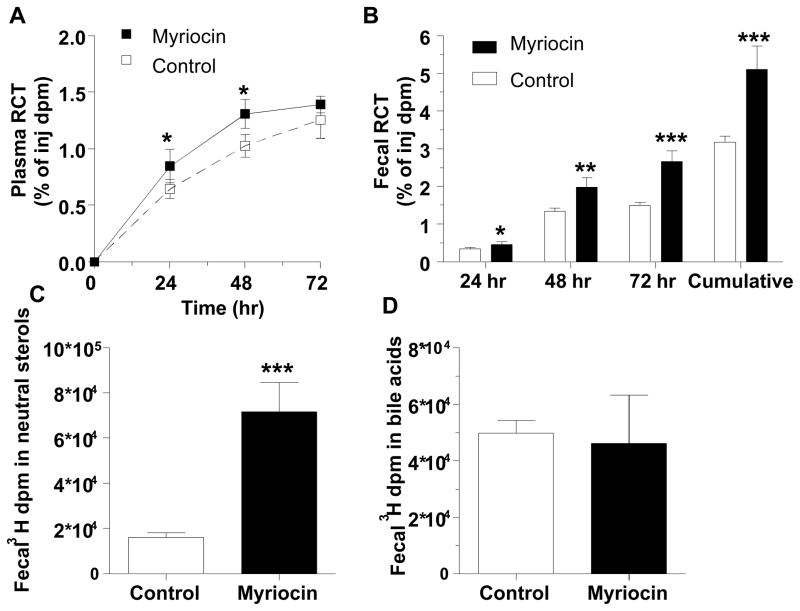
Approach and results: Mice were given (2)H2O in the drinking water, and serial blood samples were collected at different time points. HDLc and ApoAI gradually incorporated (2)H, allowing experimental measurement of fractional catabolic rates and production rates for HDLc and ApoAI. ApoE(-/-) mice displayed increased fractional catabolic rates (P<0.01) and reduced production rates of both HDLc and ApoAI (P<0.05) compared with controls. In human ApoAI transgenic mice, levels and production rates of HDLc and human ApoAI were strikingly higher than in wild-type mice. Myriocin, an inhibitor of sphingolipid synthesis, significantly increased both HDL flux and macrophage-to-feces reverse cholesterol transport, indicating compatibility of this HDL turnover method with the macrophage-specific reverse cholesterol transport assay.
Conclusions: (2)H2O-labeling can be used to measure HDLc and ApoAI flux in vivo, and to assess the role of genetic and pharmacological interventions on HDL turnover in mice. Safety, simplicity, and low cost of the (2)H2O-based HDL turnover approach suggest that this assay can be scaled for human use to study effects of HDL targeted therapies on dynamic HDL function.
Keywords: apolipoprotein A-I; cholesterol; deuterium oxide; lipoproteins, HDL; mass spectrometry; protein biosynthesis.
Figures




References
-
- Brown BG, Zhao XQ, Chait A, Fisher LD, Cheung MC, Morse JS, Dowdy AA, Marino EK, Bolson EL, Alaupovic P, Frohlich J, Albers JJ. Simvastatin and niacin, antioxidant vitamins, or the combination for the prevention of coronary disease. N Engl J Med. 2001;345:1583–1592. - PubMed
-
- Zhang Y, Zanotti I, Reilly MP, Glick JM, Rothblat GH, Rader DJ. Overexpression of apolipoprotein A-I promotes reverse transport of cholesterol from macrophages to feces in vivo. Circulation. 2003;108:661–663. - PubMed
-
- Singh IM, Shishehbor MH, Ansell BJ. High-density lipoprotein as a therapeutic target: A systematic review. JAMA. 2007;298:786–798. - PubMed
-
- Barter PJ, Caulfield M, Eriksson M, et al. Effects of torcetrapib in patients at high risk for coronary events. N Engl J Med. 2007;357:2109–2122. - PubMed
Publication types
MeSH terms
Substances
Grants and funding
LinkOut - more resources
Full Text Sources
Other Literature Sources
Medical
Miscellaneous
