Review
. 2013 Aug;41(15):7185-99.
doi: 10.1093/nar/gkt499. Epub 2013 Jun 13.

Chromatin and epigenetic features of long-range gene regulation

Affiliations
Review

Chromatin and epigenetic features of long-range gene regulation

Nathan Harmston et al. Nucleic Acids Res. 2013 Aug.

Abstract

The precise regulation of gene transcription during metazoan development is controlled by a complex system of interactions between transcription factors, histone modifications and modifying enzymes and chromatin conformation. Developments in chromosome conformation capture technologies have revealed that interactions between regions of chromatin are pervasive and highly cell-type specific. The movement of enhancers and promoters in and out of higher-order chromatin structures within the nucleus are associated with changes in expression and histone modifications. However, the factors responsible for mediating these changes and determining enhancer:promoter specificity are still not completely known. In this review, we summarize what is known about the patterns of epigenetic and chromatin features characteristic of elements involved in long-range interactions. In addition, we review the insights into both local and global patterns of chromatin interactions that have been revealed by the latest experimental and computational methods.


Figures
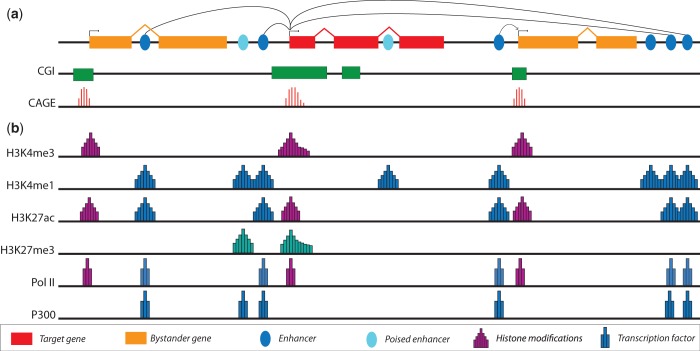
Figure 1.
Figure 1.
(a) The genomic regulatory block model of transcriptional regulation. Genes involved in the regulation of developmental processes are themselves regulated by enhancers located in a variety of locations, both upstream and downstream. Developmentally regulated genes tend to have CpG islands (CGIs) that overlap with its promoter and extend into the body of the gene. Genes with Type II and III promoters typically feature a broad TSS distribution, as detected by CAGE. (b) Regulatory elements within the genome can be identified by distinct patterns of histone modifications and TF binding. Promoters are enriched for H3K4me3, with active promoters showing evidence of PolII binding. The presence of the repressive mark at promoters and depletion of H3K4me3 is associated with inactive repressed promoters. Promoters having both H3K4me3 and H3K27me3 are termed bivalent promoters; they are repressed but poised for activation. Both poised and active enhancers are marked by the histone modification H3K4me1 and show depletion of H3K4me3. In addition, active enhancers are marked by H3K27ac and the binding of P300, whereas poised enhancers lack H3K27ac and may be marked by H3K27me3.
Figure 2.
Figure 2.
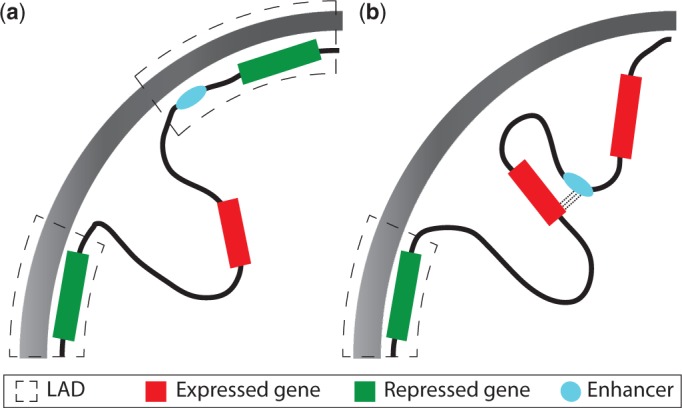
The organization and structure of chromatin within the nucleus is coupled with the regulation of gene expression (125). (a) Genes tethered to the nuclear lamina are silenced, whereas genes that are present in the centre of the nucleus are not. In addition, enhancers anchored to the lamina are restricted from interacting with their target promoters. (b) The movement of genes away from the lamina results in their upregulation, as they move to a more permissive transcriptional domain, and the movement of enhancers allows them to communicate properly and regulate the expression profile of their target gene.
Figure 3.
Figure 3.
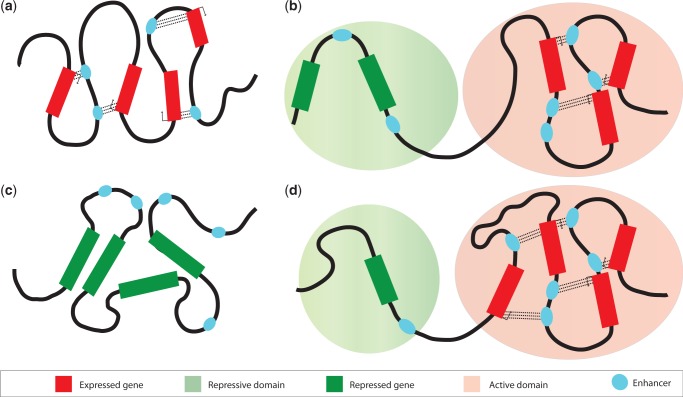
Chromatin looping is responsible for forming higher-order hub-like structures within the nucleus. (a) An active chromatin hub (ACH) is a structure that allows enhancers and promoters to come into close spatial proximity with each other (40). This structure has a high concentration of chromatin remodellers and PolII, which allows stable/high levels of transcription. Interactions between promoters and enhancers and represented by dashed lines. (b) The recruitment of genes and enhancers to a repressive chromatin hub (RCH) results in their downregulation (165). This structure potentially prevents enhancers from communicating with their cognate promoter by looping them out and preventing them from interacting. This structure may also restrict the amount of PolII from binding to gene promoters. (c and d) During development, genes in the Hox locus show a linear movement from a repressive chromatin structure to a region where they are expressed (166). This movement allows enhancers to interact with targets that were previously held in the repressive domain.

References

    1. Pearson JC, Lemons D, McGinnis W. Modulating Hox gene functions during animal body patterning. Nat. Rev. Genet. 2005;6:893–904. - PubMed
    1. Armit C, Venkataraman S, Richardson L, Stevenson P, Moss J, Graham L, Ross A, Yang Y, Burton N, Rao J, et al. eMouseAtlas, EMAGE, and the spatial dimension of the transcriptome. Mamm. Genome. 2012;23:514–524. - PMC - PubMed
    1. ENCODE Project Consortium. An integrated encyclopedia of DNA elements in the human genome. Nature. 2012;489:57–74. - PMC - PubMed
    1. Celniker SE, Dillon LAL, Gerstein MB, Gunsalus KC, Henikoff S, Karpen GH, Kellis M, Lai EC, Lieb JD, MacAlpine DM, et al. Unlocking the secrets of the genome. Nature. 2009;459:927–930. - PMC - PubMed
    1. ENCODE Project Consortium. Identification and analysis of functional elements in 1% of the human genome by the ENCODE pilot project. Nature. 2007;447:799–816. - PMC - PubMed

Publication types