


Cerebral asymmetry and language development: cause, correlate, or consequence?
- PMID: 23766329
- PMCID: PMC4031634
- DOI: 10.1126/science.1230531
Cerebral asymmetry and language development: cause, correlate, or consequence?
Abstract
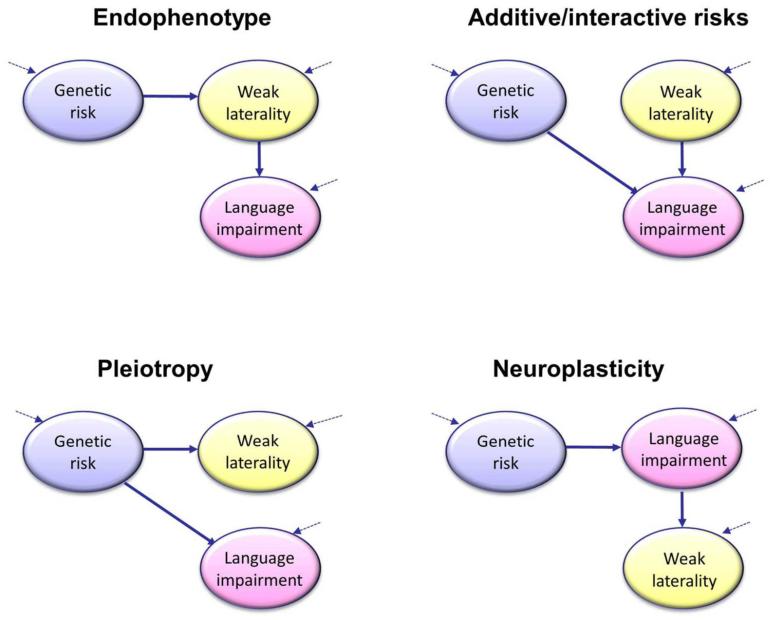
In most people, language is processed predominantly by the left hemisphere of the brain, but we do not know how or why. A popular view is that developmental language disorders result from a poorly lateralized brain, but until recently, evidence has been weak and indirect. Modern neuroimaging methods have made it possible to study normal and abnormal development of lateralized function in the developing brain and have confirmed links with language and literacy impairments. However, there is little evidence that weak cerebral lateralization has common genetic origins with language and literacy impairments. Our understanding of the association between atypical language lateralization and developmental disorders may benefit if we reconceptualize the nature of cerebral asymmetry to recognize its multidimensionality and consider variation in lateralization over developmental time. Contrary to popular belief, cerebral lateralization may not be a highly heritable, stable characteristic of individuals; rather, weak lateralization may be a consequence of impaired language learning.
Figures
References
-
- Berker EA, Berker AH, Smith A. Translation of Broca’s 1865 report: localization of speech in the third left frontal convolution. Archs Neurol. 1986;43:1065. - PubMed
-
- Amunts K. In: The Two Halves of the Brain: Information Processing in the Cerebral Hemispheres. Hugdahl K, Westerhausen R, editors. MIT Press; Cambridge, Massachusetts: 2010. pp. 145–176.
-
- Wada JA. Is functional hemispheric lateralization guided by structural cerebral asymmetry? Canad J Neurol Sci. 2009;36:S25. - PubMed
-
- Bishop DVM, Snowling MJ. Developmental dyslexia and Specific Language Impairment: Same or different? Psychol Bull. 2004;130:858. - PubMed
Publication types
MeSH terms
Substances
Grants and funding
LinkOut - more resources
Full Text Sources
Other Literature Sources
