Review
. 2013 Jun 14;340(6138):1230531.
doi: 10.1126/science.1230531.

Cerebral asymmetry and language development: cause, correlate, or consequence?

Affiliations
Review

Cerebral asymmetry and language development: cause, correlate, or consequence?

Dorothy V M Bishop. Science. .

Abstract

In most people, language is processed predominantly by the left hemisphere of the brain, but we do not know how or why. A popular view is that developmental language disorders result from a poorly lateralized brain, but until recently, evidence has been weak and indirect. Modern neuroimaging methods have made it possible to study normal and abnormal development of lateralized function in the developing brain and have confirmed links with language and literacy impairments. However, there is little evidence that weak cerebral lateralization has common genetic origins with language and literacy impairments. Our understanding of the association between atypical language lateralization and developmental disorders may benefit if we reconceptualize the nature of cerebral asymmetry to recognize its multidimensionality and consider variation in lateralization over developmental time. Contrary to popular belief, cerebral lateralization may not be a highly heritable, stable characteristic of individuals; rather, weak lateralization may be a consequence of impaired language learning.


Figures
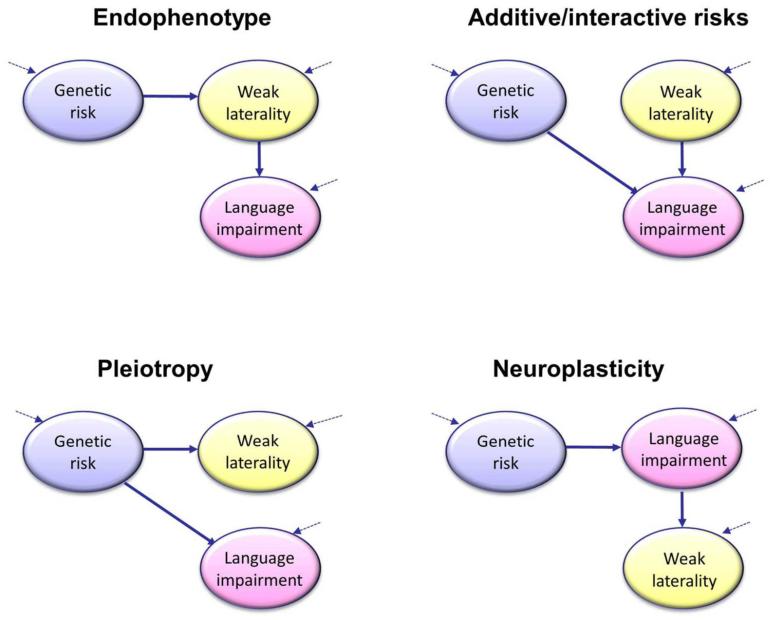
Figure 1
Figure 1
Four path diagrams of the association between weak cerebral lateralization for language and language/literacy problems. These causal models are simplified abstractions and not mutually exclusive, but they illustrate the differing predictions about the pattern of associations that might be found between genotypes, language/literacy impairment and cerebral lateralization. The Endophenotype model depicts the situation where genes that influence risk for language impairment do so by affecting cerebral lateralization. This model predicts that cerebral lateralization should be at least as heritable as language impairment, with the same genes affecting both traits. The Pleiotropy model also assumes that the same genes that lead to risk for language impairment also affect cerebral lateralization, but there is no direct causal link: weak laterality and language impairment co-occur because they have common origins, not because one causes the other. In the Additive/interactive risks model, the genetic risk factors for language impairment do not affect lateralization. However, weak laterality, which could have genetic and/or non-genetic origins, exerts an independent causal influence on language impairment, which may add or interact with other genetic risk factors. In the Neuroplasticity model, cerebral lateralization has no causal effect on language; rather, language impairment influences how the brain develops and is associated with weaker cerebral lateralization. The dotted arrows indicate that for each construct there will be sources of variation in addition to those depicted in the model.
Figure 2
Figure 2
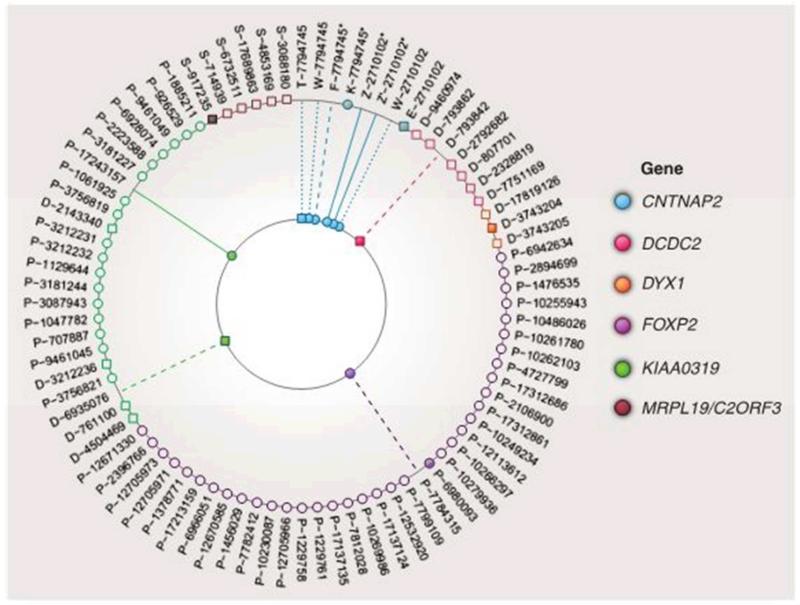
Summary of effects of language/reading associated SNPs on asymmetry of brain structure or function. Unfilled shapes on the rim of the figure correspond to SNPs with no effect on brain structure (squares) or function (circles). Filled shapes on the rim correspond to a bilateral effect. For the remaining shapes, a solid line indicates reduced asymmetry for the risk genotype; a dashed line indicates reduction of left-hemisphere size or function; a dotted line indicates other lateralized brain difference. Genes correspond to color-coding of the dots. SNP reference IDs are shown on the rim of the figure with the study identified by letter. An asterisk denotes a non-standard definition of risk genotype (see text). The study codes are (T) Tan et al (40); (Z) Scott– van Zeeland et al (39) discovery sample; (Z’) Scott-van Zeeland et al, replication sample; (F) Folia et al (43); (W) Whalley et al (41); (E) Dennis et al (42); (D) Darki et al (45); (K) Kos et al (44); (P) Pinel et al (46); (S) Scerri et al (same sample as (D)) (47). See text for more details.
Figure 3
Figure 3
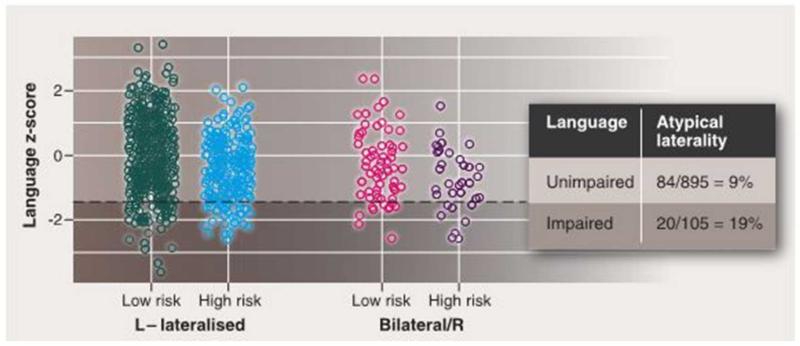
Simulated data for a common genetic variant present in 30% of the population that depresses language z-score by 0.4. In addition, language scores are depressed by 0.4 z in those with bilateral speech. The genetic variant and bilateral speech have independent origins, but their effects are additive. The rate of bilateral speech is 9% in those with unimpaired language (z-score higher than −1.5) but 19% in those with language impairment (z-score less than or equal to −1.5). If the simulation is modified to give an interaction between genetic risk and bilateral speech, then the association between bilateral speech and language impairment becomes even stronger.
Figure 4
Figure 4
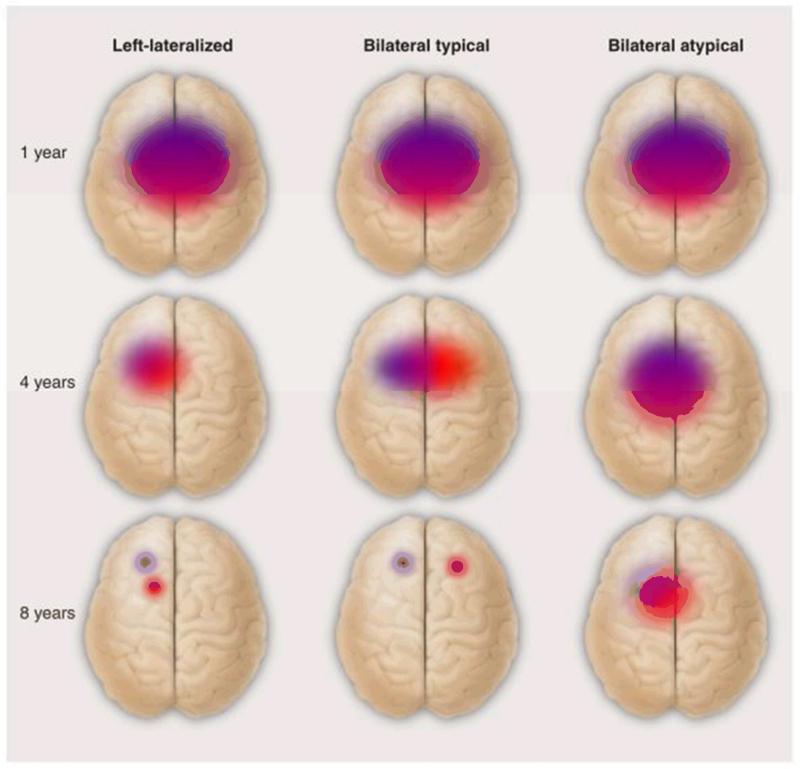
Illustration of hypothetical distinction between different kinds of typical and atypical language lateralization. Red and purple regions correspond to different language functions (e.g. naming and series repetition as tested in the Wada test). The typical developmental progression is from more diffuse language representation in infancy that steadily becomes more focal as skill develops and synaptic pruning occurs. Usually both language functions will be represented in the left hemisphere, but normal language function is compatible with separation into left and right hemispheres. For children with language impairments, the developmental progression to focal representation is much slower if it occurs at all.

References

    1. Berker EA, Berker AH, Smith A. Translation of Broca’s 1865 report: localization of speech in the third left frontal convolution. Archs Neurol. 1986;43:1065. - PubMed
    1. Amunts K. In: The Two Halves of the Brain: Information Processing in the Cerebral Hemispheres. Hugdahl K, Westerhausen R, editors. MIT Press; Cambridge, Massachusetts: 2010. pp. 145–176.
    1. Wada JA. Is functional hemispheric lateralization guided by structural cerebral asymmetry? Canad J Neurol Sci. 2009;36:S25. - PubMed
    1. Bishop DVM. What causes specific language impairment in children? Curr Dir Psychol Sci. 2006;15:217. - PMC - PubMed
    1. Bishop DVM, Snowling MJ. Developmental dyslexia and Specific Language Impairment: Same or different? Psychol Bull. 2004;130:858. - PubMed

Publication types

MeSH terms

LinkOut - more resources