Severe adverse maternal outcomes among low risk women with planned home versus hospital births in the Netherlands: nationwide cohort study
- PMID: 23766482
- PMCID: PMC3685517
- DOI: 10.1136/bmj.f3263
Severe adverse maternal outcomes among low risk women with planned home versus hospital births in the Netherlands: nationwide cohort study
Abstract
Objectives: To test the hypothesis that low risk women at the onset of labour with planned home birth have a higher rate of severe acute maternal morbidity than women with planned hospital birth, and to compare the rate of postpartum haemorrhage and manual removal of placenta.
Design: Cohort study using a linked dataset.
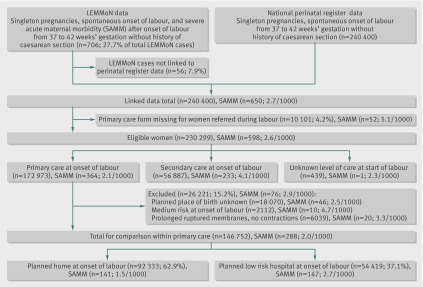
Setting: Information on all cases of severe acute maternal morbidity in the Netherlands collected by the national study into ethnic determinants of maternal morbidity in the netherlands (LEMMoN study), 1 August 2004 to 1 August 2006, merged with data from the Netherlands perinatal register of all births occurring during the same period.
Participants: 146 752 low risk women in primary care at the onset of labour.
Main outcome measures: Severe acute maternal morbidity (admission to an intensive care unit, eclampsia, blood transfusion of four or more packed cells, and other serious events), postpartum haemorrhage, and manual removal of placenta.
Results: Overall, 92 333 (62.9%) women had a planned home birth and 54 419 (37.1%) a planned hospital birth. The rate of severe acute maternal morbidity among planned primary care births was 2.0 per 1000 births. For nulliparous women the rate for planned home versus planned hospital birth was 2.3 versus 3.1 per 1000 births (adjusted odds ratio 0.77, 95% confidence interval 0.56 to 1.06), relative risk reduction 25.7% (95% confidence interval -0.1% to 53.5%), the rate of postpartum haemorrhage was 43.1 versus 43.3 (0.92, 0.85 to 1.00 and 0.5%, -6.8% to 7.9%), and the rate of manual removal of placenta was 29.0 versus 29.8 (0.91, 0.83 to 1.00 and 2.8%, -6.1% to 11.8%). For parous women the rate of severe acute maternal morbidity for planned home versus planned hospital birth was 1.0 versus 2.3 per 1000 births (0.43, 0.29 to 0.63 and 58.3%, 33.2% to 87.5%), the rate of postpartum haemorrhage was 19.6 versus 37.6 (0.50, 0.46 to 0.55 and 47.9%, 41.2% to 54.7%), and the rate of manual removal of placenta was 8.5 versus 19.6 (0.41, 0.36 to 0.47 and 56.9%, 47.9% to 66.3%).
Conclusions: Low risk women in primary care at the onset of labour with planned home birth had lower rates of severe acute maternal morbidity, postpartum haemorrhage, and manual removal of placenta than those with planned hospital birth. For parous women these differences were statistically significant. Absolute risks were small in both groups. There was no evidence that planned home birth among low risk women leads to an increased risk of severe adverse maternal outcomes in a maternity care system with well trained midwives and a good referral and transportation system.
Conflict of interest statement
Competing interests: All authors have completed the ICMJE uniform disclosure form at
Figures
Comment in
-
Healthy women with a normal singleton pregnancy at term are not likely to be harmed by planning a home birth.Evid Based Med. 2014 Apr;19(2):69. doi: 10.1136/eb-2013-101476. Epub 2013 Sep 5. Evid Based Med. 2014. PMID: 24009331 No abstract available.
References
-
- De Jonge A, Van der Goes BY, Ravelli AC, Amelink-Verburg MP, Mol BW, Nijhuis JG, et al. Perinatal mortality and morbidity in a nationwide cohort of 529,688 low-risk planned home and hospital births. BJOG 2009;116:1177-84. - PubMed
-
- Hutton EK, Reitsma AH, Kaufman K. Outcomes associated with planned home and planned hospital births in low-risk women attended by midwives in Ontario, Canada, 2003-2006: a retrospective cohort study. Birth 2009;36:180-9. - PubMed
Publication types
MeSH terms
LinkOut - more resources
Full Text Sources
Other Literature Sources
Medical