


New solution for massive, irreparable rotator cuff tears: the subacromial "biodegradable spacer"
- PMID: 23766979
- PMCID: PMC3678622
- DOI: 10.1016/j.eats.2012.02.002
New solution for massive, irreparable rotator cuff tears: the subacromial "biodegradable spacer"
Abstract
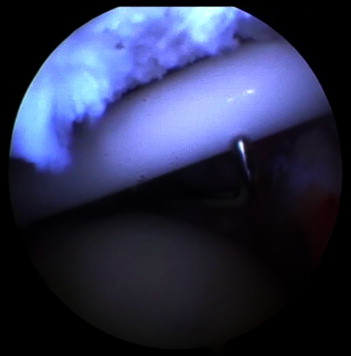
Massive, irreparable rotator cuff tears are a source of pain and disability. Although most rotator cuff tears can be completely repaired, a significant number are considered massive and irreparable. Numerous operative techniques have been described for the treatment of these kinds of tears including arthroscopic debridement, biceps tenotomy, tendon transfer, grafting, and reverse arthroplasty. We describe a surgical technique using a biodegradable subacromial balloon spacer (InSpace; OrthoSpace, Kfar Saba, Israel) implanted between the humeral head and acromion that permits smooth, frictionless gliding, restoring the shoulder biomechanics. The technique is easy to perform and is less invasive than the conventional surgical techniques available, and it may potentially serve as a bridging option in patients with massive, irreparable tears who are normally candidates for reverse arthroplasty.
Figures




References
-
- Moser M., Jablonski M.V., Horodyski M., Wright T.W. Functional outcome of surgically treated massive rotator cuff tears: A comparison of complete repair, partial repair, and debridement. Orthopedics. 2007;30:479–482. - PubMed
-
- Cole B.J., ElAttrache N.S., Anbari A. Arthroscopic rotator cuff repairs: An anatomic and biomechanical rationale for different suture-anchor repair configurations. Arthroscopy. 2007;23:662–669. - PubMed
-
- Cuff D., Pupello D., Virani N., Levy J., Frankle M. Reverse shoulder arthroplasty for the treatment of rotator cuff deficiency. J Bone Joint Surg Am. 2008;90:1244–1251. - PubMed
-
- MacDonald P.B., Altamimi S. Principles of arthroscopic repair of large and massive rotator cuff tears. Instr Course Lect. 2010;59:269–280. - PubMed
-
- Goutallier D., Postel J.M., Bemageau J. Fatty muscle degeneration in cuff ruptures: Pre- and postoperative evaluation by CT scan. Clin Orthop Relat Res. 2007:78–83. - PubMed
LinkOut - more resources
Full Text Sources
Other Literature Sources
