


Pathological examination of radical prostatectomy specimens in men with very low risk disease at biopsy reveals distinct zonal distribution of cancer in black American men
- PMID: 23770146
- PMCID: PMC4042393
- DOI: 10.1016/j.juro.2013.06.021
Pathological examination of radical prostatectomy specimens in men with very low risk disease at biopsy reveals distinct zonal distribution of cancer in black American men
Abstract
Purpose: Of men with very low risk prostate cancer at biopsy recent evidence shows that black American men are at greater risk for adverse oncologic outcomes after radical prostatectomy. We studied radical prostatectomy specimens from black and white men at very low risk to determine whether there are systematic pathological differences.
Materials and methods: Radical prostatectomy specimens were evaluated in men with National Comprehensive Cancer Network® (NCCN) very low risk prostate cancer. At diagnosis all men underwent extended biopsy sampling (10 or more cores) and were treated in the modern Gleason grade era. We analyzed tumor volume, grade and location in 87 black and 89 white men. For each specimen the dominant nodule was defined as the largest tumor with the highest grade.
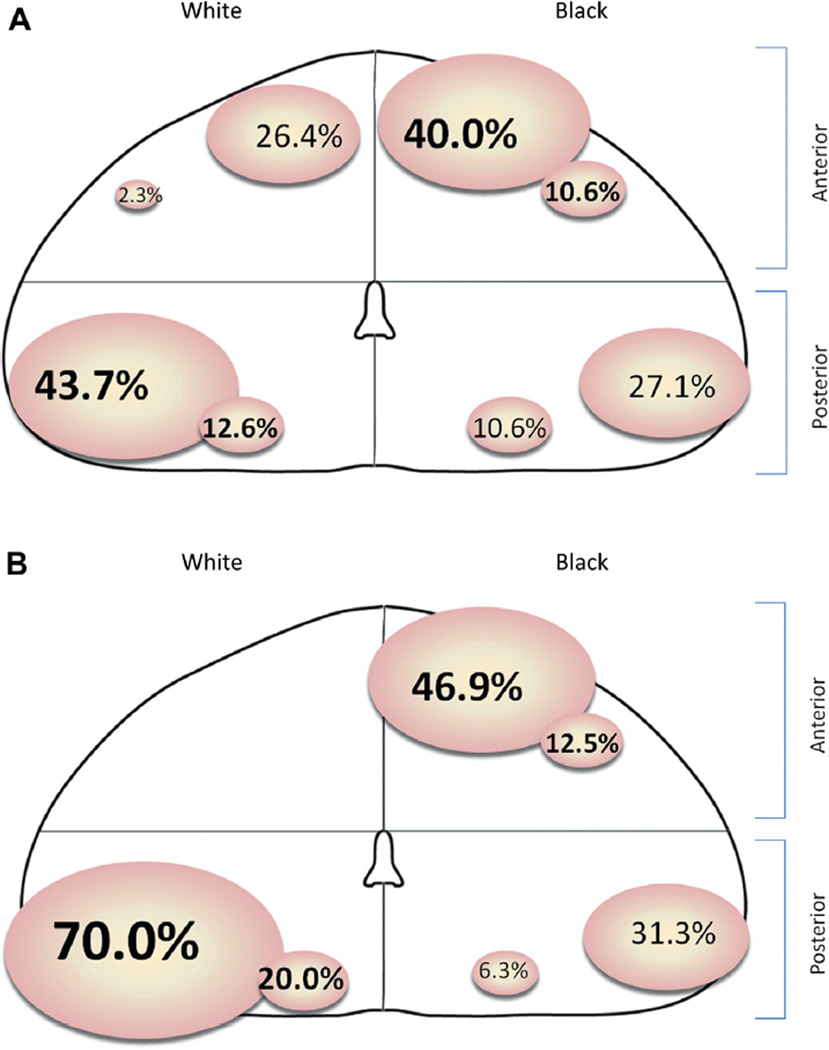
Results: Compared to white men, black men were more likely to have significant prostate cancer (61% vs 29%), Gleason 7 or greater (37% vs 11%, each p <0.001) and a volume of greater than 0.5 cm(3) (45% vs 21%, p = 0.001). Dominant nodules in black men were larger (median 0.28 vs 0.13 cm(3), p = 0.002) and more often anterior (51% vs 29%, p = 0.003). In men who underwent pathological upgrading the dominant nodule was also more frequently anterior in black than in white men (59% vs 0%, p = 0.001).
Conclusions: Black men with very low risk prostate cancer at diagnosis have a significantly higher prevalence of anterior cancer foci that are of higher grade and larger volume. Enhanced imaging or anterior zone sampling may detect these significant anterior tumors, improving the outcome in black men considering active surveillance.
Keywords: AA; AS; African Americans; BMI; GS; Gleason score; MRI; PCa; PSA; PSA density; PSAD; RP; active surveillance; black; body mass index; magnetic resonance imaging; neoplasm grading; prostate; prostate cancer; prostate specific antigen; prostatic neoplasms; radical prostatectomy; risk.
Copyright © 2014 American Urological Association Education and Research, Inc. Published by Elsevier Inc. All rights reserved.
Figures
Comment in
-
Editorial comment.J Urol. 2014 Jan;191(1):66-7. doi: 10.1016/j.juro.2013.06.127. Epub 2013 Oct 10. J Urol. 2014. PMID: 24120515 No abstract available.
References
-
- NCCN Clinical Practice Guidelines in Oncology: Prostate Cancer. Fort Washington, Pennsylvania: National Comprehensive Cancer Network; 2012. version 3.
-
- Epstein JI, Walsh PC, Carmichael M, et al. Pathologic and clinical findings to predict tumor extent of nonpalpable (stage T1c) prostate cancer. JAMA. 1994;271:368. - PubMed
-
- Bastian PJ, Mangold LA, Epstein J, et al. Characteristics of insignificant clinical T1c prostate tumors. A contemporary analysis. Cancer. 2004;101:2001. - PubMed
-
- Dall’Era MA, Albertsen PC, Bangma C, et al. Active surveillance for prostate cancer: a systematic review of the literature. Eur Urol. 2012;62:976. - PubMed
-
- Tosoian JJ, Trock B, Landis P, et al. Active surveillance program for prostate cancer: an update of the Johns Hopkins experience. J Clin Oncol. 2011;29:2185. - PubMed
Publication types
MeSH terms
Grants and funding
LinkOut - more resources
Full Text Sources
Other Literature Sources
Medical
Research Materials
Miscellaneous
