


Aberrant methylation of the TDMR of the GTF2A1L promoter does not affect fertilisation rates via TESE in patients with hypospermatogenesis
- PMID: 23770943
- PMCID: PMC3881655
- DOI: 10.1038/aja.2013.56
Aberrant methylation of the TDMR of the GTF2A1L promoter does not affect fertilisation rates via TESE in patients with hypospermatogenesis
Abstract
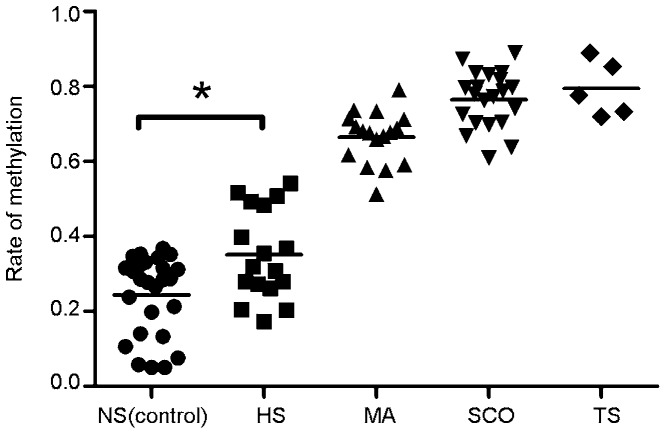
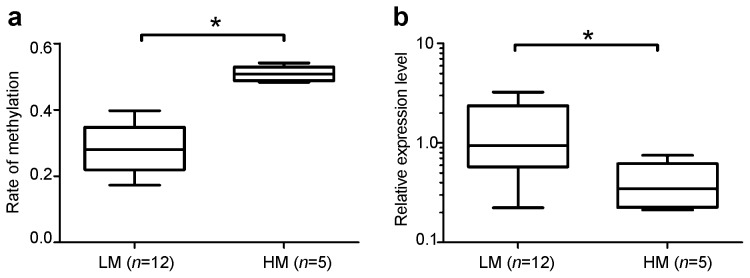
Increasing evidence shows a relationship between epigenetic regulation and male infertility. The GTF2A1L gene promoter contains the DNA methylation site of a tissue-specific differentially methylated region (TDMR). Eighty-six patients with non-obstructive azoospermia were assessed for the DNA methylation state of CpG islands in the GTF2A1L promoter using testicular genomic DNA. Based on histological criteria, 26 of the 86 patients had normal spermatogenesis (controls), 17 had hypospermatogenesis and 26 had a Sertoli cell-only phenotype or tubular sclerosis. GTF2A1L TDMR methylation was significantly lower in testes DNA from control samples than from hypospermatogenic samples (P=0.029). Patients with hypospermatogenesis were divided into two subgroups: high DNA methylation (HM, n=5) and low DNA methylation (LM, n=12). The GTF2A1L TDMR methylation rate differed significantly between the HM and LM groups (P=0.0019), and GTF2A1L expression was significantly higher among the LM than in the HM patients (P=0.023). High TDMR methylation was correlated with low GTF2A1L gene expression levels. Both groups demonstrated relatively good outcomes with respect to sperm retrieval, fertilisation, pregnancy and childbirth rates. We observed that aberrant GTF2A1L gene expression was not correlated with fertilisation rates. The testicular sperm extraction (TESE) technique may be used to overcome male infertility due to aberrant TDMR methylation.
Figures
References
-
- Cram DS, O'Bryan MK, de Kretser DM. Male infertility genetics—the future. J Androl. 2001;22:738–46. - PubMed
-
- Ezeh UI, Taub NA, Moore HD, Cooke ID. Establishment of predictive variables associated with testicular sperm retrieval in men with non-obstructive azoospermia. Hum Reprod. 1999;14:1005–12. - PubMed
-
- Sousa M, Cremades N, Silva J, Oliveira C, Ferraz L, et al. Predictive value of testicular histology in secretory azoospermic subgroups and clinical outcome after microinjection of fresh and frozen–thawed sperm and spermatids. Hum Reprod. 2002;17:1800–10. - PubMed
-
- Riggs AD. X inactivation, differentiation, and DNA methylation. Cytogenet Cell Genet. 1975;14:9–25. - PubMed
-
- Holliday R, Pugh JE. DNA modification mechanisms and gene activity during development. Science. 1975;187:226–32. - PubMed
Publication types
MeSH terms
Substances
Supplementary concepts
LinkOut - more resources
Full Text Sources
Other Literature Sources
