


Age, period and cohort effects on adult body mass index and overweight from 1991 to 2009 in China: the China Health and Nutrition Survey
- PMID: 23771721
- PMCID: PMC3733700
- DOI: 10.1093/ije/dyt052
Age, period and cohort effects on adult body mass index and overweight from 1991 to 2009 in China: the China Health and Nutrition Survey
Abstract
Background: Contributions of age-period-cohort effects to increases in BMI and overweight among Chinese adults must be resolved in order to design appropriate interventions. The objectives were to (i) describe the period effect on BMI and overweight among Chinese adults from 1991 to 2009 and assess modification of this effect by age (e.g. cohort effect) and gender, and (ii) quantify the influence of household income and community urbanicity on these effects.
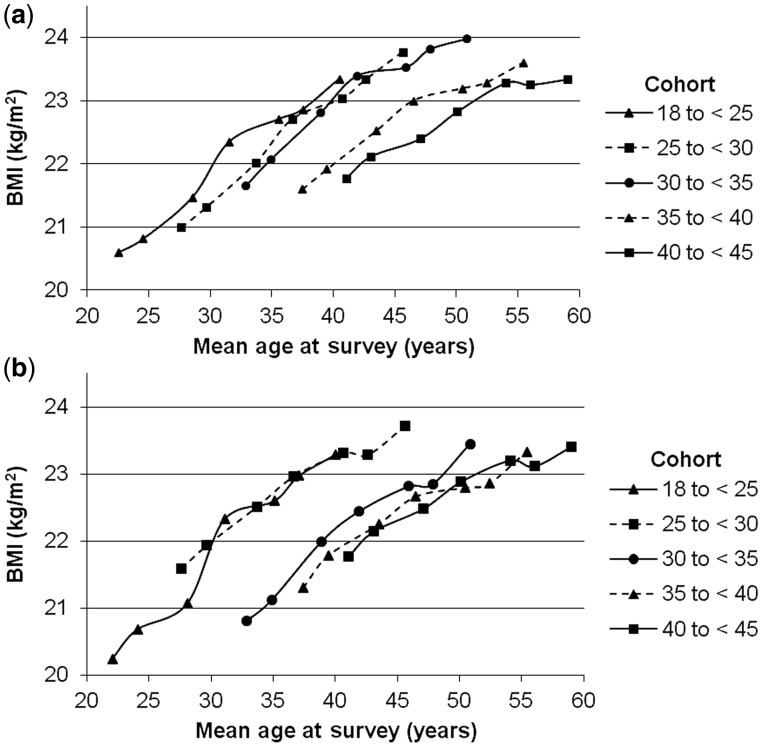
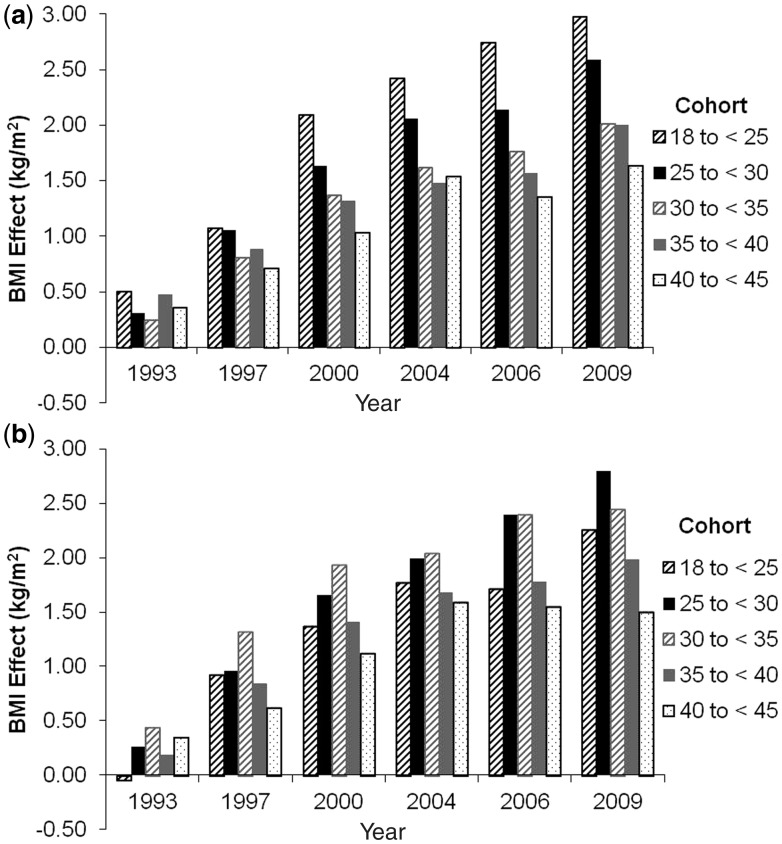
Methods: Data are from the China Health and Nutrition Survey, a prospective sample across nine provinces in China; 53,298 observations from 18,059 participants were collected over a 19-year period. A series of mixed effects models was used to explicitly assess differences in BMI within individuals over time (age effect) and population-wide differences in BMI over time (period effect), and implicitly assess differences in the experienced period effect across individuals of varying ages (cohort effect).
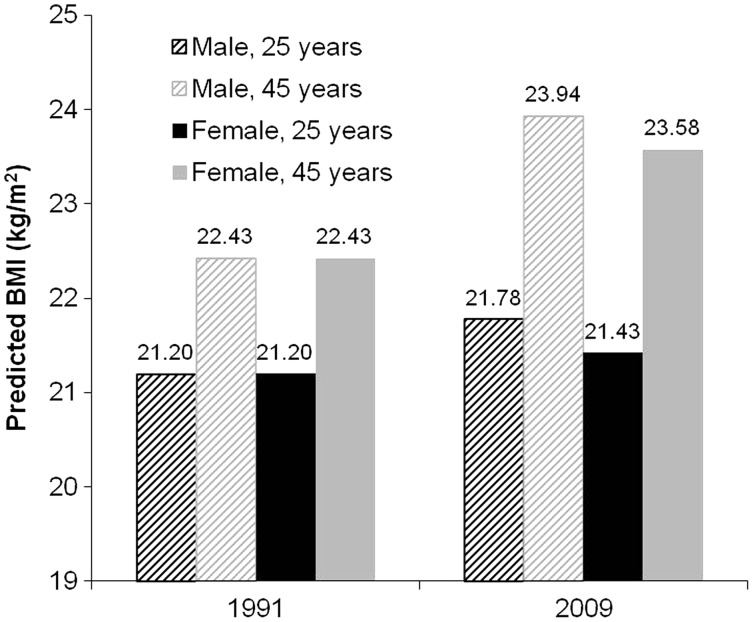
Results: Stronger period effects on BMI and overweight were observed among males compared with females; and younger cohorts had higher BMIs compared with older cohorts. Simulations predicted that increases in income and urbanicity in the order of magnitude of that observed from 1991 to 2009 would correspond to shifts in the BMIs of average individuals of 0.07 and 0.23 kg/m(2), respectively.
Conclusions: Although period effects had a stronger influence on the BMI of males, interventions should not overlook younger female cohorts who are at increased risk compared with their older counterparts.
Keywords: Age-period-cohort analysis; China; body mass index; overweight.
Figures
References
-
- National Bureau of Statistics of China. China's total population and structural changes in 2011. 2012. http://www.stats.gov.cn/english/newsandcomingevents/t20120120_402780233.htm (26 December 2012, date last accessed)
-
- He J, Klag MJ, Whelton PK, et al. Migration, blood pressure pattern, and hypertension: the Yi Migrant Study. Am J Epidemiol. 1991;134:1085–101. - PubMed
-
- Cao G-GY. Urban growth in China: past, prospect, and its impacts. Popul Environ. 2012;33:137–60.
-
- World Bank. World development indicators. 2012. http://data.worldbank.org/data-catalog/world-development-indicators (26 December 2012, date last accessed)
Publication types
MeSH terms
Grants and funding
LinkOut - more resources
Full Text Sources
Other Literature Sources
