Fibroblast growth factor 23, bone mineral density, and risk of hip fracture among older adults: the cardiovascular health study
- PMID: 23771921
- PMCID: PMC3733860
- DOI: 10.1210/jc.2013-1152
Fibroblast growth factor 23, bone mineral density, and risk of hip fracture among older adults: the cardiovascular health study
Abstract
Context: Fibroblast growth factor 23 (FGF23) is a phosphaturic hormone that also inhibits calcitriol synthesis.
Objective: Our objective was to evaluate the relationships of plasma FGF23 concentrations with bone mineral density (BMD) and hip fracture in community-dwelling older adults.
Design and setting: Linear regression and Cox proportional hazard models were used to examine the associations of plasma FGF23 concentrations with BMD and incident hip fracture, respectively. Analyses were also stratified by chronic kidney disease.
Participants: Participants included 2008 women and 1329 men ≥65 years from the 1996 to 1997 Cardiovascular Health Study visit.
Main outcome measures: Dual x-ray absorptiometry measured total hip (TH) and lumbar spine (LS) BMD in 1291 participants. Hip fracture incidence was assessed prospectively through June 30, 2008 by hospitalization records in all participants.
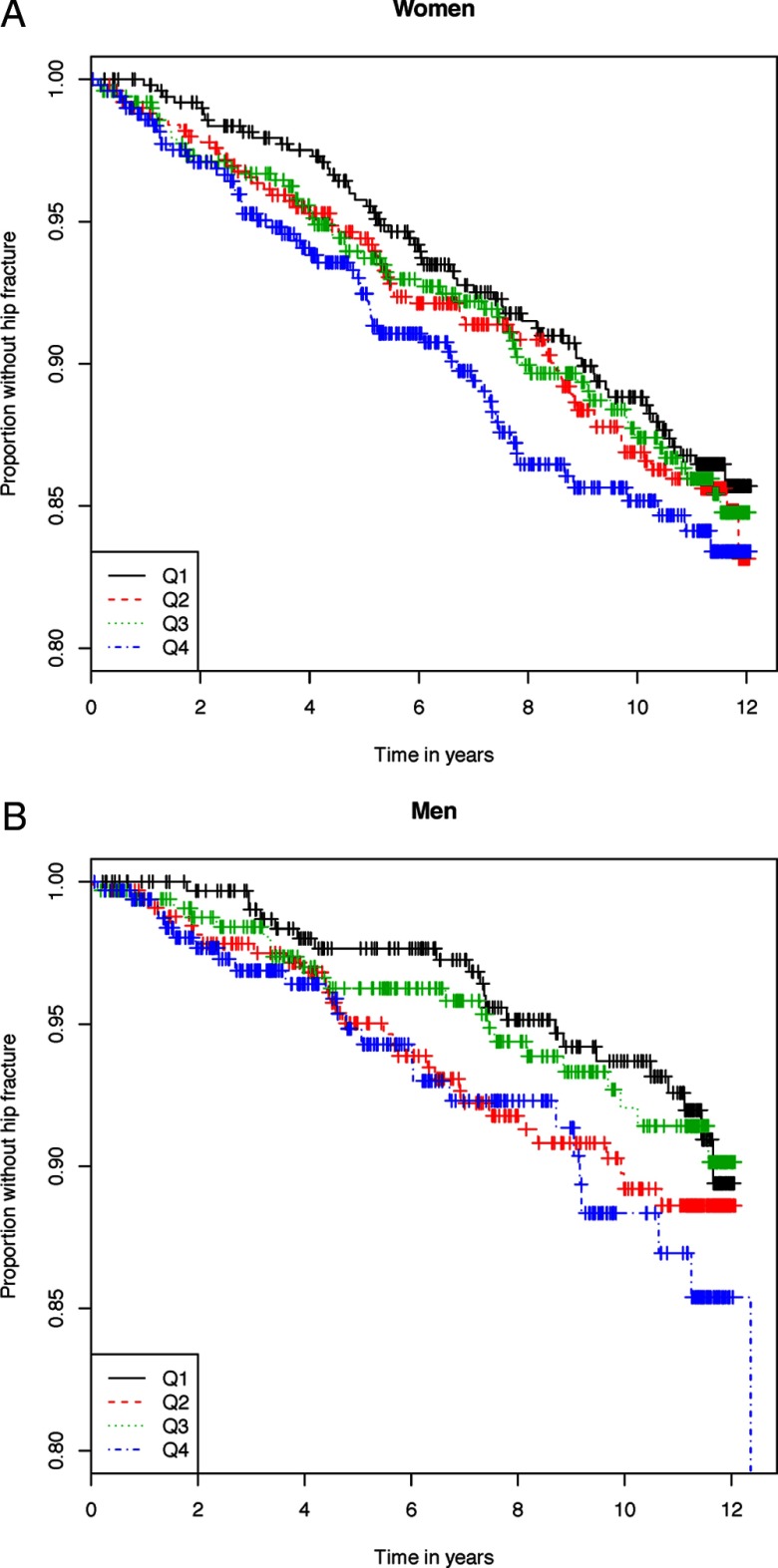
Results: Women had higher plasma FGF23 concentrations than men (75 [56-107] vs 66 [interquartile range = 52-92] relative units/mL; P < .001). After adjustment, higher FGF23 concentrations were associated with greater total hip and lumbar spine BMD in men only (β per doubling of FGF23 = 0.02, with 95% confidence interval [CI] = 0.001-0.04 g/cm(2), and 0.03 with 95% CI = 0.01-0.06 g/cm(2)). During 9.6 ± 5.1-11.0 years of follow-up, 328 hip fractures occurred. Higher FGF23 concentrations were not associated with hip fracture risk in women or men (adjusted hazard ratio = 0.95, with 95% CI = 0.78-1.15, and 1.09 with 95% CI = 0.82-1.46 per doubling of FGF23). Results did not differ by chronic kidney disease status (P > .4 for interactions).
Conclusions: In this large prospective cohort of community-dwelling older adults, higher FGF23 concentrations were weakly associated with greater lumbar spine and total hip BMD but not with hip fracture risk.
Figures
References
-
- Saito H, Maeda A, Ohtomo S, et al. Circulating FGF-23 is regulated by 1α,25-dihydroxyvitamin D3 and phosphorus in vivo. J Biol Chem. 2005;280:2543–2549 - PubMed
-
- Shimada T, Hasegawa H, Yamazaki Y, et al. FGF-23 is a potent regulator of vitamin D metabolism and phosphate homeostasis. J Bone Miner Res. 2004;19:429–435 - PubMed
-
- Prié D, Ureña Torres P, Friedlander G. Latest findings in phosphate homeostasis. Kidney Int. 2009;75:882–889 - PubMed
Publication types
MeSH terms
Substances
Grants and funding
- N01-HC-80007/HC/NHLBI NIH HHS/United States
- U01 HL080295/HL/NHLBI NIH HHS/United States
- N01 HC075150/HC/NHLBI NIH HHS/United States
- R01 HL096851/HL/NHLBI NIH HHS/United States
- N01 HC-85079/HC/NHLBI NIH HHS/United States
- N01 HC-55222/HC/NHLBI NIH HHS/United States
- HHSN268201200036C/HL/NHLBI NIH HHS/United States
- N01 HC055222/HL/NHLBI NIH HHS/United States
- N01HC-85086/HC/NHLBI NIH HHS/United States
- N01 HC015103/HC/NHLBI NIH HHS/United States
- N01 HC085086/HL/NHLBI NIH HHS/United States
- N01 HC085079/HC/NHLBI NIH HHS/United States
- R01HL096851/HL/NHLBI NIH HHS/United States
- N01 HC-54133/HC/NHLBI NIH HHS/United States
- N01 HC035129/HC/NHLBI NIH HHS/United States
LinkOut - more resources
Full Text Sources
Other Literature Sources
Medical