


Quality of end-of-life care of long-term nursing home residents with and without dementia
- PMID: 23772891
- PMCID: PMC4122312
- DOI: 10.1111/jgs.12330
Quality of end-of-life care of long-term nursing home residents with and without dementia
Abstract
Objectives: To describe the longitudinal patterns and the within- and between-facility differences in hospice use and in-hospital deaths between long-term nursing home (NH) residents with and without dementia.
Design: Retrospective analyses of secondary data sets from 2003 to 2007.
Setting: NHs in the United States.
Participants: A total of 1,261,726 decedents in 16,347 NHs were included in 2003 to 2007 trend analysis and 236,619 decedents in 15,098 NHs in 2007 were included in the within- and between-facility analyses.
Measurements: Hospice use in the last 100 days of life and in-hospital deaths were outcome measures. Dementia was defined as having a diagnosis of Alzheimer's disease or other dementia based on Minimum Data Set (MDS) health assessments.
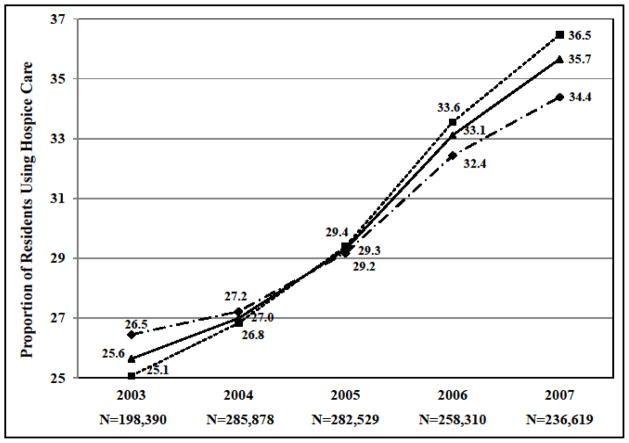
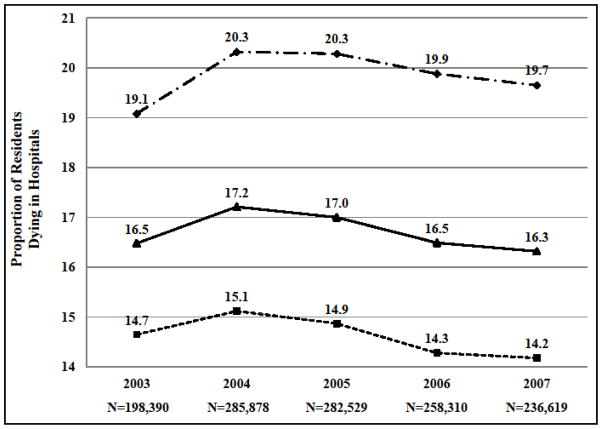
Results: Overall hospice use increased from 25.6% in 2003 to 35.7% in 2007. During this time, hospice use for decedents with dementia increased from 25.1% to 36.5%, compared with an increase from 26.5% to 34.4% for decedents without dementia. The rate of in-hospital deaths remained virtually unchanged. Within the same facility, decedents with dementia were significantly more likely to use hospice (odds ratio (OR) = 1.07, 95% confidence interval (CI) = 1.04-1.11) and less likely to die in a hospital (OR = 0.76, 95% CI = 0.74-0.78). Decedents in NHs with higher dementia prevalence, regardless of individual dementia status, were more likely to use hospice (OR = 1.67, 95% CI = 1.22-2.27).
Conclusion: NHs appear to provide less-aggressive end-of-life care to decedents with dementia than to those without. Although significantly more residents with dementia now receive hospice care at the end of life, the quality evaluation and monitoring of hospice programs have not been systematically conducted, and additional research in this area is warranted.
Keywords: dementia; hospice; hospitalization; in-hospital deaths; place of death.
© 2013, Copyright the Authors Journal compilation © 2013, The American Geriatrics Society.
Conflict of interest statement
[Table: see text]
*
Figures
 Without Dementia
 With Dementia
 Overall
 Without Dementia
With Dementia
Overall
Without Dementia
With Dementia
OverallReferences
-
- Centers for Medicare and Medicaid Services. [Accessed 06/03/2011];MDS Active Resident Information Report (online) Available from: https://www.cms.gov/MDSPubQIandResRep/04_activeresreport.asp?date=32&isS....
-
- Knight BG, Sayegh P. Mental health and aging in the 21st century. Journal of Aging & Social Policy. 2011;23(3):228. - PubMed
Publication types
MeSH terms
Grants and funding
LinkOut - more resources
Full Text Sources
Other Literature Sources
Medical
Research Materials
Miscellaneous
