. 2013 Sep;25(9):733-e575.
doi: 10.1111/nmo.12153. Epub 2013 Jun 17.

Altered colonic function and microbiota profile in a mouse model of chronic depression

Affiliations
Free PMC article

Altered colonic function and microbiota profile in a mouse model of chronic depression

A J Park et al. Neurogastroenterol Motil. 2013 Sep.
Free PMC article

Abstract

Background: Depression often coexists with the irritable bowel syndrome (IBS) which is characterized by alterations in gut function. There is emerging evidence that the microbial composition (microbiota) of the gut is altered in IBS, but the basis for this is poorly understood. The aim of this study was to determine whether the induction of chronic depression results in changes in the colonic function and in its microbial community, and to explore underlying mechanisms.

Methods: Bilateral olfactory bulbectomy (OBx) was used to induce depression-like behavior in mice. Colonic function was assessed by measuring muscle contractility, pellet excretion, c-fos activity, and serotonin levels. Microbiota profiles were obtained using denaturing gradient gel electrophoresis (DGGE). The hypothalamic-pituitary axis (HPA) was assessed by the hypothalamic expression of corticotropin-releasing hormone (CRH). In separate studies, mice without OBx received CRH via intracerebroventricular (ICV) infusion for 4 weeks prior to assessing colonic function and microbiota profiles.

Key results: Olfactory bulbectomy mice demonstrated chronic depression- and anxiety-like behaviors associated with elevated central CRH expression and increases in c-Fos activity, serotonin levels, and motility in the colon. These changes were accompanied by an altered intestinal microbial profile. Central CRH administration produced similar changes in behavior and motility and altered the microbiota profile in the colon.

Conclusions & inferences: The induction of chronic depression alters motor activity and the microbial profile in the colon likely via activation of the HPA. These findings provide a basis for linking the behavioral and gastrointestinal manifestations of IBS.

Keywords: CRH; IBS; colonic motility; depression; microbiome.


Figures

Figure 1
Figure 1
Behavioral profile of olfactory bulbectomy (OBx) Mice. (A) Olfactory bulbectomy mice step-down quicker than sham-operated controls. (B) Olfactory bulbectomy mice have a higher duration of immobility in the tail-suspension test indicative of higher levels of behavioral depression. Olfactory bulbectomy mice show elevated levels of anxiety-like behavior in an open field test as shown by (C) hyperlocomotion, (D) decreased distance travelled in the anxiety-inducing center zone, and (E) increased rearing. (F) Olfactory bulbectomy does not affect general measures of motor activity. (*P <0.05 vs sham controls). Data are presented as mean ± SEM.
Figure 2
Figure 2
Hypothalamic corticotropin-releasing hormone (CRH) expression in Olfactory bulbectomy (OBx) mice. (A) Olfactory bulbectomy mice show increased expression of CRH mRNA in the paraventricular nucleus of the hypothalamus. (*P <0.05 vs sham controls). Data are presented as mean ± SEM. (B) Photo shows the location of the paraventricular nucleus of the hypothalamus. Inset box indicates the area that was isolated for analysis of CRH expression.
Figure 3
Figure 3
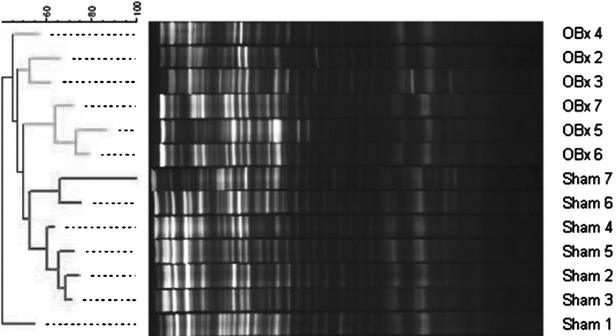
Microbiota profile in Olfactory bulbectomy (OBx) mice. Cluster analysis of the fecal microbiota at 8 weeks postsurgery shows a clear separation between OBx and sham mice. The similarity matrix for this data indicated a 60.4% and 60.9% similarity within the sham and OBx groups, respectively, and 49.1% similarity between the two groups. Branch distances indicate% similarity between individuals.
Figure 4
Figure 4
Fecal output (FO) and colonic muscle contractility in olfactory bulbectomy (OBx) mice. (A) Olfactory bulbectomy mice show increased FO when exposed to a mild stressor. (B) Longitudinal smooth muscle from OBx mice generates significantly higher contractile forces in response to a cholinergic agonist. (*P <0.05 vs sham controls). Data are presented as mean ± SEM.
Figure 5
Figure 5
Colonic c-fos expression and 5-HT levels in the colon of Olfactory bulbectomy (OBx) mice. Olfactory bulbectomy mice have higher levels of (A) c-fos protein and (B) serotonin in the colon after exposure to a mild stressor (10 min water avoidance stress; *P < 0.05). Data are presented as mean ± SEM.
Figure 6
Figure 6
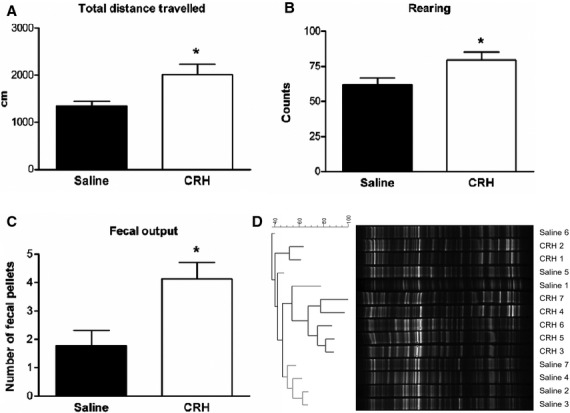
Central administration of corticotropin-releasing hormone (CRH) affects behavior and gastrointestinal function. Mice treated with CRH have higher levels of anxiety-like behavior as shown by increased (A) locomotion and (B) rearing compared with saline-treated controls. (C) Corticotropin-releasing hormone mice show increased fecal pellet output in an open field (*P < 0.05). Data are presented as mean ± SEM. (D) Twenty-eight days of CRH administration (ICV infusion) resulted in a significantly different bacterial profiles in CRH-treated mice compared with saline-treated controls (P < 0.05). Denaturing gradient gel electrophoresis profiles showed 79.4% and 65.7% similarity within the saline and CRH groups, respectively, and 68.0% similarity between the two groups.

References

    1. Folks DG. The interface of psychiatry and irritable bowel syndrome. Curr Psychiatry Rep. 2004;6:210–5. - PubMed
    1. Malinen E, Rinttila T, Kajander K, et al. Analysis of the fecal microbiota of irritable bowel syndrome patients and healthy controls with real-time PCR. Am J Gastroenterol. 2005;100:373–82. - PubMed
    1. Lyra A, Rinttila T, Nikkila J, et al. Diarrhoea-predominant irritable bow-el syndrome distinguishable by 16S rRNA gene phylotype quantification. World J Gastroenterol. 2009;15:5936–45. - PMC - PubMed
    1. Krogius-Kurikka L, Lyra A, Malinen E, et al. Microbial community analysis reveals high level phylogenetic alterations in the overall gastrointestinal microbiota of diarrhoea-predominant irritable bowel syndrome sufferers. BMC Gastroenterol. 2009;9:95. - PMC - PubMed
    1. Kassinen A, Krogius-Kurikka L, Makivuokko H, et al. The fecal microbiota of irritable bowel syndrome patients differs significantly from that of healthy subjects. Gastroenterology. 2007;133:24–33. - PubMed

Publication types

MeSH terms