


ClinicalTrials.gov registration can supplement information in abstracts for systematic reviews: a comparison study
- PMID: 23773868
- PMCID: PMC3689057
- DOI: 10.1186/1471-2288-13-79
ClinicalTrials.gov registration can supplement information in abstracts for systematic reviews: a comparison study
Abstract
Background: The inclusion of randomized controlled trials (RCTs) reported in conference abstracts in systematic reviews is controversial, partly because study design information and risk of bias is often not fully reported in the abstract. The Association for Research in Vision and Ophthalmology (ARVO) requires trial registration of abstracts submitted for their annual conference as of 2007. Our goal was to assess the feasibility of obtaining study design information critical to systematic reviews, but not typically included in conference abstracts, from the trial registration record.
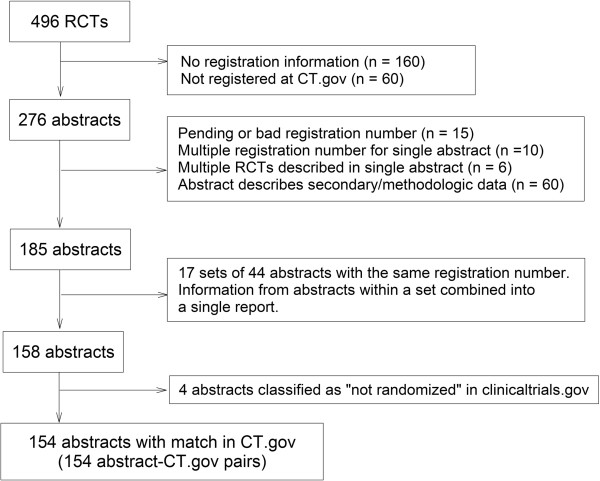
Methods: We reviewed all conference abstracts presented at the ARVO meetings from 2007 through 2009, and identified 496 RCTs; 154 had a single matching registration record in ClinicalTrials.gov. Two individuals independently extracted information from the abstract and the ClinicalTrials.gov record, including study design, sample size, inclusion criteria, masking, interventions, outcomes, funder, and investigator name and contact information. Discrepancies were resolved by consensus. We assessed the frequencies of reporting variables appearing in the abstract and the trial register and assessed agreement of information reported in both sources.
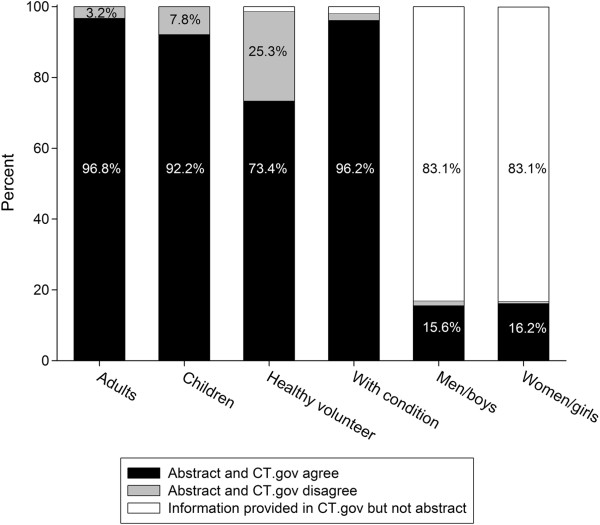
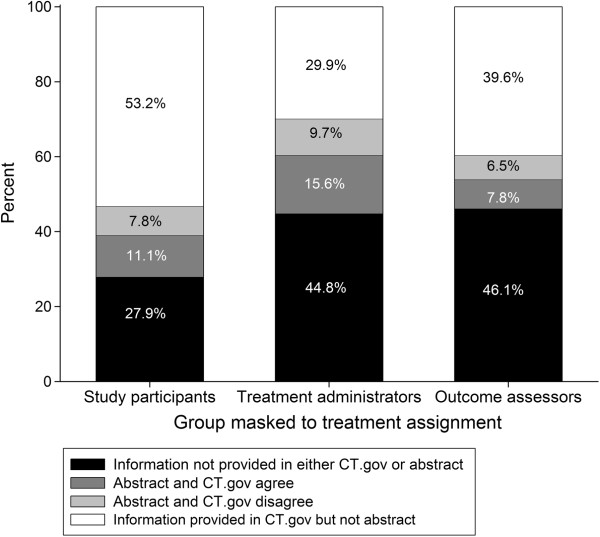
Results: We found a substantial amount of study design information in the ClinicalTrials.gov record that was unavailable in the corresponding conference abstract, including eligibility criteria associated with gender (83%; 128/154); masking or blinding of study participants (53%, 82/154), persons administering treatment (30%, 46/154), and persons measuring the outcomes (40%, 61/154)); and number of study centers (58%; 90/154). Only 34% (52/154) of abstracts explicitly described a primary outcome, but a primary outcome was included in the "Primary Outcome" field in the ClinicalTrials.gov record for 82% (126/154) of studies. One or more study interventions were reported in each abstract, but agreed exactly with those reported in ClinicalTrials.gov only slightly more than half the time (88/154, 56%). We found no contact information for study investigators in the abstract, but this information was available in less than one quarter of ClinicalTrial.gov records (17%; 26/154).
Conclusion: RCT design information not reported in conference abstracts is often available in the corresponding ClinicalTrials.gov registration record. Sometimes there is conflicting information reported in the two sources and further contact with the trial investigators may still be required.
Figures
References
-
- IOM (Institute of Medicine) Knowing What Works in Health Care: a Roadmap for the Nation. Committee on Reviewing Evidence to Identify Highly Effective Clinical Services. Washington DC: The National Academic Press; 2011.
-
- Hopewell S, Eisinga A, Clarke M. Better reporting of randomized trials in biomedical journal and conference abstracts. J Information Science. 2008;34:162–173.
-
- Dundar Y, Dodd S, Williamson P, Walley T, Dickson R. Searching for and use of conference abstracts in health technology assessments: Policy and practice. Int J Technol Assess Health Care. 2006;22:283–287. - PubMed
Publication types
MeSH terms
Grants and funding
LinkOut - more resources
Full Text Sources
Other Literature Sources
