. 2013 Oct 1;189(1):10-21.
doi: 10.1016/j.resp.2013.06.003. Epub 2013 Jun 14.

Contributions of the Kölliker-Fuse nucleus to coordination of breathing and swallowing

Affiliations

Contributions of the Kölliker-Fuse nucleus to coordination of breathing and swallowing

J M Bonis et al. Respir Physiol Neurobiol. .

Abstract

Herein we compare the effects of perturbations in the Kölliker-Fuse nucleus (KFN) and the lateral (LPBN) and medial (MPBN) parabrachial nuclei on the coordination of breathing and swallowing. Cannula was chronically implanted in goats through which ibotenic acid (IA) was injected while awake. Swallows in late expiration (E) always reset while swallows in early inspiration (I) never reset the respiratory rhythm. Before cannula implantation, all other E and I swallows did not reset the respiratory rhythm, and had small effects on E and I duration and tidal volume (VT). However, after cannula implantation in the MPBN and KFN, E and I swallows reset the respiratory rhythm and increased the effects on I and E duration and VT. Subsequent injection of IA into the KFN eliminated the respiratory phase resetting of swallows but exacerbated the effects on I and E duration and VT. We conclude that the KFN and to a lesser extent the MPBN contribute to coordination of breathing and swallowing.


Figures

Fig. 1
Fig. 1
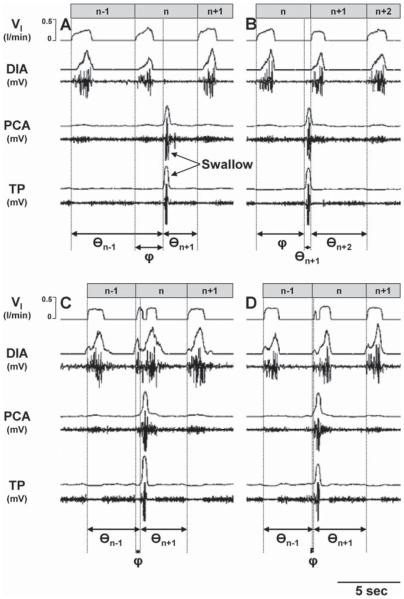
Depiction of swallow detection and derivation of variables for phase analysis. Swallows were considered solitary if the three breaths preceding (n − 1, n − 2, and n − 3) and the two breaths succeeding (n + 1 and n + 2) the breath of the swallow (n) did not contain swallows. A respiratory cycle was considered to begin with inspiration (I) followed by expiration (E). The n − 3, n − 2, and n + 2 breaths served as control breaths. The vertical line indicates the start of a swallow as evidenced by the raw and moving time average posterior cricoarytenoid (PCA) and thyropharyngeus (TP) muscles signals. Swallows were characterized according to their occurrence within the respiratory cycle as either E, late-E, I, or early-I (Panels A–D, respectively). Old phase (ϕ) was defined as the time from the start of the swallow to the beginning of the n breath. Cophases (θ) were defined as the time from the start of the swallow to the beginning of the preceding breath (θn−1) and three succeeding breaths (θn+1, θn+2, θn+3). Values are normalized as a fraction of control breaths. Panels (A–D) were acquired from the same study in a KFN goat. DIA, diaphragm.
Fig. 2
Fig. 2
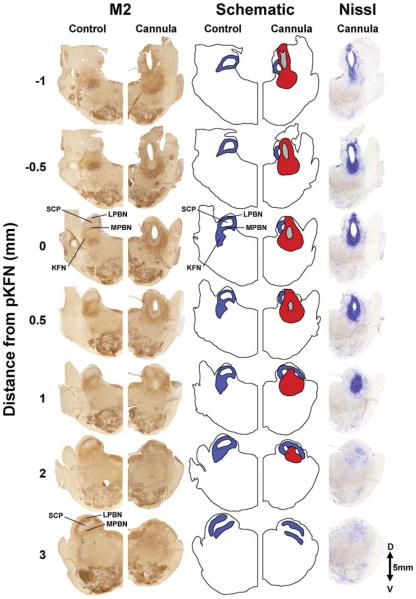
Histochemical and immunohistochemical staining for Nissl substance and M2 receptors of hemisections from a control goat and a goat with cannula implanted into the KFN. Included also is a schematic to emphasize the rostral–caudal changes in the LPBN, MPBN, and KFN beginning 1 mm caudal to the peak in number of KFN neurons and extending 3 mm rostral. Blue shaded area illustrates the orientation of the nuclei to the superior cerebellar peduncle. The tract of the cannula (gray) extends over 2 mm, and the area devoid of neurons (red) extends over 3 mm in the rostral–caudal direction. Note particularly the halo surrounding and extending beyond the cannula tip indicating tissue damage likely due primarily to ibotenic acid.
Fig. 3
Fig. 3
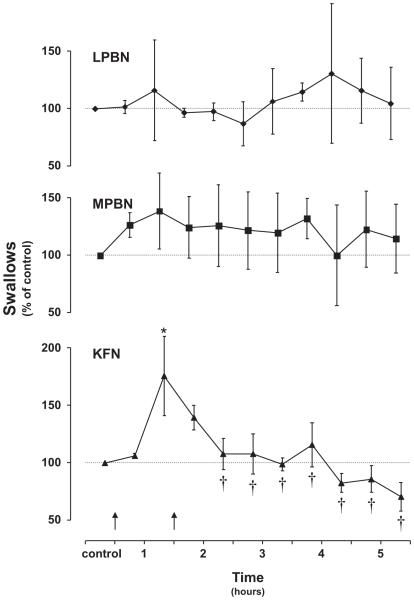
Frequency of swallows over 5 h after injecting 10 µl ibotenic acid (IA) bilaterally into the LPBN (filled diamonds), MPBN (open squares), or KFN (gray triangles) of awake goats. Ipsilateral and contralateral injections (arrows) were made at min 30 and 90, respectively. With injection into the LPBN or MPBN, occurrence of swallows did not significantly differ from control levels. Within 60–90 min after injection into the KFN, the occurrence of swallows was significantly (*P < 0.05) increased to 175% of control levels. Following this increase, the occurrence of swallows was significantly ( P < 0.05) attenuated relative to the initial transient increase. Data plotted as a percent of control levels ± SE.
Fig. 4
Fig. 4
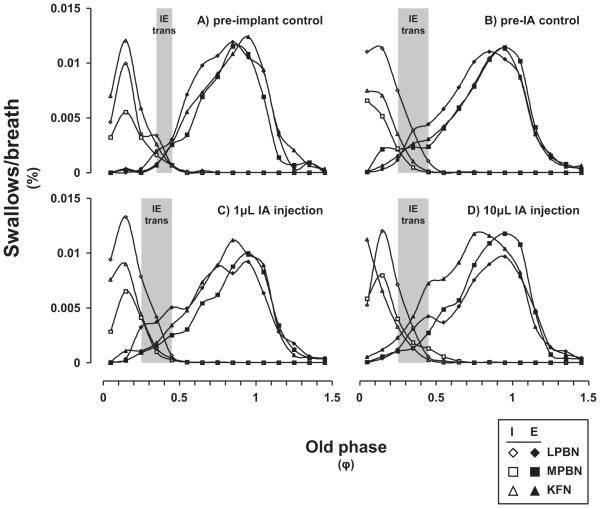
Histogram of solitary swallow (normalized to total number of breaths) occurrence with the respiratory cycle during pre-implant and pre-IA injection control (Panels A and B) and 1 and 10 µl IA injection (Panels C and D) protocols. The phase transition between inspiration (I) and expiration (E) (IE trans; denoted by gray bar) is between an old phase (ϕ) of 0.4 and 0.5 in Panel (A), but subsequently widened to between 0.3 and 0.5 in Panels (B–D). Note the conserved magnitude of swallow occurrence across all experimental conditions and cannula implantation sites, as well as the peak occurrence of I swallows at ϕ = 0.2 and E swallows at ϕ = 1 (Panels A–D). Open symbols indicate I swallows, while closed symbols indicate E swallows. ϕ values greater than 1 are possible because some respiratory cycles are longer than the total respiratory time (TTot) of control breaths, some presumably due to the effects of swallowing on respiratory timing parameters (see Fig. 8).
Fig. 5
Fig. 5
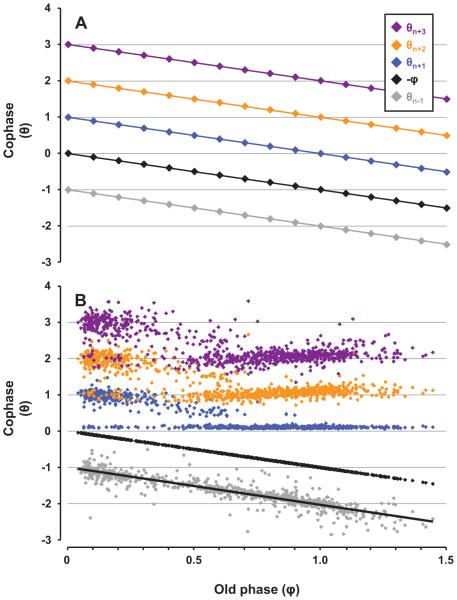
Depiction of the phase analysis of an idealized example (Panel A) and data during a pre-implant control study in a KFN goat (Panel B). In Panel (A), the idealized plot of θn versus ϕ depicts swallows having no effect on respiratory rhythm indicated by the respective points organizing into series of parallel lines with a slope of −1 and an amplitude difference where θ = 1. Thus, respiratory rhythm was not reset. In Panel (B), when considering effect of all swallow during the control study, the pattern of n + 1 breaths deviated from that in Panel (A) and persisted through subsequent breaths (n + 2 and n + 3). Thus, in this case the swallows appeared to reset respiratory rhythm, with amplitude changes where θ < 1 indicating phase advances and θ > 1 indicating phase delays. The linear regression for θn−1is y = −1.0282x − 0.9966, confirming no anticipation of the phase shift prior to swallows.
Fig. 6
Fig. 6
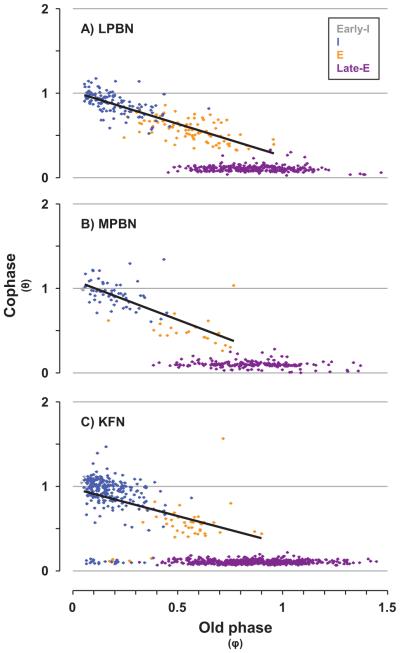
The phase analysis for n + 1 breaths during pre-implant control studies in LPBN (Panel A), MPBN (Panel B), and KFN (Panel C) goats. The swallows are categorized as expiration (E; orange), inspiration (I; blue), late-E (purple), and early-I (gray). A trendline is fitted to I and E swallows. The linear regressions for Panels (A–C) are as follows: (A) y = −0.7657x + 1.0003, (B) y = −0.9457x + 1.0992, and (C) y = −0.6551x + 0.9811. The slope of the θn+1 trendlines is similar across cannula implantation sites and near the idealized θn+1 series (y = −1x + 1), indicating minimal phase resetting under intact control, unoperated conditions. Early-I and late-E swallows phase shift in predictable and consistent manners, and were thus not analyzed in this fashion.
Fig. 7
Fig. 7
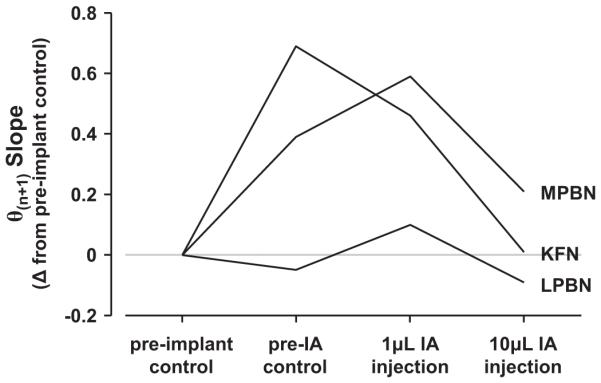
The θn+1trendline slopes (as changed from pre-implant controls) across experimental conditions for all cannula implantation sites. In LPBN goats, the slope remained unchanged from pre-implant control levels, indicating the absence of phase resetting. In MPBN and KFN animals, the slope increased (became less negative) from pre-implant control levels, indicating marked phase resetting.
Fig. 8
Fig. 8
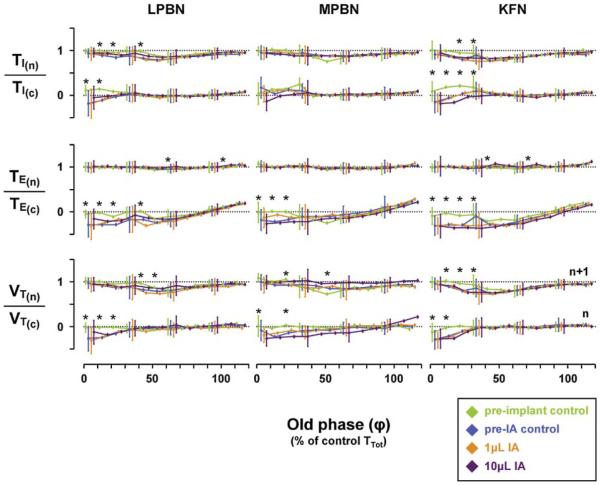
In LPBN and KFN goats, physical and chemical destruction significantly (P < 0.05) decreased inspiratory time (TI) in the n and n + 1 breaths of I swallows (ϕ ≈ 0–40%). In all 3 goat groups, physical and chemical destruction significantly (P < 0.05) decreased expiratory time (TE) and tidal volume (VT) in the n and n + 1 breaths of I swallows (ϕ ≈ 0–40%). For all conditions and cannula implantation sites, early-E swallows (ϕ ≈ 40–90%) decreased TE in the n breath, and decreased TI and VT in the n + 1 breath. Additionally, late-E swallows (ϕ > 110%) increased TE in the n breath. Asterisks denote significant (P < 0.05) differences of respective pre-implant controls from pre-IA control, 1 µl IA injection and/or 10 µl IA injection values by two-way RM ANOVA.
Fig. 9
Fig. 9
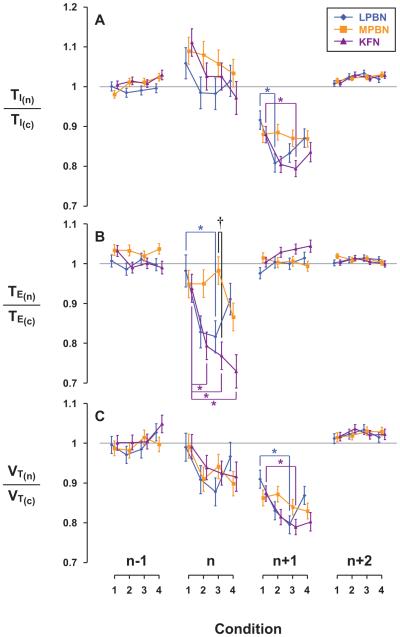
Physical and chemical destruction altered the effect of swallows on breathing in a site-dependent manner. In the n + 1 breath inspiratory time (TI; Panel A) was decreased (*P < 0.05) in LPBN goats with cannula implantation and KFN goats with 1 µl ibotenic acid (IA) injection. In the n breath expiratory time (TE ; Panel B) was decreased (*P < 0.05) in LPBN animals with 1 µl IA injection and KFN goats with all subsequent conditions. Also in the n breath, TE was decreased ( P < 0.05) in a site-dependent manner with 1 µl IA injection in KFN versus MPBN goats. In the n + 1 breath tidal volume (VT; Panel C) was decreased (*P < 0.05) in LPBN and KFN animals with 1 µl IA injections. There was no anticipation or perpetuation of the effects of swallows on breathing, as the n − 1 and n + 2 breaths did not deviate from baseline. The four conditions are (1) pre-implant controls, (2) pre-IA controls, (3) 1 µl IA injections, and (4) 10 µl IA injections. Asterisks denote significant (P < 0.05) conditional differences between bracketed values. The dagger denotes a significant (P < 0.05) implantation site difference between bracketed values.

References

    1. Bianchi AL, Denavit-Saiboe M, Champagnat J. Central control of breathing in mammals: neuronal circuitry, membrane properties and neurotransmitters. Physiological Reviews. 1995 Jan 1;75:1–45. - PubMed
    1. Bolser DC, Poliacek I, Jakus J, Fuller DD, Davenport PW. Neurogenesis of cough, other airway defensive behaviors and breathing: a holarchical system? Respiratory Physiology and Neurobiology. 2006 Jul 3;152:255–265. - PMC - PubMed
    1. Bonis JM, Neumueller SE, Krause KL, Kiner T, Smith A, Marshall BD, Qian B, Pan LG, Forster HV. A role for the Kölliker–Fuse nucleus in cholinergic modulation of breathing at night during wakefulness and NREM sleep. Journal of Applied Physiology. 2010a Jul 1;109:159–170. - PMC - PubMed
    1. Bonis JM, Neumueller SE, Krause KL, Kiner T, Smith A, Marshall BD, Qian B, Pan LG, Forster HV. Site-specific effects on respiratory rhythm and pattern of ibotenic acid injections in the pontine respiratory group of goats. Journal of Applied Physiology. 2010b Jul 1;109:171–188. - PMC - PubMed
    1. Bonis JM, Neumueller SE, Marshall BD, Krause KL, Qian B, Pan LG, Hodges MR, Forster HV. The effects of lesions in the dorsolateral pons on the coordination of swallowing and breathing in awake goats. Respiratory Physiology and Neurobiology. 2011 Feb 2;175:272–282. - PMC - PubMed

Publication types

LinkOut - more resources