


Activity of the HIV-1 attachment inhibitor BMS-626529, the active component of the prodrug BMS-663068, against CD4-independent viruses and HIV-1 envelopes resistant to other entry inhibitors
- PMID: 23774428
- PMCID: PMC3754311
- DOI: 10.1128/AAC.00513-13
Activity of the HIV-1 attachment inhibitor BMS-626529, the active component of the prodrug BMS-663068, against CD4-independent viruses and HIV-1 envelopes resistant to other entry inhibitors
Abstract
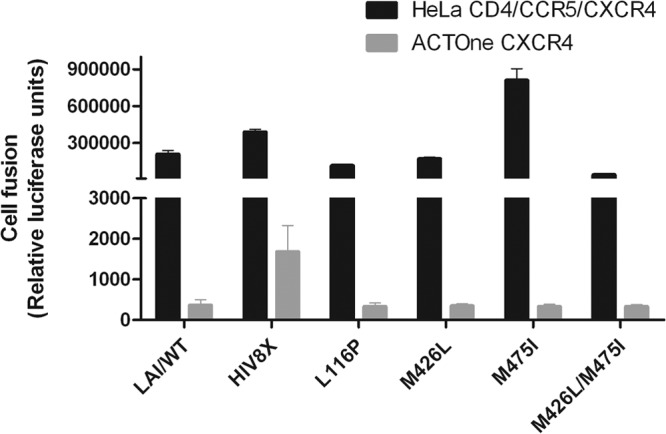
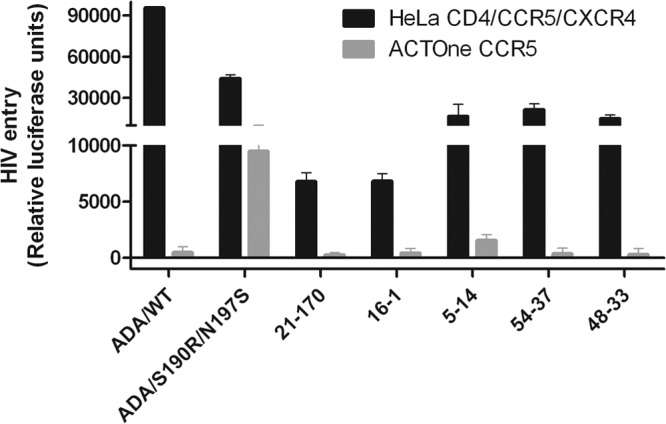
BMS-626529 is a novel small-molecule HIV-1 attachment inhibitor active against both CCR5- and CXCR4-tropic viruses. BMS-626529 functions by preventing gp120 from binding to CD4. A prodrug of this compound, BMS-663068, is currently in clinical development. As a theoretical resistance pathway to BMS-663068 could be the development of a CD4-independent phenotype, we examined the activity of BMS-626529 against CD4-independent viruses and investigated whether resistance to BMS-626529 could be associated with a CD4-independent phenotype. Finally, we evaluated whether cross-resistance exists between BMS-626529 and other HIV-1 entry inhibitors. Two laboratory-derived envelopes with a CD4-independent phenotype (one CXCR4 tropic and one CCR5 tropic), five envelopes from clinical isolates with preexisting BMS-626529 resistance, and several site-specific mutant BMS-626529-resistant envelopes were examined for their dependence on CD4 for infectivity or susceptibility to BMS-626529. Viruses resistant to other entry inhibitors (enfuvirtide, maraviroc, and ibalizumab) were also examined for susceptibility to BMS-626529. Both CD4-independent laboratory isolates retained sensitivity to BMS-626529 in CD4(-) cells, while HIV-1 envelopes from viruses resistant to BMS-626529 exhibited no evidence of a CD4-independent phenotype. BMS-626529 also exhibited inhibitory activity against ibalizumab- and enfuvirtide-resistant envelopes. While there appeared to be some association between maraviroc resistance and reduced susceptibility to BMS-626529, an absolute correlation cannot be presumed, since some CCR5-tropic maraviroc-resistant envelopes remained sensitive to BMS-626529. Clinical use of the prodrug BMS-663068 is unlikely to promote resistance via generation of CD4-independent virus. No cross-resistance between BMS-626529 and other HIV entry inhibitors was observed, which could allow for sequential or concurrent use with different classes of entry inhibitors.
Figures
References
-
- Dau B, Holodniy M. 2009. Novel targets for antiretroviral therapy: clinical progress to date. Drugs 69:31–50 - PubMed
-
- Tilton JC, Doms RW. 2010. Entry inhibitors in the treatment of HIV-1 infection. Antiviral Res. 85:91–100 - PubMed
-
- Gulick RM, Lalezari J, Goodrich J, Clumeck N, DeJesus E, Horban A, Nadler J, Clotet B, Karlsson A, Wohlfeiler M, Montana JB, McHale M, Sullivan J, Ridgway C, Felstead S, Dunne MW, van der Ryst E, Mayer H. 2008. Maraviroc for previously treated patients with R5 HIV-1 infection. N. Engl. J. Med. 359:1429–1441 - PMC - PubMed
Publication types
MeSH terms
Substances
LinkOut - more resources
Full Text Sources
Other Literature Sources
Medical
Research Materials
