


Relationship between ceftolozane-tazobactam exposure and drug resistance amplification in a hollow-fiber infection model
- PMID: 23774429
- PMCID: PMC3754319
- DOI: 10.1128/AAC.00461-13
Relationship between ceftolozane-tazobactam exposure and drug resistance amplification in a hollow-fiber infection model
Abstract
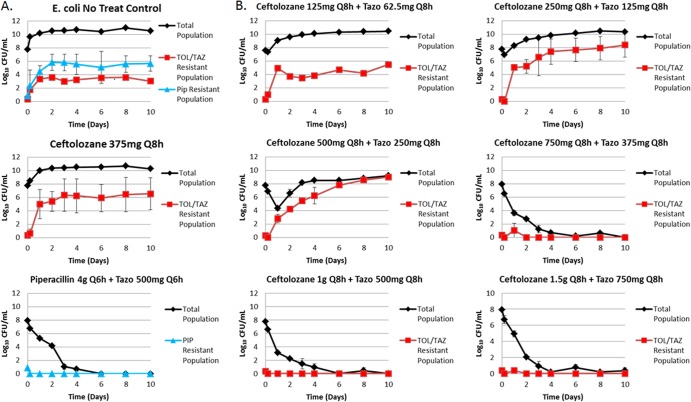
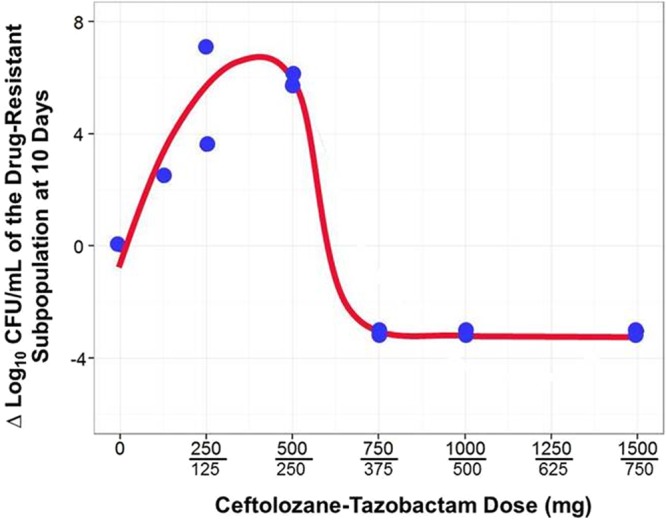
In an era of rapidly emerging antimicrobial-resistant bacteria, it is critical to understand the importance of the relationships among drug exposure, duration of therapy, and selection of drug resistance. Herein we describe the results of studies designed to determine the ceftolozane-tazobactam exposure necessary to prevent the amplification of drug-resistant bacterial subpopulations in a hollow-fiber infection model. The challenge isolate was a CTX-M-15-producing Escherichia coli isolate genetically engineered to transcribe a moderate level of blaCTX-M-15. This organism's blaCTX-M-15 transcription level was confirmed by relative quantitative reverse transcription-PCR (qRT-PCR), β-lactamase hydrolytic assays, and a ceftolozane MIC value of 16 mg/liter. In these studies, the experimental duration (10 days), ceftolozane-tazobactam dose ratio (2:1), and dosing interval (every 8 h) were selected to approximate those expected to be used clinically. The ceftolozane-tazobactam doses studied ranged from 125-62.5 to 1,500-750 mg. Negative- and positive-control arms included no treatment and piperacillin-tazobactam at 4.5 g every 6 h, respectively. An inverted-U-shaped function best described the relationship between bacterial drug resistance amplification and drug exposure. The least- and most-intensive ceftolozane-tazobactam dosing regimens, i.e., 125-62.5, 750-375, 1,000-500, and 1,500-750 mg, did not amplify drug resistance, while drug resistance amplification was observed with intermediate-intensity dosing regimens (250-125 and 500-250 mg). For the intermediate-intensity ceftolozane-tazobactam dosing regimens, the drug-resistant subpopulation became the dominant population by days 4 to 6. The more-intensive ceftolozane-tazobactam dosing regimens (750-375, 1,000-500, and 1,500-750 mg) not only prevented drug resistance amplification but also virtually sterilized the model system. These data support the selection of ceftolozane-tazobactam dosing regimens that minimize the potential for on-therapy drug resistance amplification.
Figures
References
-
- Tam VH, Louie A, Deziel MR, Weiguo L, Leary R, Drusano GL. 2005. Bacterial-population responses to drug-selective pressure: examination of garenoxacin's effect on Pseudomonas aeruginosa. J. Infect. Dis. 192:420–428 - PubMed
-
- VanScoy B, Mendes RE, Nicasio AM, Castanheira M, Bulik CC, Okusanya OO, Bhavnani SM, Forrest A, Jones RN, Friedrich LV, Steenbergen JN, Ambrose PG. 2013. Pharmacokinetics-pharmacodynamics of tazobactam in combination with ceftolozane in an in vitro infection model. Antimicrob. Agents Chemother. 57:2809–2814 - PMC - PubMed
-
- Clinical and Laboratory Standards Institute 2012. Methods for dilution antimicrobial susceptibility tests for bacteria that grow aerobically. Approved standard—. 9th ed. CLSI document M07-A9 Clinical and Laboratory Standards Institute, Wayne, PA
Publication types
MeSH terms
Substances
LinkOut - more resources
Full Text Sources
Other Literature Sources
Medical
