


Associations of urinary cadmium with age and urinary proteins: further evidence of physiological variations unrelated to metal accumulation and toxicity
- PMID: 23774576
- PMCID: PMC3764089
- DOI: 10.1289/ehp.1306607
Associations of urinary cadmium with age and urinary proteins: further evidence of physiological variations unrelated to metal accumulation and toxicity
Abstract
Background: The current risk assessment for environmental cadmium (Cd) largely relies on the assumption that urinary Cd (U-Cd) is a reliable biomarker of the Cd body burden. Recent studies have questioned the validity of this assumption.
Objectives: We studied the lifetime trend of U-Cd as a function of diuresis, gender, smoking status, and protein tubular reabsorption. We also analyzed the associations between U-Cd and urinary proteins.
Methods: Cd, retinol-binding protein, and albumin were measured in the urine of six cohorts of the general population of Belgium, with a mean age ranging from 5.7 to 88.1 years (n = 1,567). Variations of U-Cd with age were modeled using natural cubic splines.
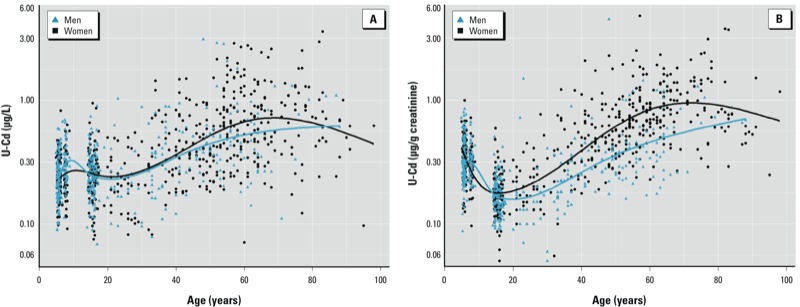
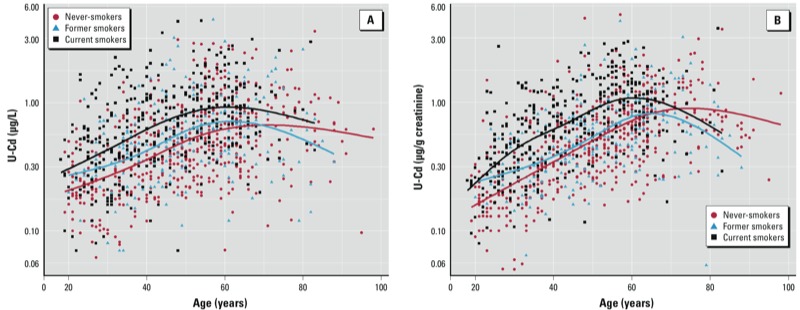
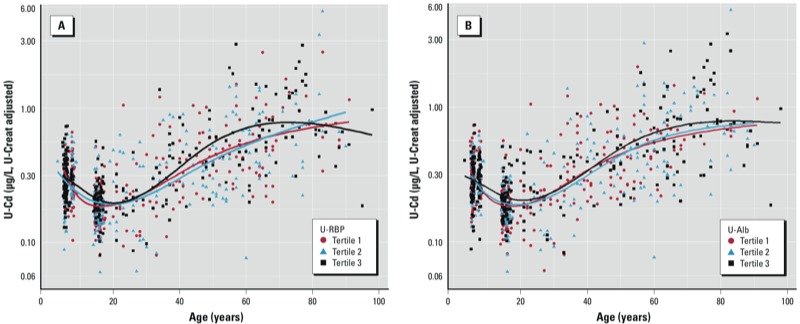
Results: In both genders, U-Cd decreased to a minimum (~ 0.20 μg/L) at the end of adolescence, then increased until 60-70 years of age (~ 0.60 μg/L in never-smokers) before leveling off or decreasing. When U-Cd was expressed in micrograms per gram of creatinine, these variations were amplified (minimum, 0.15 µg/g creatinine; maximum, 0.70 µg/g creatinine) and much higher U-Cd values were observed in women. We observed no difference in U-Cd levels between never-smokers and former smokers, and the difference with current smokers did not increase over time. Lifetime curves of U-Cd were higher with increasing urinary retinol-binding protein or albumin, a consequence of the coexcretion of Cd with proteins.
Conclusions: At low Cd exposure levels, U-Cd and age are associated through nonlinear and nonmonotonic relationships that appear to be driven mainly by recent Cd intake and physiological variations in the excretion of creatinine and proteins.
Conflict of interest statement
The authors declare they have no actual or potential competing financial interests.
Figures
Comment in
-
Urinary cadmium as a marker of exposure in epidemiological studies.Environ Health Perspect. 2013 Oct;121(10):A296. doi: 10.1289/ehp.1307376. Environ Health Perspect. 2013. PMID: 24218673 Free PMC article. No abstract available.
-
Urinary cadmium as a marker of exposure in epidemiological studies: Bernard and Chaumont respond.Environ Health Perspect. 2013 Oct;121(10):A296-7. doi: 10.1289/ehp.1307376R. Environ Health Perspect. 2013. PMID: 24218674 Free PMC article. No abstract available.
References
-
- Aguilera I, Daponte A, Gil F, Hernandez AF, Godoy P, Pla A, et al. Urinary levels of arsenic and heavy metals in children and adolescents living in the industrialized area of Ria of Huelva (SW Spain). Environ Int. 2010;36:563–569. - PubMed
-
- Benedetti JL, Samuel O, Dewailly E, Gingras S, Lefebvre MA. Levels of cadmium in kidney and liver tissues among a Canadian population (province of Quebec). J Toxicol Environ Health A. 1999;56:145–163. - PubMed
Publication types
MeSH terms
Substances
LinkOut - more resources
Full Text Sources
Other Literature Sources
Medical
Miscellaneous