. 2013 Jul 15;191(2):583-93.
doi: 10.4049/jimmunol.1300483. Epub 2013 Jun 17.

HLA-A*01:03, HLA-A*24:02, HLA-B*08:01, HLA-B*27:05, HLA-B*35:01, HLA-B*44:02, and HLA-C*07:01 monochain transgenic/H-2 class I null mice: novel versatile preclinical models of human T cell responses

Affiliations

HLA-A*01:03, HLA-A*24:02, HLA-B*08:01, HLA-B*27:05, HLA-B*35:01, HLA-B*44:02, and HLA-C*07:01 monochain transgenic/H-2 class I null mice: novel versatile preclinical models of human T cell responses

Rachid Boucherma et al. J Immunol. .

Abstract

We have generated a panel of transgenic mice expressing HLA-A*01:03, -A*24:02, -B*08:01, -B*27:05, -B*35:01, -B*44:02, or -C*07:01 as chimeric monochain molecules (i.e., appropriate HLA α1α2 H chain domains fused with a mouse α3 domain and covalently linked to human β2-microglobulin). Whereas surface expression of several transgenes was markedly reduced in recipient mice that coexpressed endogenous H-2 class I molecules, substantial surface expression of all human transgenes was observed in mice lacking H-2 class I molecules. In these HLA monochain transgenic/H-2 class I null mice, we observed a quantitative and qualitative restoration of the peripheral CD8(+) T cell repertoire, which exhibited a TCR diversity comparable with C57BL/6 WT mice. Potent epitope-specific, HLA-restricted, IFN-γ-producing CD8(+) T cell responses were generated against known reference T cell epitopes after either peptide or DNA immunization. HLA-wise, these new transgenic strains encompass a large proportion of individuals from all major human races and ethnicities. In combination with the previously created HLA-A*02:01 and -B*07:02 transgenic mice, the novel HLA transgenic mice described in this report should be a versatile preclinical animal model that will speed up the identification and optimization of HLA-restricted CD8(+) T cell epitopes of potential interest in various autoimmune human diseases and in preclinical evaluation of T cell-based vaccines.


Conflict of interest statement

Disclosures

The authors have no financial conflicts of interest.

Figures
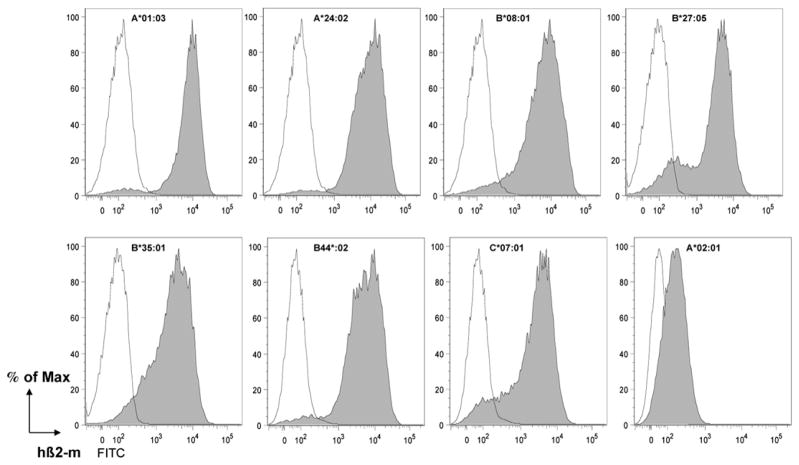
FIGURE 1
FIGURE 1
Cell-surface expression of the seven HLA monochains in a H-2 class I null context. Ficoll-purified splenocytes from individual HLA class I monochain transgenic, H-2 class I null (closed gray histograms), and H-2 Kb, Db, mouse β2-m triple-KO (negative control, open histograms) mice (n = 1) were labeled with anti–β2-m mAb Tü 99 and flow cytometrically analyzed. This experiment was performed more than five times.
FIGURE 2
FIGURE 2
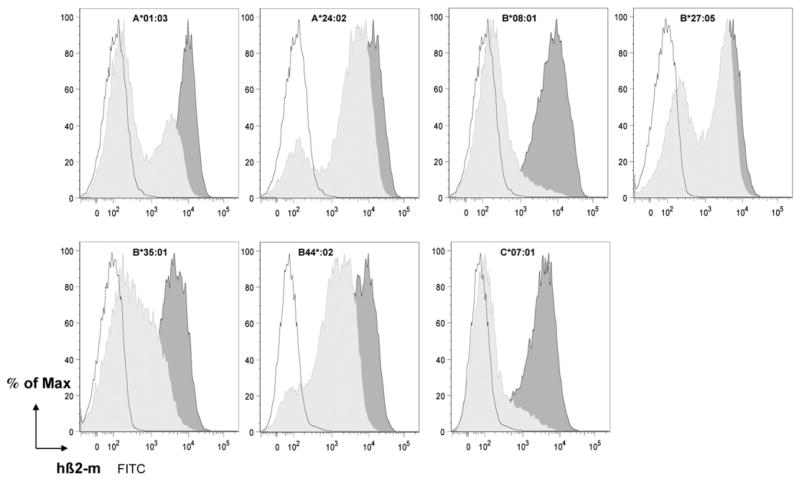
Cell-surface expression of the seven monochains in a H-2 class I+ context. Ficoll-purified splenocytes from individual HLA class I monochain transgenic H-2 class I null (dark gray histograms), HLA class I monochain transgenic × OF1 F1 hybrid (light gray histograms), and H-2 Kb, Db, mouse β2-m triple-KO (negative control, open histograms) mice (n = 1) were labeled with anti–β2-m mAb Tü 99 and flow cytometrically analyzed. This experiment was performed thrice.
FIGURE 3
FIGURE 3
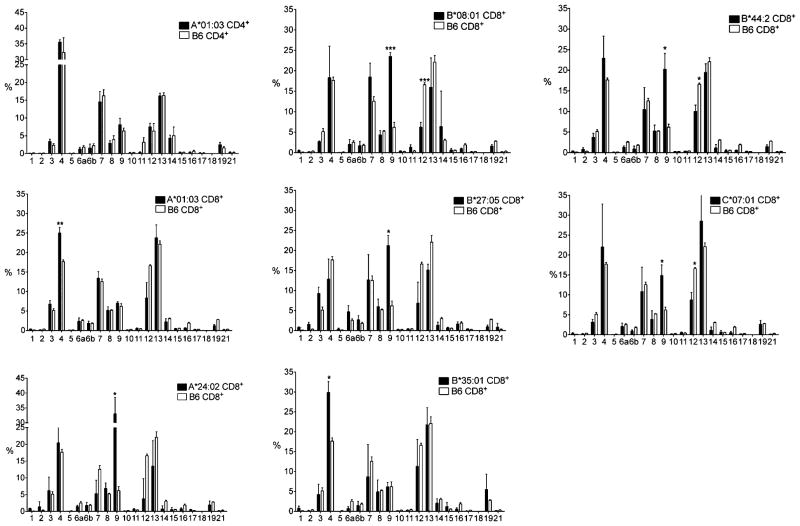
CD8+ and CD4+ T cells TCR AV peripheral repertoire. Relative peripheral representation in percentage of the AV segment families (International Immunogenetics Information System nomenclature, http://www.imgt.org) as evaluated by quantitative RT-PCR in purified CD8+ and CD4+ T cells from HLA-A*01.03, -A*24:02, -B*08:01, -B*27:05, -B*33:01, -B*44:02, and -C*07:01 monochain transgenic and from C57BL/6 (B6) mice. Open and closed bars correspond to C57BL/6 and monochain strains, respectively. CD4+ T cell AV profiles of A*01:03 versus C57BL/6 mice are illustrated in the upper left panel, similar CD4+ AV profiles (data not shown) being obtained with the six additional monochains. The results are means of the values from at least four individually tested mice. Statistical analyses of the data were carried out with the unpaired t test with Welch’s correction, *p < 0.05, **p < 0.005, ***p < 0.0005.
FIGURE 4
FIGURE 4
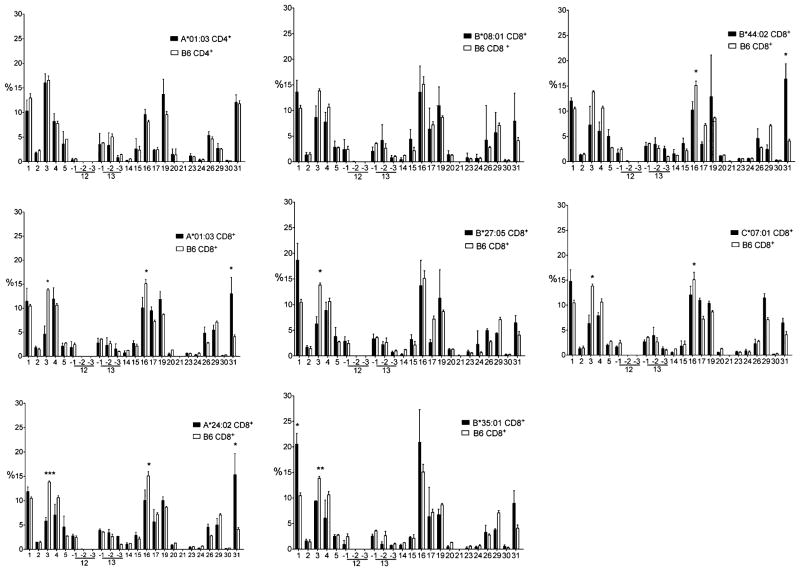
CD8+ and CD4+ T cells TCR BV peripheral repertoire. Relative peripheral representation in percentage of the BV segment families (International Immunogenetics Information System nomenclature, http://www.imgt.org) as evaluated by quantitative RT-PCR in purified CD8+ and CD4+ T cells from HLA-A*01:03, -A*24:02, -B*08:01, -B*27:05, -B*35:01, -B*44:02, and -C*07:01 monochain transgenic and from C57BL/6 (B6) mice. Open and closed bars correspond to C57BL/6 and monochain strains, respectively. CD4+ T cell BV profiles of A*01:03 versus C57BL/6 mice are illustrated in the upper left panel, similar CD4+ BV profiles (not shown) being obtained with the six additional monochains. The results are means of the values from at least four individually tested mice. Statistical analyses of the data were carried out with the unpaired t test with Welch’s correction, *p < 0.05, **p < 0.005, ***p < 0.0005.
FIGURE 5
FIGURE 5
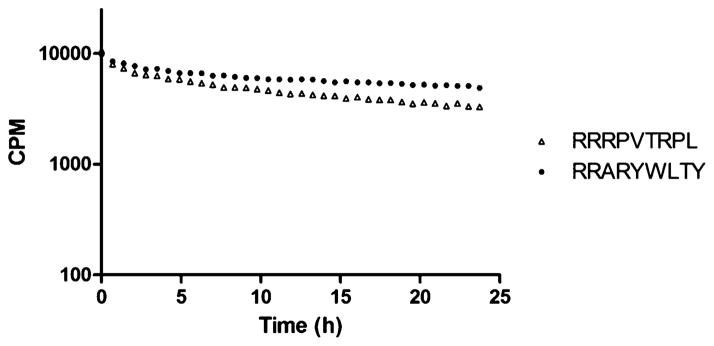
Peptide–HLA-C*07:01 dissociation. Dissociation of predicted HLA-C*07:01 binding peptides RRRPVTRPL (T1/2 16.1 h) and RRARYWLTY (T1/2 29.4 h) from HLA-C*07:01 measured by scintillation proximity assay.

References

    1. Pascolo S. HLA class I transgenic mice: development, utilisation and improvement. Expert Opin Biol Ther. 2005;5:919–938. - PubMed
    1. Cardinaud S, Moris A, Février M, Rohrlich PS, Weiss L, Langlade-Demoyen P, Lemonnier FA, Schwartz O, Habel A. Identification of cryptic MHC I-restricted epitopes encoded by HIV-1 alternative reading frames. J Exp Med. 2004;199:1053–1063. - PMC - PubMed
    1. Szpak Y, Vieville JC, Tabary T, Naud MC, Chopin M, Edelson C, Cohen JHM, Dausset J, de Kozak Y, Pla M. Spontaneous retinopathy in HLA-A29 transgenic mice. Proc Natl Acad Sci USA. 2001;98:2572–2576. - PMC - PubMed
    1. Toma A, Laïka T, Haddouk S, Luce S, Briand JP, Camoin L, Connan F, Lambert M, Caillat-Zucman S, Carel JC, et al. Recognition of human proinsulin leader sequence by class I-restricted T-cells in HLA-A*0201 transgenic mice and in human type 1 diabetes. Diabetes. 2009;58:394–402. - PMC - PubMed
    1. Visseren MJW, van der Burg SH, van der Voort EIH, Brandt RMP, Schrier PI, van der Bruggen P, Boon T, Melief CJM, Kast WM. Identification of HLA-A*0201-restricted CTL epitopes encoded by the tumor-specific MAGE-2 gene product. Int J Cancer. 1997;73:125–130. - PubMed

Publication types

MeSH terms