


The lack of evidence for PET or PET/CT surveillance of patients with treated lymphoma, colorectal cancer, and head and neck cancer: a systematic review
- PMID: 23776200
- PMCID: PMC3980728
- DOI: 10.2967/jnumed.112.119362
The lack of evidence for PET or PET/CT surveillance of patients with treated lymphoma, colorectal cancer, and head and neck cancer: a systematic review
Abstract
PET and PET/CT are widely used for surveillance of patients after cancer treatments. We conducted a systematic review to assess the diagnostic accuracy and clinical impact of PET and PET/CT used for surveillance in several cancers.
Methods: We searched MEDLINE and Cochrane Library databases from 1996 to March 2012 for English-language studies of PET or PET/CT used for surveillance of patients with lymphoma, colorectal cancer, or head and neck cancer. We included prospective or retrospective studies that reported test accuracy and comparative studies that assessed clinical impact.
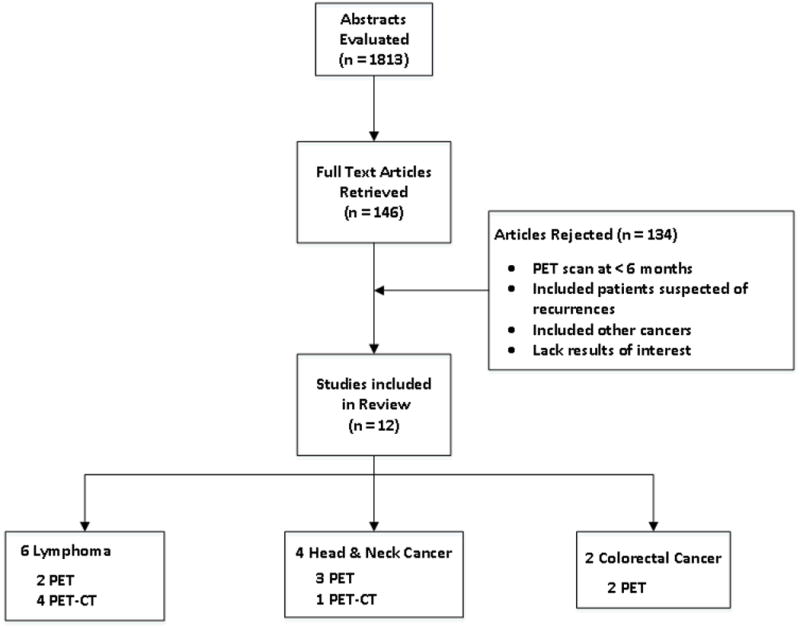
Results: Twelve studies met our inclusion criteria: 6 lymphoma (n = 767 patients), 2 colorectal cancer (n = 96), and 4 head and neck cancer (n = 194). All studies lacked a uniform definition of surveillance and scan protocols. Half the studies were retrospective, and a third were rated as low quality. The majority reported sensitivities and specificities in the range of 90%-100%, although several studies reported lower results. The only randomized controlled trial, a colorectal cancer study with 65 patients in the surveillance arm, reported earlier detection of recurrences with PET and suggested improved clinical outcomes.
Conclusion: There is insufficient evidence to draw conclusions on the clinical impact of PET or PET/CT surveillance for these cancers. The lack of standard definitions for surveillance, heterogeneous scanning protocols, and inconsistencies in reporting test accuracy preclude making an informed judgment on the value of PET for this potential indication.
Keywords: PET; PET/CT; colorectal; lymphoma; surveillance.
Conflict of interest statement
Figures
Comment in
-
Surveillance of cancer patients with imaging: self-evident or evidence-based?J Nucl Med. 2013 Sep;54(9):1513-5. doi: 10.2967/jnumed.113.127183. Epub 2013 Aug 8. J Nucl Med. 2013. PMID: 23929825 No abstract available.
-
Standards for reporting PET clinical trials.J Nucl Med. 2013 Sep;54(9):1516-7. doi: 10.2967/jnumed.113.127845. Epub 2013 Aug 12. J Nucl Med. 2013. PMID: 23940302 Free PMC article. No abstract available.
References
-
- Mujoomdar M MKNE. Positron Emission Tomography (PET) in Oncology: A Systematic Review of Clinical Effectiveness and Indications for Use. Ottawa: Canadian Agency for Drugs and Technologies in Health; Jan 4, 2010. Ref Type: Generic. - PubMed
-
- von Schulthess GK, Steinert HC, Hany TF. Integrated PET/CT: current applications and future directions. Radiology. 2006;238(2):405–422. - PubMed
-
- Podoloff DA, Ball DW, Ben-Josef E, et al. NCCN task force: clinical utility of PET in a variety of tumor types. J Natl Compr Canc Netw. 2009;7(Suppl 2):S1–26. - PubMed
-
- Meyer RM, Ambinder RF, Stroobants S. Hodgkin's lymphoma: evolving concepts with implications for practice. Hematology Am Soc Hematol Educ Program. 2004:184–202. - PubMed
-
- Meta J, Seltzer M, Schiepers C, et al. Impact of 18F-FDG PET on managing patients with colorectal cancer: the referring physician's perspective. J Nucl Med. 2001;42(4):586–590. - PubMed
Publication types
MeSH terms
Grants and funding
LinkOut - more resources
Full Text Sources
Other Literature Sources
Medical
Miscellaneous
