. 2013 Jul 2;110(27):11079-84.
doi: 10.1073/pnas.1302094110. Epub 2013 Jun 17.

Reversion of a fungal genetic code alteration links proteome instability with genomic and phenotypic diversification

Affiliations

Reversion of a fungal genetic code alteration links proteome instability with genomic and phenotypic diversification

Ana R Bezerra et al. Proc Natl Acad Sci U S A. .

Abstract

Many fungi restructured their proteomes through incorporation of serine (Ser) at thousands of protein sites coded by the leucine (Leu) CUG codon. How these fungi survived this potentially lethal genetic code alteration and its relevance for their biology are not understood. Interestingly, the human pathogen Candida albicans maintains variable Ser and Leu incorporation levels at CUG sites, suggesting that this atypical codon assignment flexibility provided an effective mechanism to alter the genetic code. To test this hypothesis, we have engineered C. albicans strains to misincorporate increasing levels of Leu at protein CUG sites. Tolerance to the misincorporations was very high, and one strain accommodated the complete reversion of CUG identity from Ser back to Leu. Increasing levels of Leu misincorporation decreased growth rate, but production of phenotypic diversity on a phenotypic array probing various metabolic networks, drug resistance, and host immune cell responses was impressive. Genome resequencing revealed an increasing number of genotype changes at polymorphic sites compared with the control strain, and 80% of Leu misincorporation resulted in complete loss of heterozygosity in a large region of chromosome V. The data unveil unanticipated links between gene translational fidelity, proteome instability and variability, genome diversification, and adaptive phenotypic diversity. They also explain the high heterozygosity of the C. albicans genome and open the door to produce microorganisms with genetic code alterations for basic and applied research.

Keywords: codon reassignment; evolution; tRNA.


Conflict of interest statement

The authors declare no conflict of interest.

Figures
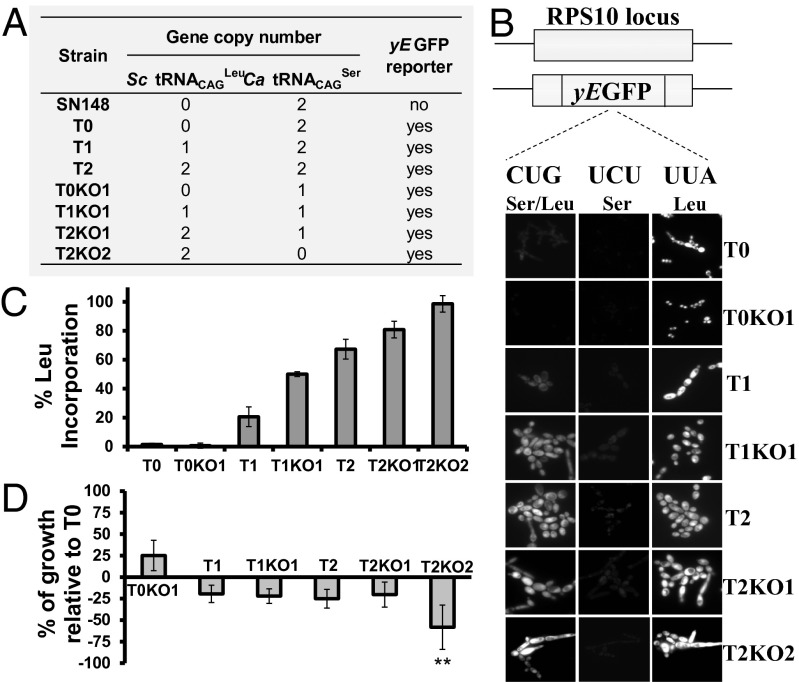
Fig. 1.
Fig. 1.
Construction of highly mistranslating and C. albicans reverted strains. (A) Table depicting the main characteristics of the mistranslating strains. (B) The reporter system is based on the yEGFP gene. The Leu UUA codon at position 201 (positive control) was mutated to a UCU Ser codon (negative control) and the ambiguous CUG codon. Incorporation of Ser at this position inactivates yEGFP, whereas Leu incorporation produces functional yEGFP. Fluorescence measured by epifluorescence microscopy is directly proportional to the level of Leu inserted at the CUG-201 site. (C) In T0, T1, and T2 cells, ambiguity is 1.45 ± 0.85%, 20.61 ± 1.81%, and 67.29 ± 6.83%, respectively. Strains T0KO1, T1KO1, and T2KO1 show 0.64 ± 0.82%, 50.04 ± 1.64%, and 80.84 ± 5.79% of Leu incorporation, whereas KO cells (T2KO2) incorporate 98.46 ± 1.75% of Leu. Data represent the mean ± SD of five independent experiments. (D) Growth rate analysis of mistranslating strains. Data represent the mean ± SD of triplicates of three independent clones. **P < 0.01, one-way ANOVA post-Dunnett comparison test with 95% confidence interval relative to T0 cells.
Fig. 2.
Fig. 2.
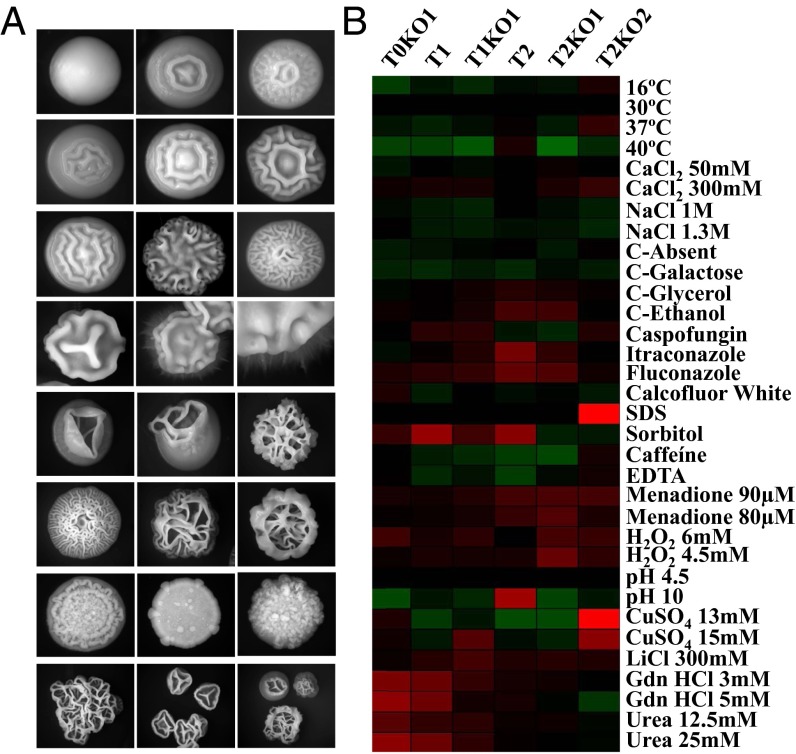
Phenotypic diversity produced by mistranslating C. albicans strains. (A) The repertoire of colony morphology phenotypes includes smooth, ring, wrinkled, and hyphae. KO mutants do not show the smooth or ring phenotypes, and colonies consist primarily of pseudohyphal and hyphal cell types. (B) A phenotypic screen carried out in stress media is shown on the panel where growth scores are represented by the color of the indicated square. Black represents a phenotype that is indistinguishable from the control (T0); green and red represent a reduction and enhancement phenotype, respectively. The growth score represents a ratio between growth in normal 2% glucose, 1% yeast extract, and 1% peptone (YPD) medium and growth in YPD supplemented with stressors. Triplicates of three independent clones from each strain were tested and compared with the T0 control cells.
Fig. 3.
Fig. 3.
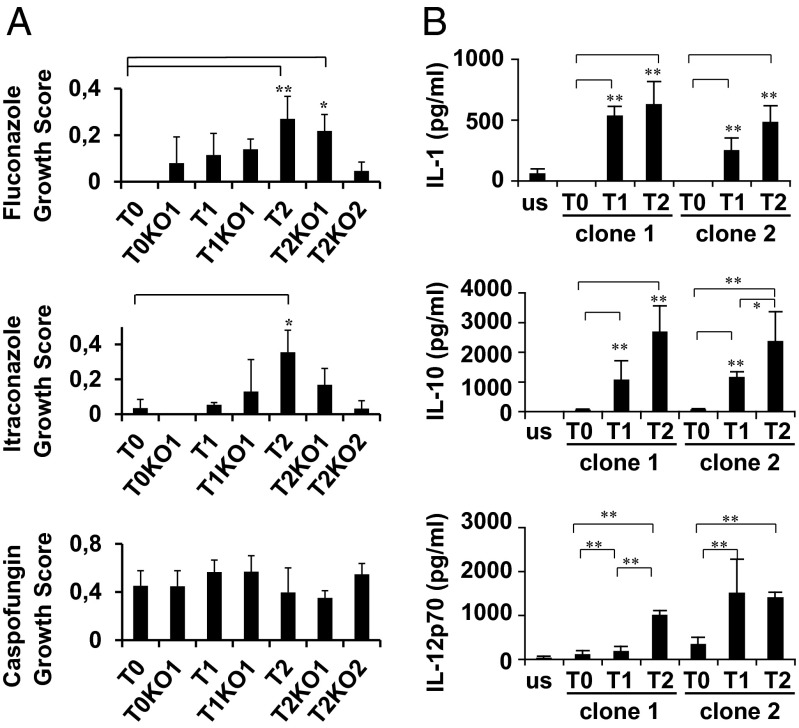
Mistranslation modulates antifungal and immune responses. (A) Growth of C. albicans strains in YPD medium supplemented with antifungals. The growth score represents a ratio between growth in normal YPD medium and growth in YPD supplemented with fluconazole, itraconazole, and caspofungin, respectively. Data represent the mean ± SD of triplicates of three independent clones (**P < 0.01, *P < 0.1, one-way ANOVA post-Dunnett comparison test with 95% confidence interval relative to the T0 control cells). (B) In vitro immune reactivity to C. albicans mistranslating strains. Monocyte-derived DCs were exposed for 24 h to C. albicans cells or no stimuli (us in the graph) in a concentration (expressed as stimuli:DC ratio) of 5:1. Cytokine production in supernatants was evaluated by Milliplex technology. Data represent the mean ± SD (n = 6). Statistical comparisons were performed using a Kruskal–Wallis test with a posthoc paired comparison. Differences between samples are represented as horizontal bars. *P < 0.05, **P < 0.01.
Fig. 4.
Fig. 4.
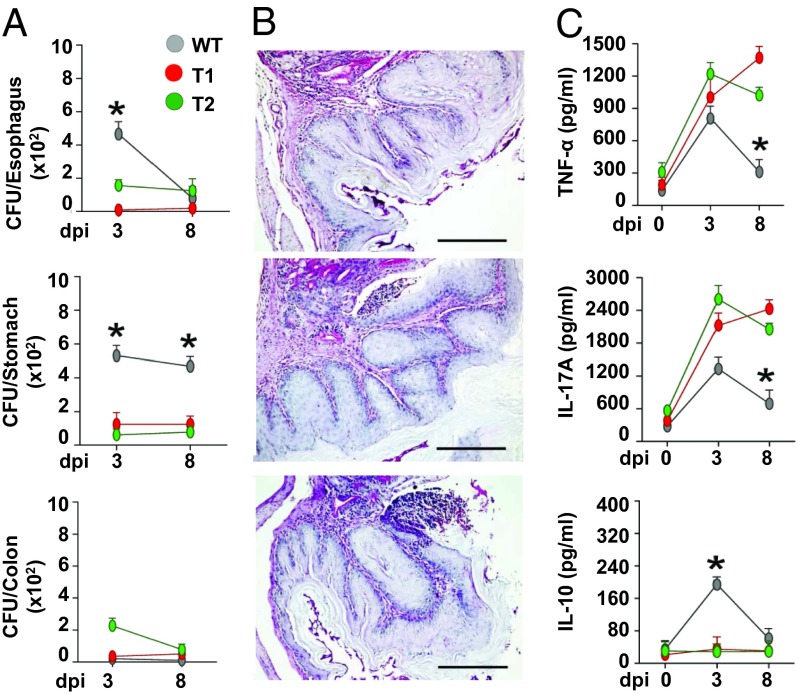
In vivo immune responses to C. albicans mistranslating strains. (A) C57BL/6 mice were infected intragastrically with control T0, T1, or T2 strains (six mice/group). Fungal growth (mean log10 CFU ± SE, n = 3) in the stomach, exophagus, and colon of infected mice was assessed at different days postinfection (dpi). (B) Stomach histology (periodic acid–Schiff staining) and mononuclear or polymorphonuclear cells staining were done at 3 dpi. Representative images of two independent experiments were depicted; bars indicate magnifications. (C) Stomach homogenates at 3 dpi time points were tested for levels of TNFα, IL-17A, and IL-10 by specific ELISA (mean values ± SD, n = 3). *P ≤ 0.01, WT strain.
Fig. 5.
Fig. 5.
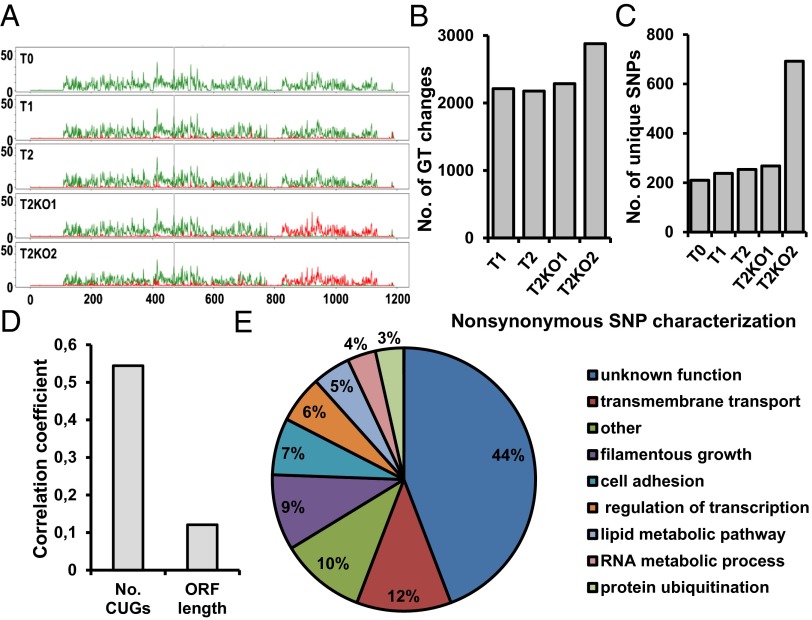
Genome sequencing of mistranslating and reverted C. albicans strains. (A) Genomic analysis of the control (T0) and misincorporating strains shows LOH in a region of chromosome 5 in T2KO1 and T2KO2. SNPs per kilobase are shaded green; density of LOH SNPs is in red, and gray vertical lines indicate the major repeat sequence. (B) Discounting LOH regions, the number of genotype (GT) changes compared with the control strain increases with the degree of mistranslation in the four altered strains. (C) The number of heterozygote SNPs unique to a specific strain increases as the degree of amino acid misincorporation increases. (D) Genes with a higher number of CUGs accumulated higher levels of unique nonsynonymous mutations in strain T2KO2. Pearson correlation was used as a measure of relationship between the number of nonsynonymous mutations and the number of CUG codons. This correlation was stronger than the relation between ORF length and nonsynonymous genotype changes. (E) Gene ontology process terms for the unique genes containing nonsynonymous genotype changes identified in T2KO2 compared with control T0. The graph represents the percentage of genes from the total of 86 containing nonsynonymous mutations.

References

    1. Yamao F, et al. UGA is read as tryptophan in Mycoplasma capricolum. Proc Natl Acad Sci USA. 1985;82(8):2306–2309. - PMC - PubMed
    1. Oba T, Andachi Y, Muto A, Osawa S. CGG: An unassigned or nonsense codon in Mycoplasma capricolum. Proc Natl Acad Sci USA. 1991;88(3):921–925. - PMC - PubMed
    1. Ohama T, Muto A, Osawa S. Role of GC-biased mutation pressure on synonymous codon choice in Micrococcus luteus, a bacterium with a high genomic GC-content. Nucleic Acids Res. 1990;18(6):1565–1569. - PMC - PubMed
    1. Meyer F, et al. UGA is translated as cysteine in pheromone 3 of Euplotes octocarinatus. Proc Natl Acad Sci USA. 1991;88(9):3758–3761. - PMC - PubMed
    1. Ohama T, et al. Non-universal decoding of the leucine codon CUG in several Candida species. Nucleic Acids Res. 1993;21(17):4039–4045. - PMC - PubMed

Publication types

MeSH terms