Assessment of the level of trace element zinc in seminal plasma of males and evaluation of its role in male infertility
- PMID: 23776785
- PMCID: PMC3657968
- DOI: 10.4103/2229-516X.91152
Assessment of the level of trace element zinc in seminal plasma of males and evaluation of its role in male infertility
Abstract
Background: Male infertility is a serious problem all over the world. Nutritional deficiency of trace element Zinc (Zn) may play a role in male infertility as Zn plays an important role not only in normal testicular development, but also in spermatogenesis and sperm motility. Deficiency of Zn is associated with hypogonadism and insufficient development of secondary sex characteristics.
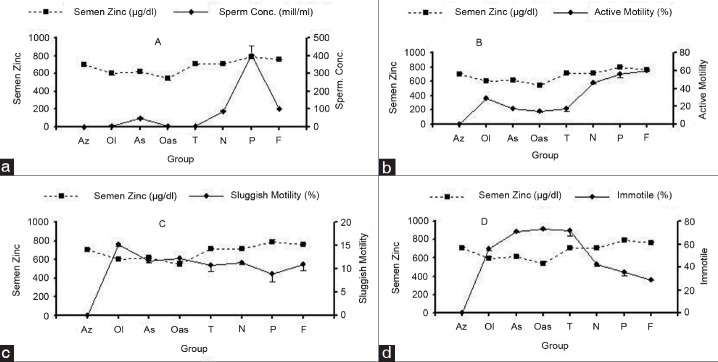
Objective: The present study was designed to analyze the level of seminal Zn among different groups of infertile patients and to correlate it with sperm concentration, active, sluggish and immotile fractions of seminal parameters, with an objective to establish the role of Zn in male infertility.
Setting and design: The present study was carried out in five- years period from 2004 to 2009. It was a descriptive analytical study with non probability sampling.
Materials and methods: Semen examination of the patients was carried out according to the standardized method of the World Health Organization. Semen Zn was estimated by color 5 Br. PAPS method.
Statistical analysis: All statistical analyses were performed by using SPSS (Version 14.0 for windows) software, by applying student's t-test.
Results: The result showed that seminal Zn was 702.92±10.60, 598.48±12.95, 617.54±9.55, 542.29±22.75, 710.36±7.87, 712.06±7.96, 789.36±21.33, and 762.06±8.99 mg/dl in azoospermic, oligozoospermic, asthenozoospermic, oligoasthenozoospermic, teratozoospermic, normozoospermic, polyzoospermic, and proven fathers group, respectively.
Conclusions: Decreased concentration of seminal Zn do affect the sperm count, while increased level of seminal plasma Zn causes decreased sperm motility; so, it is suggested that administration of Zn should be very carefully monitored in such patients having low sperm count but normal sperm motility, as adequate seminal Zn is required for normal sperm function.
Keywords: Asthenozoospsermia; azoospermia; male infertility; oligozoospermia; seminal zinc.
Conflict of interest statement
Figures
References
-
- Turek PJ. Male infertility. In: Tanagho EA, McAninch JW, editors. Smith's Genreral Urology. 17th ed. USA: The McGraw-Hill Companies; 2008. p. 684.
-
- Agarwal A, Makker K, Sharma R. Clinical relevance of oxidative stress in Male Factor Infertility. Am J Reprod Immunol. 2007;59:02–11. - PubMed
-
- Wong WY, Thomas CM, Merkus JM, Zielhuis GA, Steegers-Theunissen RP. Male factor sub-fertility: Possible causes and the impact of nutritional factors. Fertil Steril. 2000;73:435–42. - PubMed