Low triiodothyronine predicts mortality in critically ill patients
- PMID: 23776904
- PMCID: PMC3683206
- DOI: 10.4103/2230-8210.109715
Low triiodothyronine predicts mortality in critically ill patients
Abstract
Objective: Alteration in thyroid hormones are seen in critically ill patients admitted to intensive care units. Our objective was to study the thyroid hormone profile, prolactin and, glycosylated hemoglobin (HbA1c) at admission and analyze their correlation with mortality.
Materials and methods: In this single centre, prospective, observational study, 100 consecutive patients (52M; 48F) admitted to medical ICU irrespective of diagnosis were included. Patients with previous thyroid disorders and drugs affecting thyroid function were excluded. All participants underwent complete physical examination and a single fasting blood sample obtained at admission was analyzed for total triiodothyronine (T3), total thyroxine (T4), thyroid stimulating hormone (TSH), HbA1c, and prolactin. The patients were divided into two groups: Group 1 - survivors (discharged from the hospital) and Group 2 - nonsurvivors (patients succumbed to their illness inside the hospital). The data were analyzed by appropriate statistical methods and a P-value of <0.05 was considered significant.
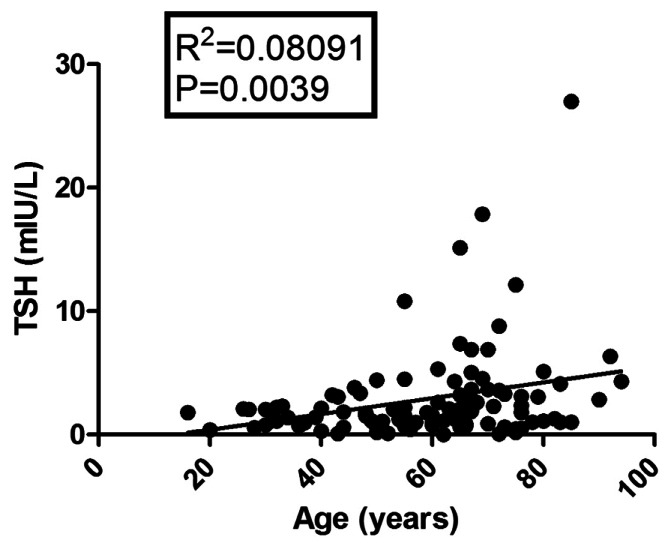
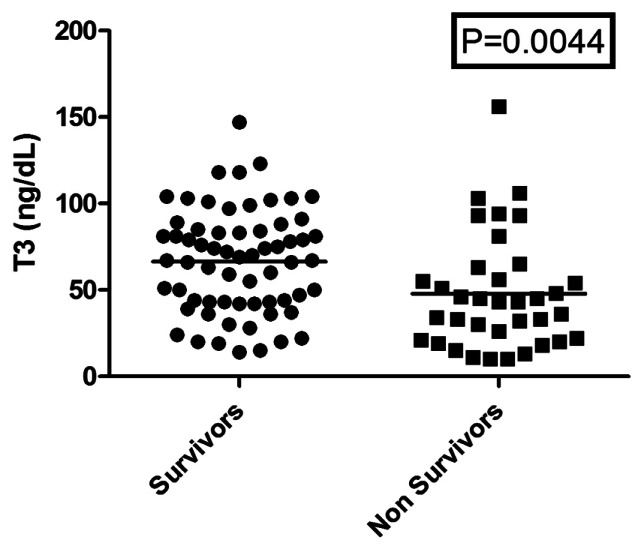
Results: The mean age of the participants was 58.7 ± 16.9 years and the mean duration of ICU stay was 3.3 ± 3.1 days. A total of 64 patients survived, whereas remaining 36 succumbed to their illness. The baseline demographic profile was comparable between survivors and nonsurvivors. Nonsurvivors had low T3 when compared with survivors (49.1 ± 32.7 vs. 66.2 ± 30.1, P = 0.0044). There was no significant difference observed between survivors and nonsurvivors with respect to T4, TSH, HbA1c, and prolactin.
Conclusion: Our study showed that low T3 is an important marker of mortality in critically ill patients. Admission HbA1c, prolactin, T4, and TSH did not vary between survivors and nonsurvivors.
Keywords: Admission HbA1c; critically ill; medical ICU; thyroid hormone profile.
Conflict of interest statement
Figures
References
-
- Van den Berghe G, de Zegher F, Bouillon R. Clinical review 95: Acute and prolonged critical illness as different neuroendocrine paradigms. J Clin Endocrinol Metab. 1998;83:1827–34. - PubMed
-
- Van den Berghe G, de Zegher F, Baxter RC, Veldhuis JD, Wouters P, Schetz M, et al. Neuroendocrinology of prolonged critical illness: Effects of exogenous thyrotropin-releasing hormone and its combination with growth hormone secretagogues. J Clin Endocrinol Metab. 1998;83:309–19. - PubMed
-
- Brent GA, Hershman JM. Thyroxine therapy in patients with severe nonthyroidal illnesses and low serum thyroxine concentration. J Clin Endocrinol Metab. 1986;63:1–8. - PubMed
-
- Van den Berghe G. Endocrine evaluation of patients with critical illness. Endocrinol Metab Clin North Am. 2003;32:385–410. - PubMed
LinkOut - more resources
Full Text Sources
Other Literature Sources