


Using qualitative evidence on patients' views to help understand variation in effectiveness of complex interventions: a qualitative comparative analysis
- PMID: 23777465
- PMCID: PMC3693880
- DOI: 10.1186/1745-6215-14-179
Using qualitative evidence on patients' views to help understand variation in effectiveness of complex interventions: a qualitative comparative analysis
Abstract
Background: Complex healthcare interventions consist of multiple components which may vary in trials conducted in different populations and contexts. Pooling evidence from trials in a systematic review is challenging because it is unclear which components are needed for effectiveness. The potential is recognised for using recipients' views to explore why some complex interventions are effective and others are not. Methods to maximise this potential are poorly developed.
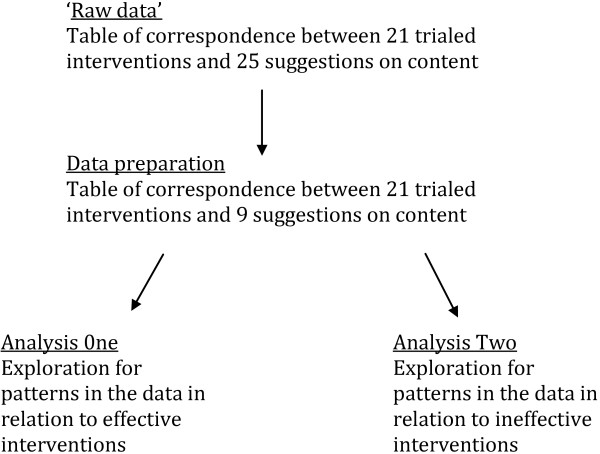
Methods: We used a novel approach to explore how patients' views may explain the disparity in effectiveness of complex interventions. We used qualitative comparative analysis to explore agreement between qualitative syntheses of data on patients' views and evidence from trialed interventions to increase adherence to treatments. We first populated data matrices to reflect whether the content of each trialed intervention could be matched with suggestions arising from patients' views. We then used qualitative comparative analysis software to identify, by a process of elimination, the smallest number of configurations (patterns) of components that corresponded with patients' suggestions and accounted for whether each intervention was effective or ineffective.
Results: We found suggestions by patients were poorly represented in interventions. Qualitative comparative analysis identified particular combinations of components corresponding with patients' suggestions and with whether an intervention was effective or ineffective. Six patterns were identified for an effective and four for an ineffective intervention. Two types of patterns arose for the effective interventions, one being didactic (providing clear information or instruction) and the other interactive (focusing on personal risk factors).
Conclusions: Our analysis highlights how data on patients' views has the potential to identify key components across trials of complex interventions or inform the content of new interventions to be trialed.
References
-
- Lamb SE, Becker C, Gillespie LD, Smith JL, Finnegan S, Potter R, Pfeiffer K. for The Taxonomy Investigators. Reporting of complex interventions in clinical trials: development of a taxonomy to classify and describe fall-prevention interventions. Trials. 2011;12:125. doi: 10.1186/1745-6215-12-125. - DOI - PMC - PubMed
-
- on behalf of the Cochrane Qualitative Research Methods Group. Qualitative research and Cochrane reviews. In: The Cochrane Collaboration, Higgins JPT, Green S, editor. Cochrane Handbook for Systematic Reviews of Interventions. Version 5.1.0 [updated March 2011] 2011. Chapter 20. Available at [ http://www.cochrane-handbook.org]
Publication types
MeSH terms
Grants and funding
LinkOut - more resources
Full Text Sources
Other Literature Sources
Medical
