Case Reports
. 2013 Jul;19(7):1041-8.
doi: 10.3201/eid1907.121365.

Transmission of Streptococcus equi subspecies zooepidemicus infection from horses to humans

Affiliations
Case Reports

Transmission of Streptococcus equi subspecies zooepidemicus infection from horses to humans

Sinikka Pelkonen et al. Emerg Infect Dis. 2013 Jul.

Abstract

Streptococcus equi subspecies zooepidemicus (S. zooepidemicus) is a zoonotic pathogen for persons in contact with horses. In horses, S. zooepidemicus is an opportunistic pathogen, but human infections associated with S. zooepidemicus are often severe. Within 6 months in 2011, 3 unrelated cases of severe, disseminated S. zooepidemicus infection occurred in men working with horses in eastern Finland. To clarify the pathogen's epidemiology, we describe the clinical features of the infection in 3 patients and compare the S. zooepidemicus isolates from the human cases with S. zooepidemicus isolates from horses. The isolates were analyzed by using pulsed-field gel electrophoresis, multilocus sequence typing, and sequencing of the szP gene. Molecular typing methods showed that human and equine isolates were identical or closely related. These results emphasize that S. zooepidemicus transmitted from horses can lead to severe infections in humans. As leisure and professional equine sports continue to grow, this infection should be recognized as an emerging zoonosis.

Keywords: Streptococcus equi subsp. zooepidemicus; abscess; bacteria; equine; meningitis; sepsis; septic arthritis; streptococci; zoonoses; β-hemolytic streptococcus.


Figures
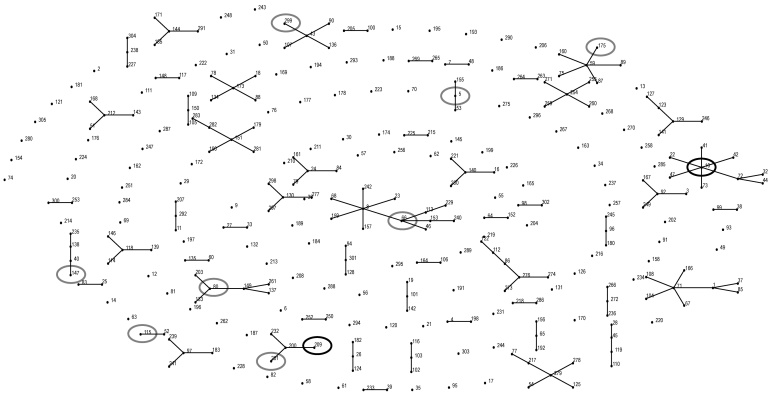
Figure 1
Figure 1
eBURST diagram (http://eburst.mlst.net) of all multilocus sequence typing (MLST) sequence types (STs) for Streptococcus equi subspecies zooepidemicus and S. equi subsp. equi recorded in the PubMLST database (http://pubmlst.org/szooepidemicus) (February 7, 2013). Single-locus variants (SLVs) are connected by a solid line. Black circles indicate strains isolated in this study from human cases and 1 horse (ST-10: Hum1, horse isolate 648/11, and Hum2; ST-209: Hum3 isolate). Gray circles indicate strains isolated from horses in this study. SzP protein sequence types were identical (GenBank accession no. AF519488) for the double-locus variants ST-201 and ST-209, whereas the SzP protein STs differed for strains not closely related by MLST (as described in Table 2).
Figure 2
Figure 2
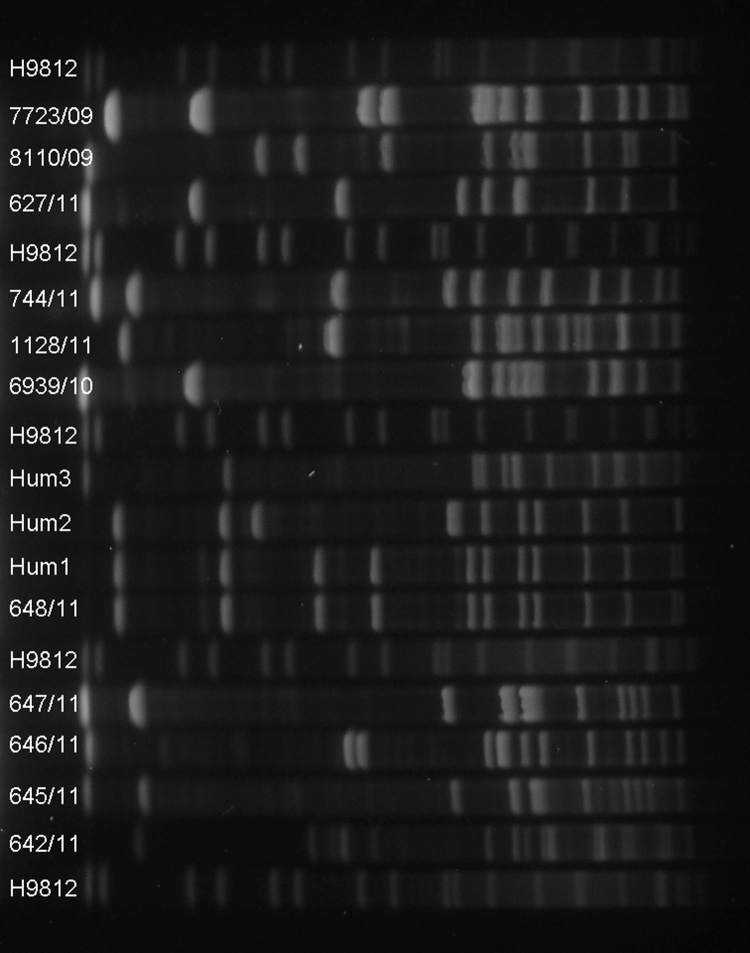
Pulsed-field gel electrophoresis of Streptococcus equi subspecies zooepidemicus isolates using SmaI. The lanes are marked with the number of the respective isolate. DNA of Salmonella enterica serovar Braenderup H9182 was used as a molecular marker.

References

    1. Timoney JF. The pathogenic equine streptococci. Vet Res. 2004;35:397–409. 10.1051/vetres:2004025 - DOI - PubMed
    1. Laus F, Preziuso S, Spaterna A, Beribe F, Tesei B, Cuteri V. Clinical and epidemiological investigation of chronic upper respiratory diseases caused by beta-haemolytic streptococci in horses. Comp Immunol Microbiol Infect Dis. 2007;30:247–60. 10.1016/j.cimid.2007.02.003 - DOI - PubMed
    1. Newton JR, Laxton R, Wood JL, Chanter N. Molecular epidemiology of Streptococcus zooepidemicus infection in naturally occurring equine respiratory disease. Vet J. 2008;175:338–45. 10.1016/j.tvjl.2007.02.018 - DOI - PubMed
    1. Blum S, Elad D, Zukin N, Lysnyansky I, Weisblith L, Perl S, et al. Outbreak of Streptococcus equi subsp. zooepidemicus infections in cats. Vet Microbiol. 2010;144:236–9. 10.1016/j.vetmic.2009.12.040 - DOI - PMC - PubMed
    1. Fan H, Wang Y, Tang F, Lu C. Determination of the mimic epitope of the M-like protein adhesin in swine Streptococcus equi subsp. zooepidemicus. BMC Microbiol. 2008;8:170. 10.1186/1471-2180-8-170 - DOI - PMC - PubMed

Publication types