. 2013 Jul;123(7):3037-41.
doi: 10.1172/JCI68035. Epub 2013 Jun 17.

Loss-of-function mutations in SIM1 contribute to obesity and Prader-Willi-like features

Affiliations

Loss-of-function mutations in SIM1 contribute to obesity and Prader-Willi-like features

Amélie Bonnefond et al. J Clin Invest. 2013 Jul.

Abstract

Sim1 haploinsufficiency in mice induces hyperphagic obesity and developmental abnormalities of the brain. In humans, abnormalities in chromosome 6q16, a region that includes SIM1, were reported in obese children with a Prader-Willi-like syndrome; however, SIM1 involvement in obesity has never been conclusively demonstrated. Here, SIM1 was sequenced in 44 children with Prader-Willi-like syndrome features, 198 children with severe early-onset obesity, 568 morbidly obese adults, and 383 controls. We identified 4 rare variants (p.I128T, p.Q152E, p.R581G, and p.T714A) in 4 children with Prader-Willi-like syndrome features (including severe obesity) and 4 other rare variants (p.T46R, p.E62K, p.H323Y, and p.D740H) in 7 morbidly obese adults. By assessing the carriers' relatives, we found a significant contribution of SIM1 rare variants to intra-family risk for obesity. We then assessed functional effects of the 8 substitutions on SIM1 transcriptional activities in stable cell lines using luciferase gene reporter assays. Three mutations showed strong loss-of-function effects (p.T46R, p.H323Y, and p.T714A) and were associated with high intra-family risk for obesity, while the variants with mild or no effects on SIM1 activity were not associated with obesity within families. Our genetic and functional studies demonstrate a firm link between SIM1 loss of function and severe obesity associated with, or independent of, Prader-Willi-like features.


Figures
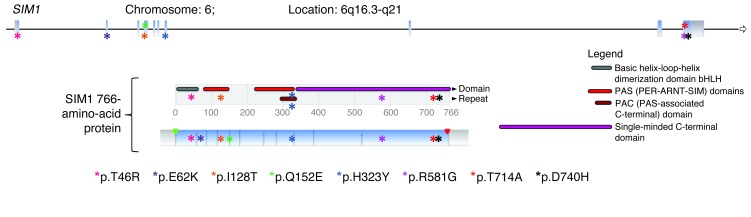
Figure 1
Figure 1. Location of the 8 SIM1 rare substitutions.
At the top are shown the substitution locations in exons. In the middle are shown the substitution locations in protein domains (only substitutions located in specific domains are reported). At the bottom are shown the substitution locations in the SIM1 766-amino-acid protein.
Figure 2
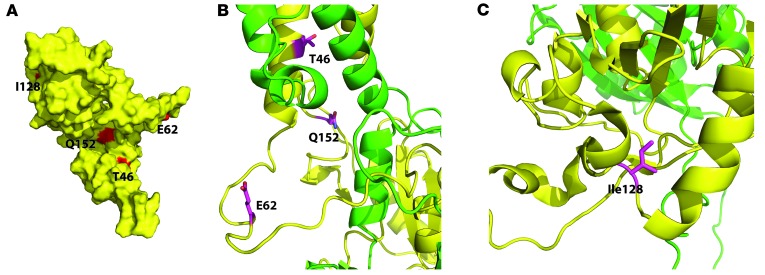
Figure 2. Homology model of the SIM1:ARNT2 heterodimer.
SIM1 is shown in yellow and ARNT2 in green. (A) Surface representation of SIM1, with amino acids that harbor variants shown in red. (B and C) Ribbons diagram of the SIM1:ARNT2 heterodimer, with amino acids that harbor variants depicted in pink.
Figure 3
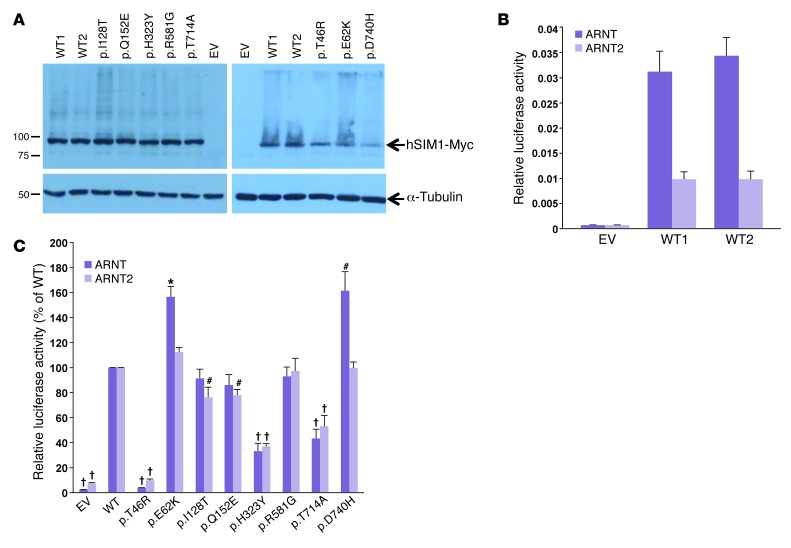
Figure 3. Functional assessment of each rare non-synonymous SIM1 variant.
(A) WT and mutant SIM1 proteins display similar levels of expression in doxycycline-induced 293 Flp-In T-Rex cells. Western blot analysis of Myc-tagged SIM1 overexpression in whole cell extracts from 2 independently derived WT stable cell lines, 8 SIM1 mutant cell lines, and 1 empty vector (EV) cell line. (B) Independently derived WT SIM1 cell lines display similar levels of activity in doxycycline-induced 293 Flp-In T-Rex cells. Two independently derived WT SIM1 293 Flp-In T-Rex stable cell lines and 1 EV cell line were analyzed. Results shown are the mean of at least 3 experiments performed in triplicate ± SEM. (C) Effect of SIM1 variants on the transcriptional activity of SIM1. Two independently derived WT SIM1 293 Flp-In T-Rex stable cell lines, 8 SIM1 mutant cell lines, and 1 EV cell line were analyzed. Results are the mean of at least 3 experiments performed in triplicate ± SEM expressed relative to the 2 WT lines, which have been combined into a single average value and normalized to 100% (*P < 0.05, #P < 0.01, P < 0.001 vs. WT).

References

    1. Michaud JL, Rosenquist T, May NR, Fan CM. Development of neuroendocrine lineages requires the bHLH-PAS transcription factor SIM1. Genes Dev. 1998;12(20):3264–3275. doi: 10.1101/gad.12.20.3264. - DOI - PMC - PubMed
    1. Michaud JL, et al. Sim1 haploinsufficiency causes hyperphagia, obesity and reduction of the paraventricular nucleus of the hypothalamus. Hum Mol Genet. 2001;10(14):1465–1473. doi: 10.1093/hmg/10.14.1465. - DOI - PubMed
    1. Holder JL, Jr, et al. Sim1 gene dosage modulates the homeostatic feeding response to increased dietary fat in mice. Am J Physiol Endocrinol Metab. 2004;287(1):E105–E113. doi: 10.1152/ajpendo.00446.2003. - DOI - PubMed
    1. Yang C, et al. Adenoviral-mediated modulation of Sim1 expression in the paraventricular nucleus affects food intake. J Neurosci. 2006;26(26):7116–7120. doi: 10.1523/JNEUROSCI.0672-06.2006. - DOI - PMC - PubMed
    1. Gilhuis HJ, van Ravenswaaij CM, Hamel BJ, Gabreels FJ. Interstitial 6q deletion with a Prader-Willi-like phenotype: a new case and review of the literature. Eur J Paediatr Neurol. 2000;4(1):39–43. doi: 10.1053/ejpn.1999.0259. - DOI - PubMed

Publication types

MeSH terms