Brown fat activation mediates cold-induced thermogenesis in adult humans in response to a mild decrease in ambient temperature
- PMID: 23780370
- PMCID: PMC3701264
- DOI: 10.1210/jc.2012-4213
Brown fat activation mediates cold-induced thermogenesis in adult humans in response to a mild decrease in ambient temperature
Abstract
Context: The contribution of brown adipose tissue (BAT) to the energy balance in humans exposed to sustainable cold has not been completely established, partially because of measurement limitations of both BAT activity and energy expenditure (EE).
Objective: The objective of the study was to characterize the role of BAT activation in cold-induced thermogenesis (CIT).
Design: This study was a single-blind, randomized crossover intervention.
Setting: The study was conducted at the National Institutes of Health Clinical Center.
Study participants: Thirty-one healthy volunteers participated in the study.
Interventions: The intervention included mild cold exposure.
Main outcomes: CIT and BAT activation were the main outcomes in this study.
Methods: Overnight EE measurement by whole-room indirect calorimeter at 24 °C or 19 °C was followed by 2-[18F]-fluoro-2-deoxy-D-glucose positron emission tomography (PET) scan. After 36 hours, volunteers crossed over to the alternate study temperature under identical conditions. BAT activity was measured in a 3-dimensional region of interest in the upper torso by comparing the uptake at the two temperatures.
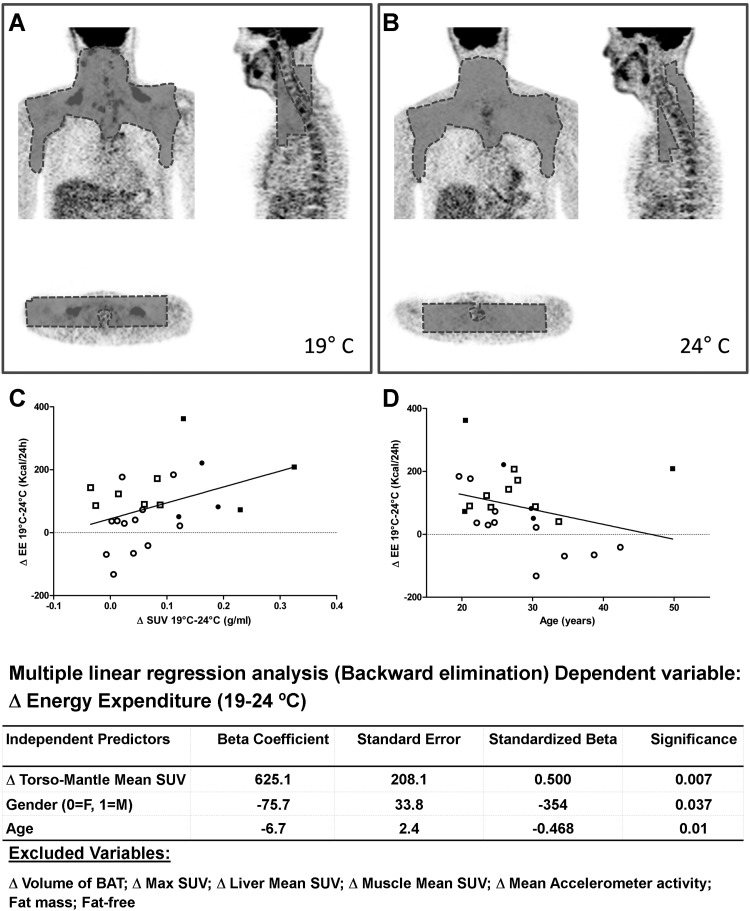
Results: Twenty-four volunteers (14 males, 10 females) had a complete data set. When compared with 24 °C, exposure at 19 °C resulted in increased EE (5.3 ± 5.9%, P < .001), indicating CIT response and mean BAT activity (10.5 ± 11.1%, P < .001). Multiple regression analysis indicated that a difference in BAT activity (P < .001), age (P = .01), and gender (P = .037) were independent contributors to individual variability of CIT.
Conclusions: A small reduction in ambient temperature, within the range of climate-controlled buildings, is sufficient to increase human BAT activity, which correlates with individual CIT response. This study uncovers for the first time a spectrum of BAT activation among healthy adults during mild cold exposure not previously recognized by conventional PET and PET-computed tomography methods. The enhancement of cold-induced BAT stimulation may represent a novel environmental strategy in obesity treatment.
Figures
References
-
- Yoneshiro T, Aita S, Matsushita M, et al. Age-related decrease in cold-activated brown adipose tissue and accumulation of body fat in healthy humans. Obesity (Silver Spring). 2011;19:1755–1760 - PubMed
-
- Claessens-van Ooijen AM, Westerterp KR, et al. Heat production and body temperature during cooling and rewarming in overweight and lean men. Obesity (Silver Spring). 2006;14:1914–1920 - PubMed
-
- Dauncey MJ. Influence of mild cold on 24 h energy expenditure, resting metabolism and diet-induced thermogenesis. Br J Nutr. 1981;45:257–267 - PubMed
-
- DeGroot DW, Havenith G, Kenney WL. Responses to mild cold stress are predicted by different individual characteristics in young and older subjects. J Appl Physiol. 2006;101:1607–1615 - PubMed
Publication types
MeSH terms
Substances
Grants and funding
LinkOut - more resources
Full Text Sources
Other Literature Sources