


Early progression of diabetic nephropathy correlates with methylglyoxal-derived advanced glycation end products
- PMID: 23780945
- PMCID: PMC3781566
- DOI: 10.2337/dc12-2689
Early progression of diabetic nephropathy correlates with methylglyoxal-derived advanced glycation end products
Abstract
Objective: Increased advanced glycation end products (AGEs) and oxidation products (OPs) are proposed to lead to progression of diabetic nephropathy (DN). We investigated the relationship between AGEs, OPs, and progression of DN in 103 subjects with type 1 diabetes participating in the Natural History of Diabetic Nephropathy Study.
Research design and methods: Mean age of subjects was 17.6±7.4 years, and mean duration of diabetes was 8.3±4.9 years. All patients were normoalbuminuric. Change in glomerular basement membrane (GBM) width from baseline to 5 years, measured using electron micrographs of renal biopsies, was our primary end point, and mesangial fractional volume was a secondary end point. Fast progressors (FPs) were defined as those in the upper quartile of GBM change, and the remaining patients were classified as slow progressors (SPs). AGEs (3-deoxyglucosone and methylglyoxal hydroimidazolones [MGHI]), carboxymethyl lysine (CML), carboxyethyl lysine (CEL), and OPs (methionine sulfoxide and 2-aminoadipic acid) were measured at year 5 by liquid chromatography/triple-quadruple mass spectroscopy on 10-K plasma filtrates.
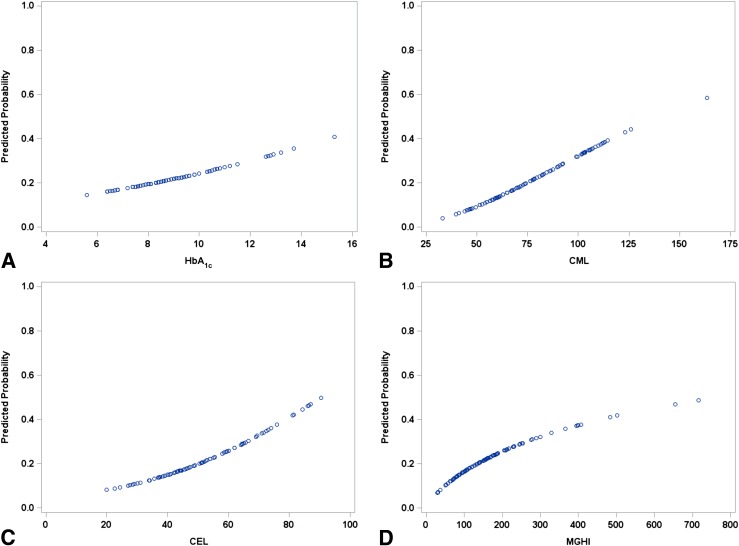
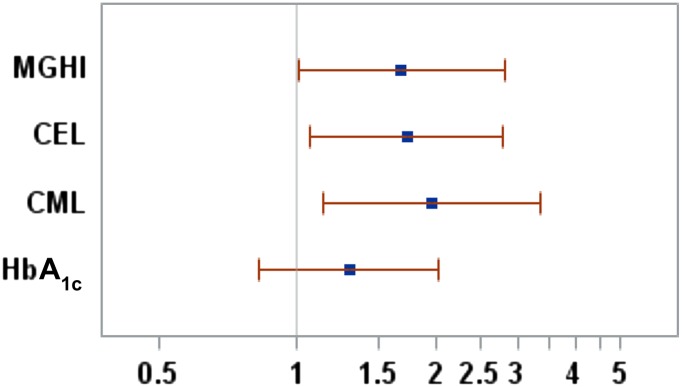
Results: We found that MGHI, CEL, and CML levels were significantly higher in FPs relative to SPs. No product predicted mesangial expansion. A model containing only HbA1c accounted for 4.7% of GBM width variation, with the total variability explained by the model increasing to 11.6% when MGHI, CEL, and CML were added to the regression model (7.9% increase). MGHI was a significant independent predictor of FP. Using a logistic regression model to relate each biomarker to the probability of a subject's classification as an FP, CML, CEL, and MGHI, but not HbA1c, showed a significant relationship to the probability of FP.
Conclusions: The results suggest that these three major AGEs may be early indicators of progression of important DN lesions.
Figures
References
-
- The Diabetes Control and Complications Trial Research Group The effect of intensive treatment of diabetes on the development and progression of long-term complications in insulin-dependent diabetes mellitus. N Engl J Med 1993;329:977–986 - PubMed
-
- Turner RC, Cull CA, Frighi V, Holman RR, UK Prospective Diabetes Study (UKPDS) Group Glycemic control with diet, sulfonylurea, metformin, or insulin in patients with type 2 diabetes mellitus: progressive requirement for multiple therapies (UKPDS 49). JAMA 1999;281:2005–2012 - PubMed
-
- Caramori ML, Fioretto P, Mauer M. The need for early predictors of diabetic nephropathy risk: is albumin excretion rate sufficient? Diabetes 2000;49:1399–1408 - PubMed
-
- Drummond K, Mauer M, International Diabetic Nephropathy Study Group The early natural history of nephropathy in type 1 diabetes: II. Early renal structural changes in type 1 diabetes. Diabetes 2002;51:1580–1587 - PubMed
-
- Mogensen CE, Christensen CK. Predicting diabetic nephropathy in insulin-dependent patients. N Engl J Med 1984;311:89–93 - PubMed
Publication types
MeSH terms
Substances
LinkOut - more resources
Full Text Sources
Other Literature Sources
Medical
Miscellaneous
