


Race/ethnicity disparities in dysglycemia among U.S. women of childbearing age found mainly in the nonoverweight/nonobese
- PMID: 23780951
- PMCID: PMC3781530
- DOI: 10.2337/dc12-2312
Race/ethnicity disparities in dysglycemia among U.S. women of childbearing age found mainly in the nonoverweight/nonobese
Abstract
Objective: To describe the burden of dysglycemia-abnormal glucose metabolism indicative of diabetes or high risk for diabetes-among U.S. women of childbearing age, focusing on differences by race/ethnicity.
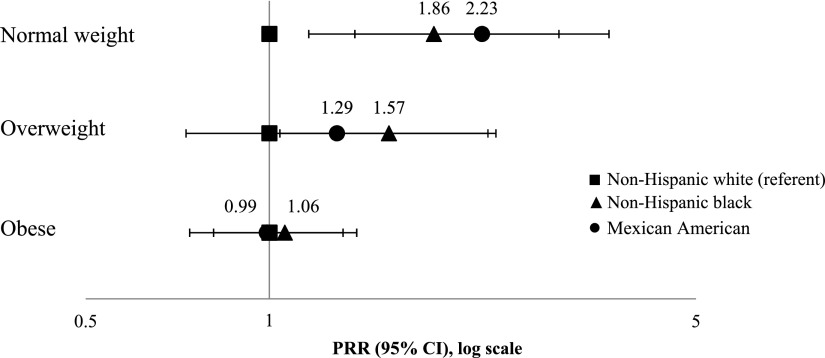
Research design and methods: Using U.S. National Health and Nutrition Examination Survey data (1999-2008), we calculated the burden of dysglycemia (i.e., prediabetes or diabetes from measures of fasting glucose, A1C, and self-report) in nonpregnant women of childbearing age (15-49 years) by race/ethnicity status. We estimated prevalence risk ratios (PRRs) for dysglycemia in subpopulations stratified by BMI (measured as kilograms divided by the square of height in meters), using predicted marginal estimates and adjusting for age, waist circumference, C-reactive protein, and socioeconomic factors.
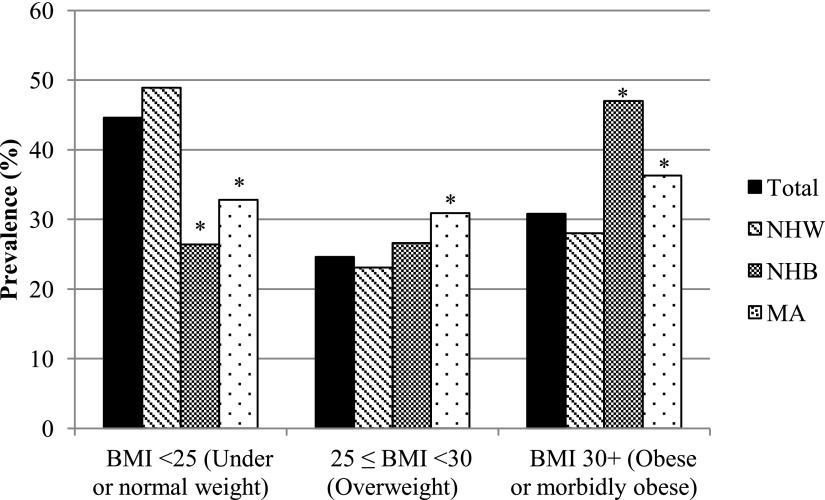
Results: Based on data from 7,162 nonpregnant women, representing>59,000,000 women nationwide, 19% (95% CI 17.2-20.9) had some level of dysglycemia, with higher crude prevalence among non-Hispanic blacks and Mexican Americans vs. non-Hispanic whites (26.3% [95% CI 22.3-30.8] and 23.8% [19.5-28.7] vs. 16.8% [14.4-19.6], respectively). In women with BMI<25 kg/m2, dysglycemia prevalence was roughly twice as high in both non-Hispanic blacks and Mexican Americans vs. non-Hispanic whites. This relative increase persisted in adjusted models (PRRadj 1.86 [1.16-2.98] and 2.23 [1.38-3.60] for non-Hispanic blacks and Mexican Americans, respectively). For women with BMI 25-29.99 kg/m2, only non-Hispanic blacks showed increased prevalence vs. non-Hispanic whites (PRRadj 1.55 [1.03-2.34] and 1.28 [0.73-2.26] for non-Hispanic blacks and Mexican Americans, respectively). In women with BMI>30 kg/m2, there was no significant increase in prevalence of dysglycemia by race/ethnicity category.
Conclusions: Our findings show that dysglycemia affects a significant portion of U.S. women of childbearing age and that disparities by race/ethnicity are most prominent in the nonoverweight/nonobese.
Figures
References
-
- Cowie CC, Rust KF, Byrd-Holt DD, et al. Prevalence of diabetes and impaired fasting glucose in adults in the U.S. population: National Health And Nutrition Examination Survey 1999-2002. Diabetes Care 2006;29:1263–1268 - PubMed
-
- Resnick HE, Valsania P, Halter JB, Lin X, Black SA. Differential effects of BMI on diabetes risk among black and white Americans. Diabetes Care 1998;21:1828–1835 - PubMed
-
- Owens MD, Beckles GL, Ho KK, Gorrell P, Brady J, Kaftarian JS. Women with diagnosed diabetes across the life stages: underuse of recommended preventive care services. J Womens Health (Larchmt) 2008;17:1415–1423 - PubMed
MeSH terms
Substances
Grants and funding
LinkOut - more resources
Full Text Sources
Other Literature Sources
Medical
Research Materials
