. 2013 Sep;41(9):1651-61.
doi: 10.1124/dmd.113.051094. Epub 2013 Jun 18.

The relative contributions of CYP3A4 and CYP3A5 to the metabolism of vinorelbine

Affiliations

The relative contributions of CYP3A4 and CYP3A5 to the metabolism of vinorelbine

Ariel R Topletz et al. Drug Metab Dispos. 2013 Sep.

Abstract

Vinorelbine is a semisynthetic vinca alkaloid used in the treatment of advanced breast and non-small cell lung cancers. Vincristine, a related vinca alkaloid, is 9-fold more efficiently metabolized by CYP3A5 than by CYP3A4 in vitro. This study quantified the relative contribution of CYP3A4 and CYP3A5 to the metabolism of vinorelbine in vitro using cDNA-expressed human cytochrome P450s (P450s) and human liver microsomes (HLMs). CYP3A4 and CYP3A5 were identified as the P450s capable of oxidizing vinorelbine using a panel of human enzymes and selective P450 inhibitors in HLMs. For CYP3A4 coexpressed with cytochrome b5 (CYP3A4+b5) and CYP3A5+b5, the Michaelis-Menten constants for vinorelbine were 2.6 and 3.6 μM, respectively, but the Vmax of 1.4 pmol/min/pmol was common to both enzymes. In HLMs, the intrinsic clearance of vinorelbine metabolism was highly correlated with CYP3A4 activity, and there was no significant difference in intrinsic clearance between CYP3A5 high and low expressers. When radiolabeled vinorelbine substrate was used, there were clear qualitative differences in metabolite formation fingerprints between CYP3A4+b5 and CYP3A5+b5 as determined by NMR and mass spectrometry analysis. One major metabolite (M2), a didehydro-vinorelbine, was present in both recombinant and microsomal systems but was more abundant in CYP3A4+b5 incubations. We conclude that despite the equivalent efficiency of recombinant CYP3A4 and CYP3A5 in vinorelbine metabolism the polymorphic expression of CYP3A5, as shown by the kinetics with HLMs, may have a minimal effect on systemic clearance of vinorelbine.


Figures
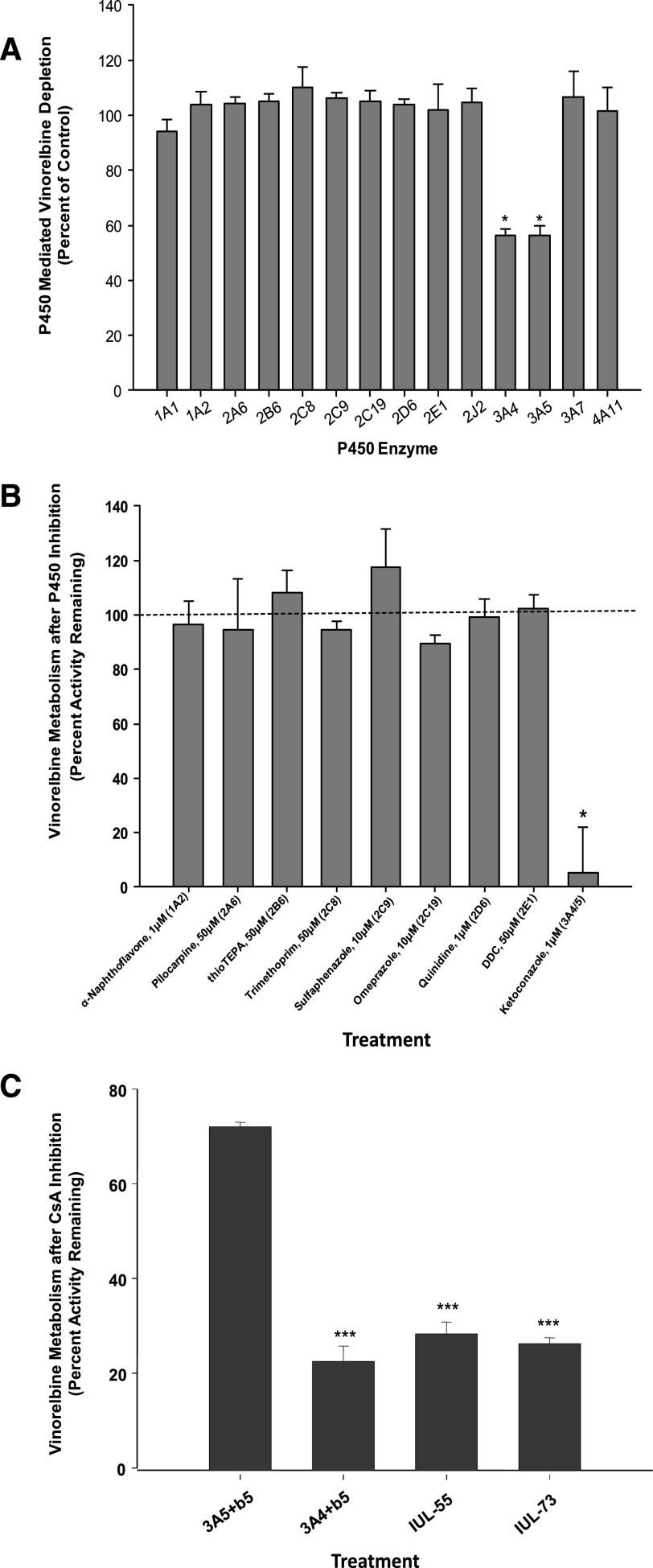
Fig. 1.
Fig. 1.
(A) Percentage of depletion from control for a panel of cytochrome P450 enzymes incubated with vinorelbine. Incubations were performed in duplicate, using 5 µM vinorelbine and 200 pmol/ml of P450 for 60 minutes. The control was insect cell protein that did not express P450 enzymes. CYP3A4 and CYP3A5 were the only enzymes that showed a statistically significant difference in vinorelbine depletion from the control (*P < 0.001). (B) Remaining percentage of active depletion of vinorelbine by HLMs normalized to control after chemical inhibition by hepatic P450s. Vinorelbine (1 µM) was incubated for 12 minutes with 0.8 mg/ml of protein from pooled HLMs and each chemical inhibitor at their respective Ki concentrations. The control contained no chemical inhibitors. Only the inhibition of CYP3A by ketoconazole (1 µM) showed significantly diminished activity (*P < 0.001). (C) Inhibition of vinorelbine metabolism by cyclosporine A in CYP3A4 and CYP3A5 supersomes and HLMs with high CYP3A5 (IUL-73) and low CYP3A5 (IUL-55) expression. (***P < 0.001).
Fig. 2.
Fig. 2.
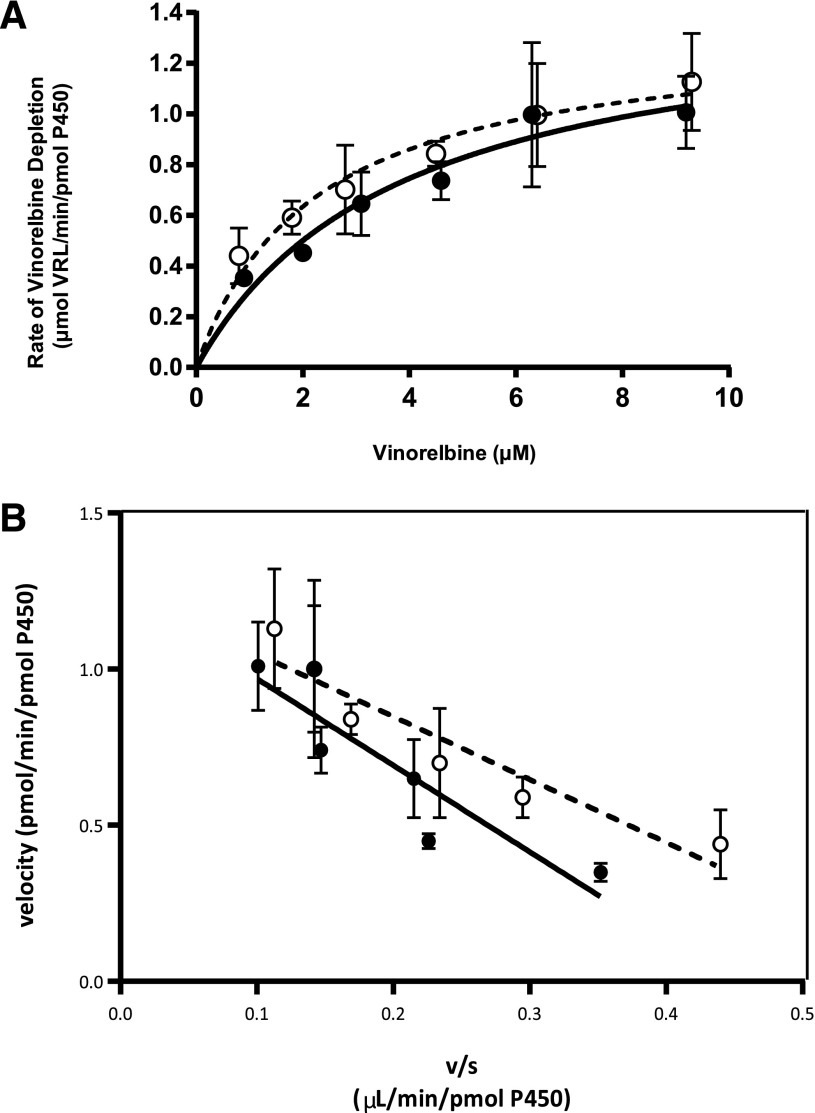
(A) Vinorelbine depletion rate plotted against vinorelbine concentration when incubated with CYP3A4+b5 (○) or CYP3A5+b5 (●). (B) Eadie-Hofstee plots of CYP3A4+b5 (○) or CYP3A5+b5 (●)-mediated metabolism of vinorelbine. All incubations were performed in triplicate with 30 pmol/ml CYP3A4+b5 or CYP3A5+b5 for 5 minutes. Lines represent the best fit to the Michaelis-Menten equation for vinorelbine metabolism by CYP3A4+b5 (dotted line) or CYP3A5+b5 (solid line) as determined using WinNonLin.
Fig. 3.
Fig. 3.
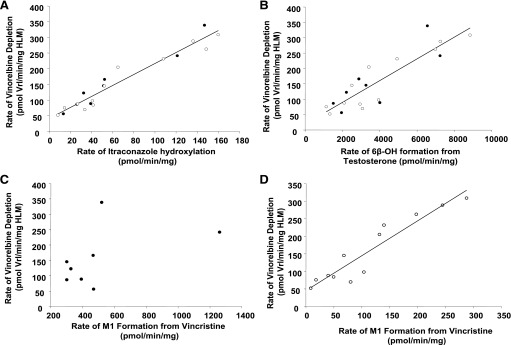
Relationships between rate of vinorelbine metabolism by HLMs and the rates of hydroxy-itraconazole (OH-ITZ) formation from itraconazole (A; r2 = 0.93, P < 0.001), testosterone 6β -hydroxylation (B; r2 = 0.78, P < 0.001) and vincristine M1 formation in HLMs with high CYP3A5 protein content (C; r2 = 0.23, P = 0.224) and low protein content (D; r2 = 0.89, P < 0.001). Microsomes are designated by CYP3A5 protein content: high (●) and low (○). All incubations were performed in triplicate; 1 μM vinorelbine and 0.8 mg/ml protein content per HLM were incubated for 12 minutes.
Fig. 4.
Fig. 4.
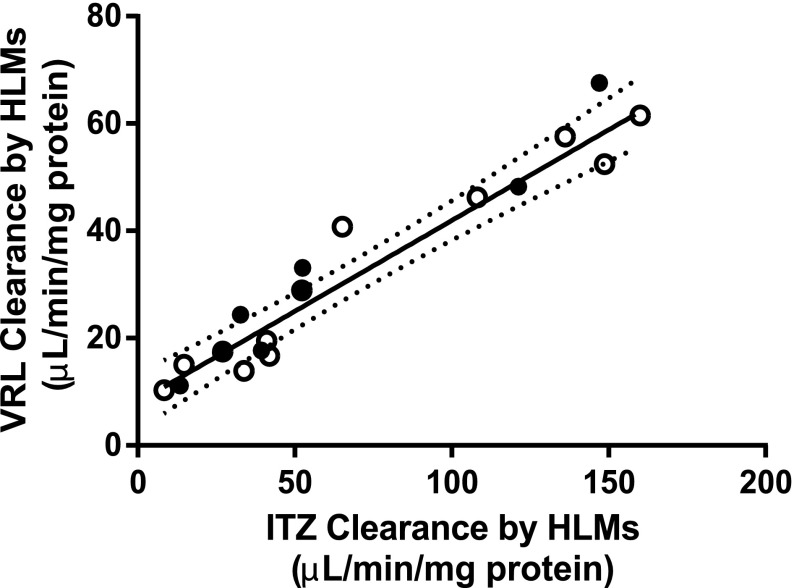
Formation of hydroxy-itraconazole (OH-ITZ) (µl/min/mg protein) plotted against vinorelbine clearance (µl/min/mg protein) between HLMs with high (●) and low (○) CYP3A5 protein content. Regression line and 95% confidence intervals represent the correlation between HLMs with low CYP3A5 content (○), in which clearance is predominantly CYP3A4-mediated. The majority of HLMs regardless of CYP3A5 expression fell within the 95% confidence intervals. After correcting for CYP3A4 contribution, CYP3A5 did not significantly contribute to vinorelbine clearance in HLMs.
Fig. 5.
Fig. 5.
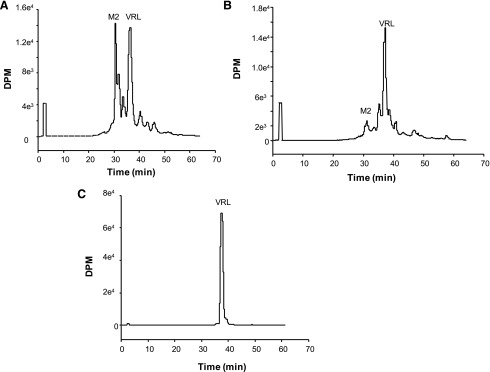
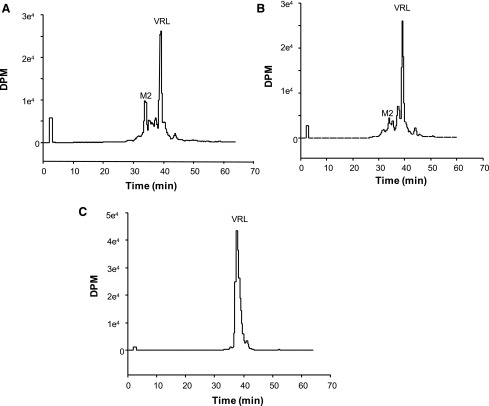
Radiochromatograms of 3H vinorelbine (dpm) incubated with CYP3A4+b5 (A), CYP3A5+b5 (B), or non-P450-expressing insect control (C) supersomes. Fractions were separated by HPLC, collected in 20-second intervals, and quantified by scintillation count. The relative formation of M2 appears to be 3-fold higher when vinorelbine is incubated with CYP3A4+b5 than with CYP3A5+b5. M2, metabolite 2.
Fig. 6.
Fig. 6.
Radiochromatograms of 3H vinorelbine (dpm) incubated with HLMs IUL-55 (low CYP3A5 protein content; A), IUL-73 (high CYP3A5 protein content; B), or IUL-73 lacking NADPH as control (C). Fractions were separated by HPLC, collected in 20-second intervals, and quantified by scintillation count. The relative detection of M2 is 1.5-fold higher for IUL-55 than by IUL-73 (M2, metabolite 2). Based upon supersome data, and that both IUL-55 and IUL-73 contained similar amounts of CYP3A4 protein, the difference in M2 detection may be due to subsequent metabolism of M2 by CYP3A5 in IUL-73.

References

    1. Baker SD, Sparreboom A. (2006) Predicting vinorelbine disposition and toxicity: does BSA provide more than a “bad statistical association”? J Clin Oncol 24:2412–2413 - PubMed
    1. Bapiro TE, Egnell AC, Hasler JA, Masimirembwa CM. (2001) Application of higher throughput screening (HTS) inhibition assays to evaluate the interaction of antiparasitic drugs with cytochrome P450s. Drug Metab Dispos 29:30–35 - PubMed
    1. Beulz-Riché D, Grudé P, Puozzo C, Sautel F, Filaquier C, Riché C, Ratanasavanh D. (2005) Characterization of human cytochrome P450 isoenzymes involved in the metabolism of vinorelbine. Fundam Clin Pharmacol 19:545–553 - PubMed
    1. de Graeve J, van Heugen JC, Zorza G, Fahy J, Puozzo C. (2008) Metabolism pathway of vinorelbine (Navelbine) in human: characterisation of the metabolites by HPLC-MS/MS. J Pharm Biomed Anal 47:47–58 - PubMed
    1. Dennison JB, Jones DR, Renbarger JL, Hall SD. (2007) Effect of CYP3A5 expression on vincristine metabolism with human liver microsomes. J Pharmacol Exp Ther 321:553–563 - PubMed

Publication types

LinkOut - more resources