


Aluminum exclusion and aluminum tolerance in woody plants
- PMID: 23781222
- PMCID: PMC3679494
- DOI: 10.3389/fpls.2013.00172
Aluminum exclusion and aluminum tolerance in woody plants
Abstract
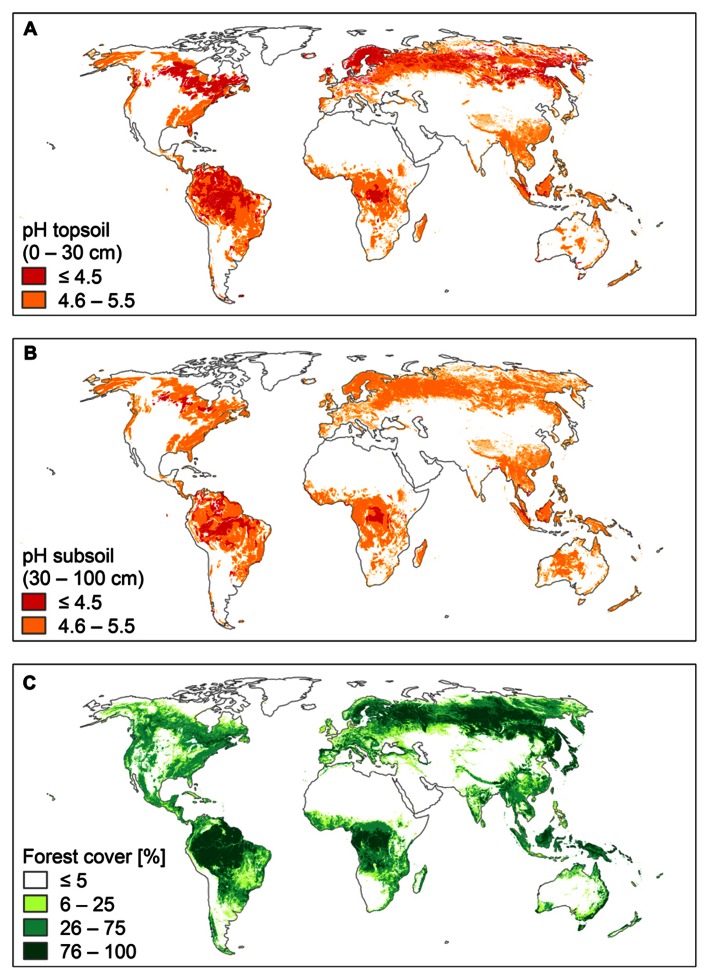
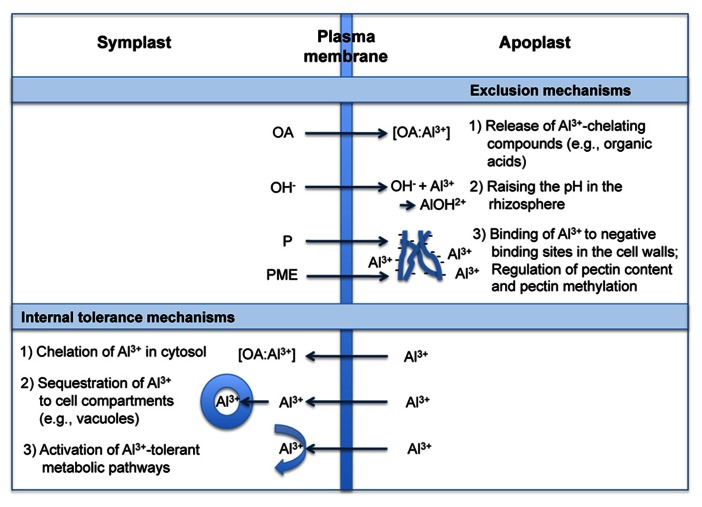
The aluminum (Al) cation Al(3) (+) is highly rhizotoxic and is a major stress factor to plants on acid soils, which cover large areas of tropical and boreal regions. Many woody plant species are native to acid soils and are well adapted to high Al(3) (+) conditions. In tropical regions, both woody Al accumulator and non-Al accumulator plants occur, whereas in boreal regions woody plants are non-Al accumulators. The mechanisms of these adaptations can be divided into those that facilitate the exclusion of Al(3) (+) from root cells (exclusion mechanisms) and those that enable plants to tolerate Al(3) (+) once it has entered the root and shoot symplast (internal tolerance mechanisms). The biochemical and molecular basis of these mechanisms have been intensively studied in several crop plants and the model plant Arabidopsis. In this review, we examine the current understanding of Al(3) (+) exclusion and tolerance mechanisms from woody plants. In addition, we discuss the ecology of woody non-Al accumulator and Al accumulator plants, and present examples of Al(3) (+) adaptations in woody plant populations. This paper complements previous reviews focusing on crop plants and provides insights into evolutionary processes operating in plant communities that are widespread on acid soils.
Keywords: acid soils; adaptation; aluminum; organic acids; resistance; tolerance; toxicity.
Figures
References
-
- Ahonen-Jonnarth U., van Hees P. A. W., Lundström U. S., Finlay R. D. (2000). Organic acids produced by mycorrhizal Pinus sylvestris exposed to elevated aluminium and metal concentrations. New Phytol. 146 557–567 10.1046/j.1469-8137.2000.00653.x - DOI
-
- Blaser P., Zysset M., Zimmermann S., Luster J. (1999). Soil acidification in southern Switzerland between 1987 and 1997: a case study based on the critical load concept. Environ. Sci. Technol. 33 2383–2389 10.1021/es9808144 - DOI
-
- Brunner I., Brodbeck S., Walthert L. (2002). Fine root chemistry, starch concentration, and ‘vitality’ of subalpine conifer forests in relation to soil pH. For. Ecol. Manag. 165 75–84 10.1016/S0378-1127(01)00633-8 - DOI
LinkOut - more resources
Full Text Sources
Other Literature Sources
