


Androgen receptor (AR) physiological roles in male and female reproductive systems: lessons learned from AR-knockout mice lacking AR in selective cells
- PMID: 23782840
- PMCID: PMC4076350
- DOI: 10.1095/biolreprod.113.109132
Androgen receptor (AR) physiological roles in male and female reproductive systems: lessons learned from AR-knockout mice lacking AR in selective cells
Abstract
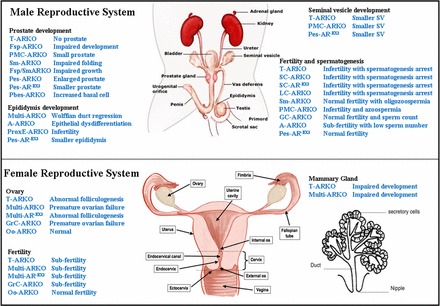
Androgens/androgen receptor (AR) signaling is involved primarily in the development of male-specific phenotypes during embryogenesis, spermatogenesis, sexual behavior, and fertility during adult life. However, this signaling has also been shown to play an important role in development of female reproductive organs and their functions, such as ovarian folliculogenesis, embryonic implantation, and uterine and breast development. The establishment of the testicular feminization (Tfm) mouse model exploiting the X-linked Tfm mutation in mice has been a good in vivo tool for studying the human complete androgen insensitivity syndrome, but this mouse may not be the perfect in vivo model. Mouse models with various cell-specific AR knockout (ARKO) might allow us to study AR roles in individual types of cells in these male and female reproductive systems, although discrepancies are found in results between labs, probably due to using various Cre mice and/or knocking out AR in different AR domains. Nevertheless, no doubt exists that the continuous development of these ARKO mouse models and careful studies will provide information useful for understanding AR roles in reproductive systems of humans and may help us to develop more effective and more specific therapeutic approaches for reproductive system-related diseases.
Keywords: ARKO mice; androgen receptor; androgens; fertility; male sexual function; reproductive system; sex differentiation; spermatogenesis.
Figures
References
-
- Heemers HV, Tindall DJ. Androgen receptor (AR) coregulators: a diversity of functions converging on and regulating the AR transcriptional complex. Endocr Rev 2007; 28: 778 808. - PubMed
-
- Heinlein CA, Chang C. The roles of androgen receptors and androgen-binding proteins in nongenomic androgen actions. Mol Endocrinol 2002; 16: 2181 2187. - PubMed
-
- Patrao MT, Silva EJ, Avellar MC. Androgens and the male reproductive tract: an overview of classical roles and current perspectives. Arq Bras Endocrinol Metab 2009; 53: 934 945. - PubMed
-
- Cooke PS, Young P, Cunha GR. Androgen receptor expression in developing male reproductive organs. Endocrinology 1991; 128: 2867 2873. - PubMed
Publication types
MeSH terms
Substances
Grants and funding
LinkOut - more resources
Full Text Sources
Other Literature Sources
Molecular Biology Databases
Research Materials
