


Innovative interventions to promote positive dental health behaviors and prevent dental caries in preschool children: study protocol for a randomized controlled trial
- PMID: 23782918
- PMCID: PMC3658868
- DOI: 10.1186/1745-6215-14-118
Innovative interventions to promote positive dental health behaviors and prevent dental caries in preschool children: study protocol for a randomized controlled trial
Abstract
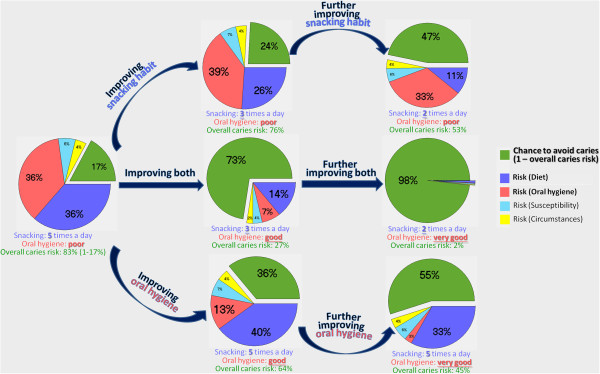
Background: Dental caries (tooth decay) is highly prevalent and is largely attributable to unhealthy self-care behaviors (diet and oral hygiene). The conventional (health) education (CE), focusing on disseminating information and giving normative advice, often fails to achieve sustained behavioral changes. This study incorporates two innovative elements into CE: (i) motivational interviewing (MI), a client-centered counseling for changing behaviors, and (ii) an interactive caries risk assessment (RA) tool, which is devised to facilitate dental counseling and may enhance MI in several ways. Through a randomized, controlled, evaluator-blinded trial, three intervention schemes (CE, CE+MI, and CE+MI+RA) will be compared for their effectiveness in eliciting dentally healthy behaviors and preventing caries in preschool children.
Methods/design: This study targets 3-year-old children who are at a critical stage for embedding health habits. Children with unfavorable dental behaviors (insufficient toothbrushing and/or frequent snacking) and their parents will be recruited from 12 participating kindergartens. Parent-child dyads (n=690) will be randomly assigned into three groups. In the first group (CE), oral health information and advice will be delivered to parents through pamphlets. In the second group (CE+MI), in addition to the pamphlets, individual MI counseling with each parent will be performed by one of two trained dental hygienists. In the third group (CE+MI+RA), besides pamphlets and MI, interactive RA will be integrated into MI to motivate parents and facilitate their informed decision making and goal planning. At baseline and after 12 and 24 months, parents will complete a questionnaire and children will undergo a dental examination. The effectiveness of the intervention schemes will be compared over 12 and 24 months. The primary outcome will be caries increment in children and proportion of caries-free children. Secondary outcomes will be changes in parental efficacy for protecting children's oral health and changes in children's dental behaviors.
Discussion: Motivating and empowering parents to cultivate dentally healthy habits of young children presents both promises and challenges. With careful methodological considerations, this study is expected to provide scientific evidence for public health workers, dentists, and dental auxiliaries (nurses and hygienists) to choose appropriate interventions to advance children's oral health.
Trial registration: HKCTR-1455.
Figures
References
-
- World Health Organization. Changing levels of dental caries experience (DMFT) among 12-year-olds in developed and developing countries. Geneva: WHO; 2001.
-
- American Academy of Pediatric Dentistry. Policy on Early Childhood Caries (ECC): classifications, consequences, and preventive strategies. Pediatr Dent. 2009;30:40–43. - PubMed
-
- U.S. Department of Health and Human Services. Trends in oral health status: United States, 1988-1994 and 1999-2004. Vital Health Stat. 2007;11(248):1–92. - PubMed
-
- Hong Kong Department of Health. Oral Health Survey 2001. Hong Kong Department of Health: Hong Kong SAR; 2003.
-
- U.S. Department of Health and Human Services. Oral health in America: a report of the Surgeon General. J Calif Dent Assoc. 2000;28:685–695. - PubMed
Publication types
MeSH terms
LinkOut - more resources
Full Text Sources
Other Literature Sources
Medical
