


A consortium of Aggregatibacter actinomycetemcomitans, Streptococcus parasanguinis, and Filifactor alocis is present in sites prior to bone loss in a longitudinal study of localized aggressive periodontitis
- PMID: 23784124
- PMCID: PMC3754677
- DOI: 10.1128/JCM.00729-13
A consortium of Aggregatibacter actinomycetemcomitans, Streptococcus parasanguinis, and Filifactor alocis is present in sites prior to bone loss in a longitudinal study of localized aggressive periodontitis
Abstract
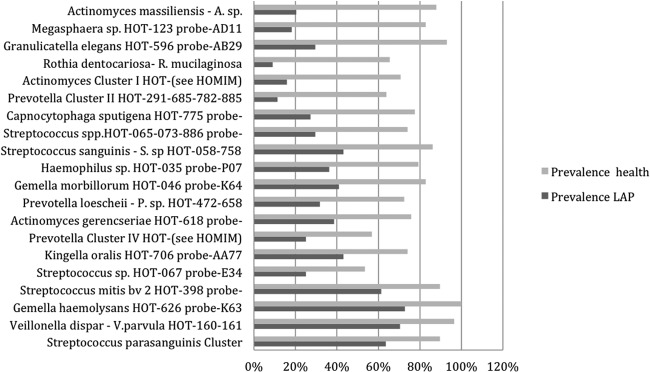
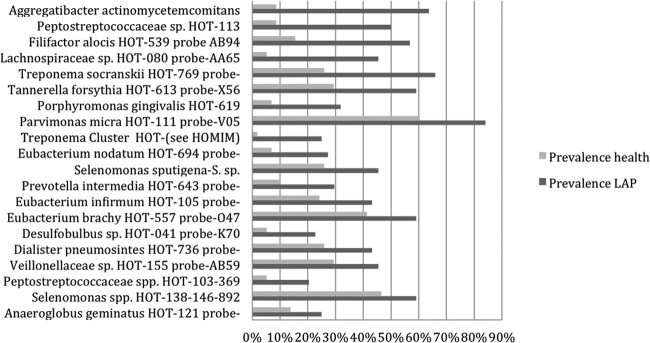
Aggregatibacter actinomycetemcomitans-induced localized aggressive periodontitis (LAP) in African-American adolescents has been documented but is poorly understood. Two thousand fifty-eight adolescents aged 11 to 17 years were screened for their periodontal status and the presence of A. actinomycetemcomitans in their oral cavity. Seventy-one A. actinomycetemcomitans-negative and 63 A. actinomycetemcomitans-positive periodontally healthy subjects were enrolled, sampled, examined, and radiographed yearly for 3 years. Gingival and periodontal pocket depth and attachment levels were recorded. Disease presentation was characterized by bone loss (BL). Subgingival sites were sampled every 6 months to assess (i) the role of A. actinomycetemcomitans in BL and (ii) the association of A. actinomycetemcomitans and other microbes in their relationships to BL. Sixteen of 63 subjects with A. actinomycetemcomitans developed BL (the other 47 subjects with A. actinomycetemcomitans had no BL). No A. actinomycetemcomitans-negative subjects developed BL. Human oral microbe identification microarray (HOMIM) was used for subgingival microbial assessment. On a subject level, pooled data from A. actinomycetemcomitans-positive subjects who remained healthy had higher prevalences of Streptococcus and Actinomyces species, while A. actinomycetemcomitans-positive subjects with BL had higher prevalences of Parvimonas micra, Filifactor alocis, A. actinomycetemcomitans, and Peptostreptococcus sp. human oral taxon 113 (HOT-113). At vulnerable sites, A. actinomycetemcomitans, Streptococcus parasanguinis, and F. alocis levels were elevated prior to BL. In cases where the three-organism consortium (versus A. actinomycetemcomitans alone) was detected, the specificity for detecting sites of future BL increased from 62% to 99%, with a sensitivity of 89%. We conclude that detecting the presence of A. actinomycetemcomitans, S. parasanguinis, and F. alocis together indicates sites of future BL in LAP. A synergistic interaction of this consortium in LAP causation is possible and is the subject of ongoing research.
Figures
References
-
- Newman MG, Socransky SS, Savitt ED, Propas DA, Crawford A. 1976. Studies of the microbiology of periodontosis. J. Periodontol. 47:373–379 - PubMed
-
- Slots J. 1976. The predominant cultivable organisms in juvenile periodontitis. Scand. J. Dent. Res. 84:1–10 - PubMed
-
- Bogert M, Berthold P, Brightman V, Craig R, DiRienzo JM, Lai C-H, Lally E, Oler J, Rams T, Shenker B, Slots J, Taichman NS, Tisot R. 1989. Longitudinal study of LJP families—two year surveillance. J. Dental Res. 68:312
-
- Fine DH, Markowitz K, Furgang D, Fairlie K, Ferrandiz J, Nasri C, McKiernan M, Gunsolley J. 2007. Aggregatibacter actinomycetemcomitans and its relationship to initiation of localized aggressive periodontitis: longitudinal cohort study of initially healthy adolescents. J. Clin. Microbiol. 45:3859–3869 - PMC - PubMed
Publication types
MeSH terms
Grants and funding
LinkOut - more resources
Full Text Sources
Other Literature Sources
Research Materials
