


Prediction of severe, persistent activity-of-daily-living disability in older adults
- PMID: 23785110
- PMCID: PMC3783096
- DOI: 10.1093/aje/kwt097
Prediction of severe, persistent activity-of-daily-living disability in older adults
Abstract
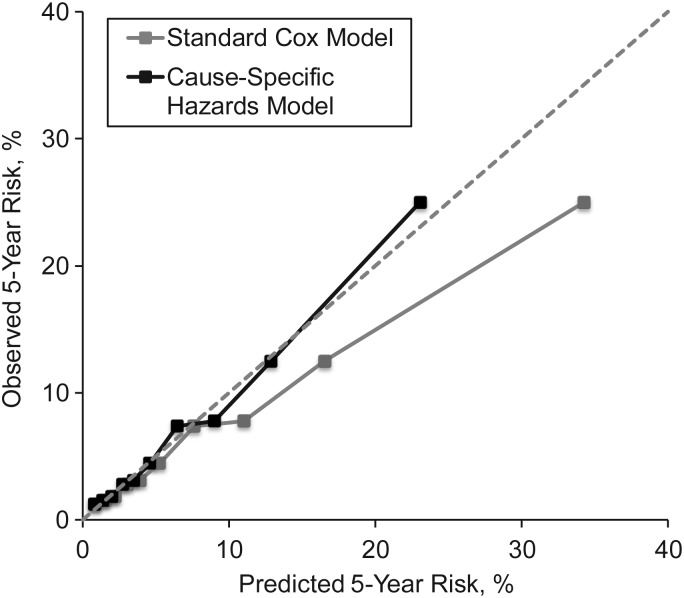
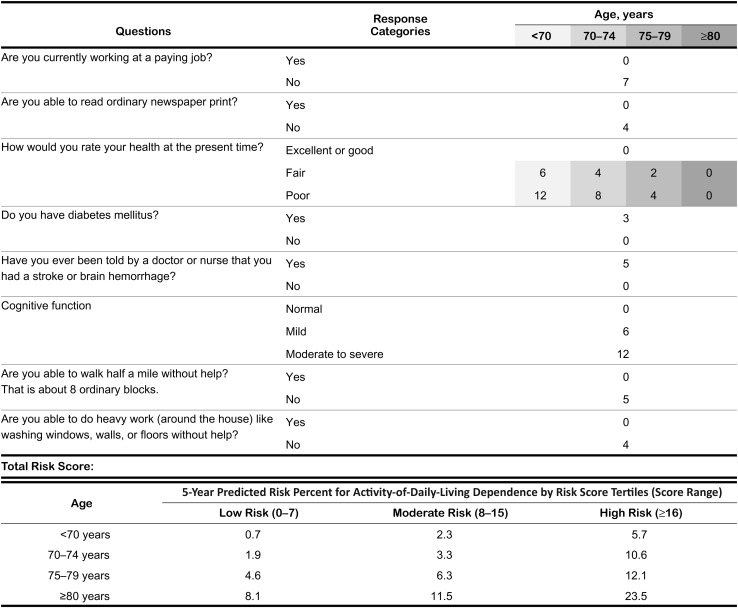
In a prospective cohort of nondisabled adults aged 65 years or more in the Established Populations for Epidemiologic Studies of the Elderly (1981-1987 and 1985-1992), we used a competing risk approach to predict the 5-year risk of severe, persistent activities-of-daily-living (ADLs) disability, defined as dependence in ≥3 ADLs for 2 consecutive annual interviews or for 1 interview followed by death in the subsequent year. During 5 years, 6.8% developed severe, persistent ADL dependence, and 14.6% died without severe, persistent ADL dependence in the derivation cohort (n = 8,301); the corresponding percentages were 6.8% and 15.8% in the validation cohort (n = 4,177). A model based on age, current employment, visual impairment, self-rated health, diabetes mellitus, history of stroke or brain hemorrhage, cognitive function, and self-reported physical function showed good calibration. Discrimination, assessed by C statistics, for <70, 70-74, 75-79, and ≥80 years, was 0.75, 0.74, 0.65, and 0.66 in the derivation cohort and 0.70, 0.72, 0.70, and 0.65 in the validation cohort, respectively. In conclusion, a simple risk score based on routinely available clinical information can predict severe, persistent disability in 5 years. Future studies should examine whether physical performance measures can further improve prediction in the oldest old.
Keywords: activities of daily living; aged; prognosis.
Figures
References
-
- Congressional Budget Office. Washington, DC: Congressional Budget Office; 2004. Financing long-term care for the elderly http://www.cbo.gov/ftpdocs/54xx/doc5400/04-26-LongTermCare.pdf. (Accessed October 20, 2011)
-
- Soldo BJ, Manton KG. Health status and service needs of the oldest old: current patterns and future trends. Milbank Mem Fund Q Health Soc. 1985;63(2):286–319. - PubMed
-
- Branch L, Jette A, Evashwick C, et al. Toward understanding elders’ health service utilization. J Community Health. 1981;7(2):80–92. - PubMed
Publication types
MeSH terms
Grants and funding
LinkOut - more resources
Full Text Sources
Other Literature Sources
Medical
