


Analogous responses in the nucleus accumbens and cingulate cortex to pain onset (aversion) and offset (relief) in rats and humans
- PMID: 23785130
- PMCID: PMC3763092
- DOI: 10.1152/jn.00284.2013
Analogous responses in the nucleus accumbens and cingulate cortex to pain onset (aversion) and offset (relief) in rats and humans
Abstract
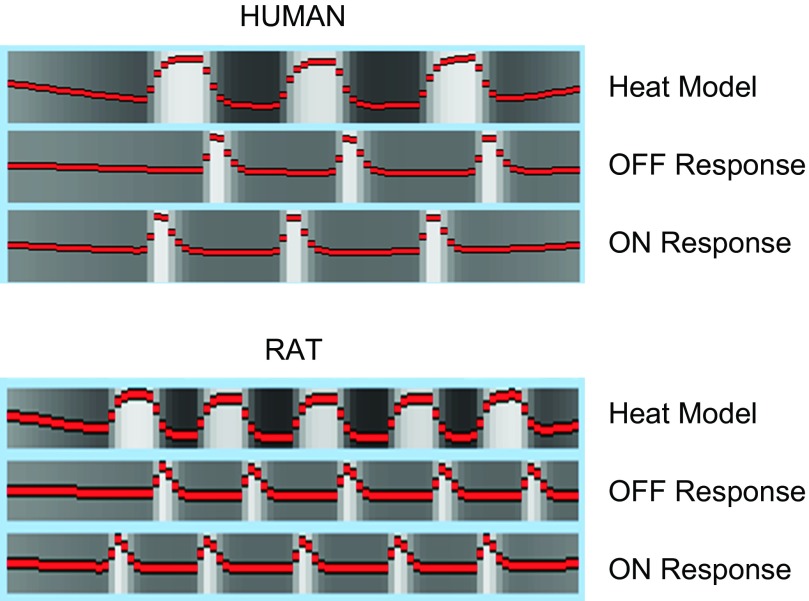
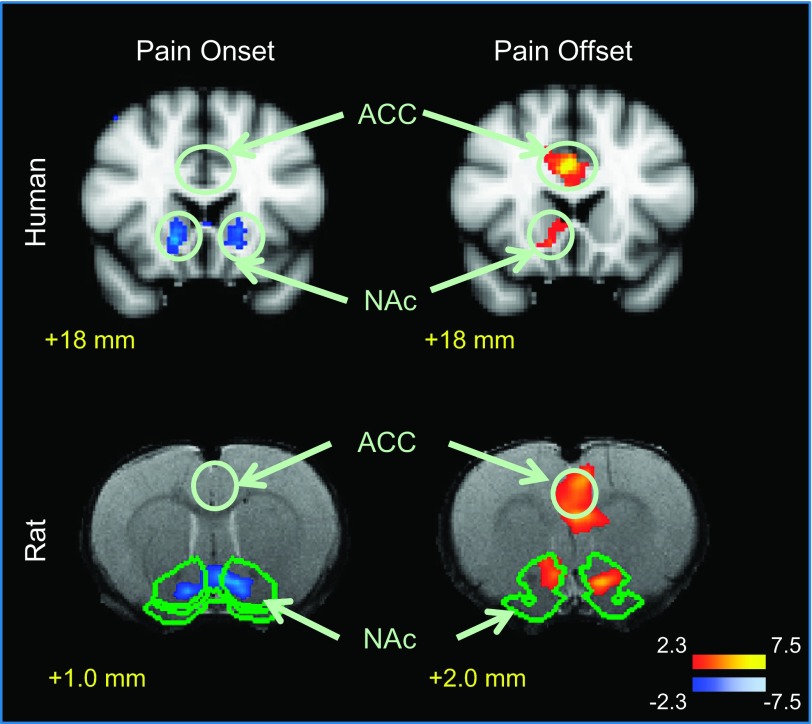
In humans, functional magnetic resonance imaging (fMRI) activity in the anterior cingulate cortex (ACC) and the nucleus accumbens (NAc) appears to reflect affective and motivational aspects of pain. The responses of this reward-aversion circuit to relief of pain, however, have not been investigated in detail. Moreover, it is not clear whether brain processing of the affective qualities of pain in animals parallels the mechanisms observed in humans. In the present study, we analyzed fMRI blood oxygen level-dependent (BOLD) activity separately in response to an onset (aversion) and offset (reward) of a noxious heat stimulus to a dorsal part of a limb in both humans and rats. We show that pain onset results in negative activity change in the NAc and pain offset produces positive activity change in the ACC and NAc. These changes were analogous in humans and rats, suggesting that translational studies of brain circuits modulated by pain are plausible and may offer an opportunity for mechanistic investigation of pain and pain relief.
Keywords: anterior cingulate cortex; aversion and reward; fMRI; nucleus accumbens; pain.
Figures
References
-
- Aharon I, Becerra L, Chabris CF, Borsook D. Noxious heat induces fMRI activation in two anatomically distinct clusters within the nucleus accumbens. Neurosci Lett 392: 159–164, 2006 - PubMed
-
- Albrechet-Souza L, Carvalho MC, Brandao ML. D1-like receptors in the nucleus accumbens shell regulate the expression of contextual fear conditioning and activity of the anterior cingulate cortex in rats. Int J Neuropsychopharmacol 16: 1045–1057, 2013 - PubMed
-
- Allman JM, Tetreault NA, Hakeem AY, Park S. The von Economo neurons in apes and humans. Am J Hum Biol 23: 5–21, 2011 - PubMed
-
- Altier N, Stewart J. The role of dopamine in the nucleus accumbens in analgesia. Life Sci 65: 2269–2287, 1999 - PubMed
-
- Apkarian AV, Bushnell MC, Treede RD, Zubieta JK. Human brain mechanisms of pain perception and regulation in health and disease. Eur J Pain 9: 463–484, 2005 - PubMed
Publication types
MeSH terms
Grants and funding
LinkOut - more resources
Full Text Sources
Other Literature Sources
Medical
