


Socioeconomic inequalities in the use of dental care services in Europe: what is the role of public coverage?
- PMID: 23786417
- PMCID: PMC3864569
- DOI: 10.1111/cdoe.12056
Socioeconomic inequalities in the use of dental care services in Europe: what is the role of public coverage?
Abstract
Objectives: The aim of this study was to analyse inequalities in the use of dental care services according to socioeconomic position (SEP) in individuals aged ≥50 years in European countries in 2006, to examine the association between the degree of public coverage of dental services and the extent of inequalities, and specifically to determine whether countries with higher public health coverage show lower inequalities.
Methods: We carried out a cross-sectional study of 12 364 men and 14 692 women aged ≥50 years from 11 European countries. Data were extracted from the second wave of the Survey of Health, Ageing and Retirement in Europe (SHARE 2006). The dependent variable was use of dental care services within the previous year, and the independent variables were education level as a measure of SEP, whether services were covered to some degree by the country's public health system, and chewing ability as a marker of individuals' need for dental services. Age-standardized prevalence of the use of dental care as a function of SEP was calculated, and age-adjusted indices of relative inequality (RII) were computed for each type of dental coverage, sex and chewing ability.
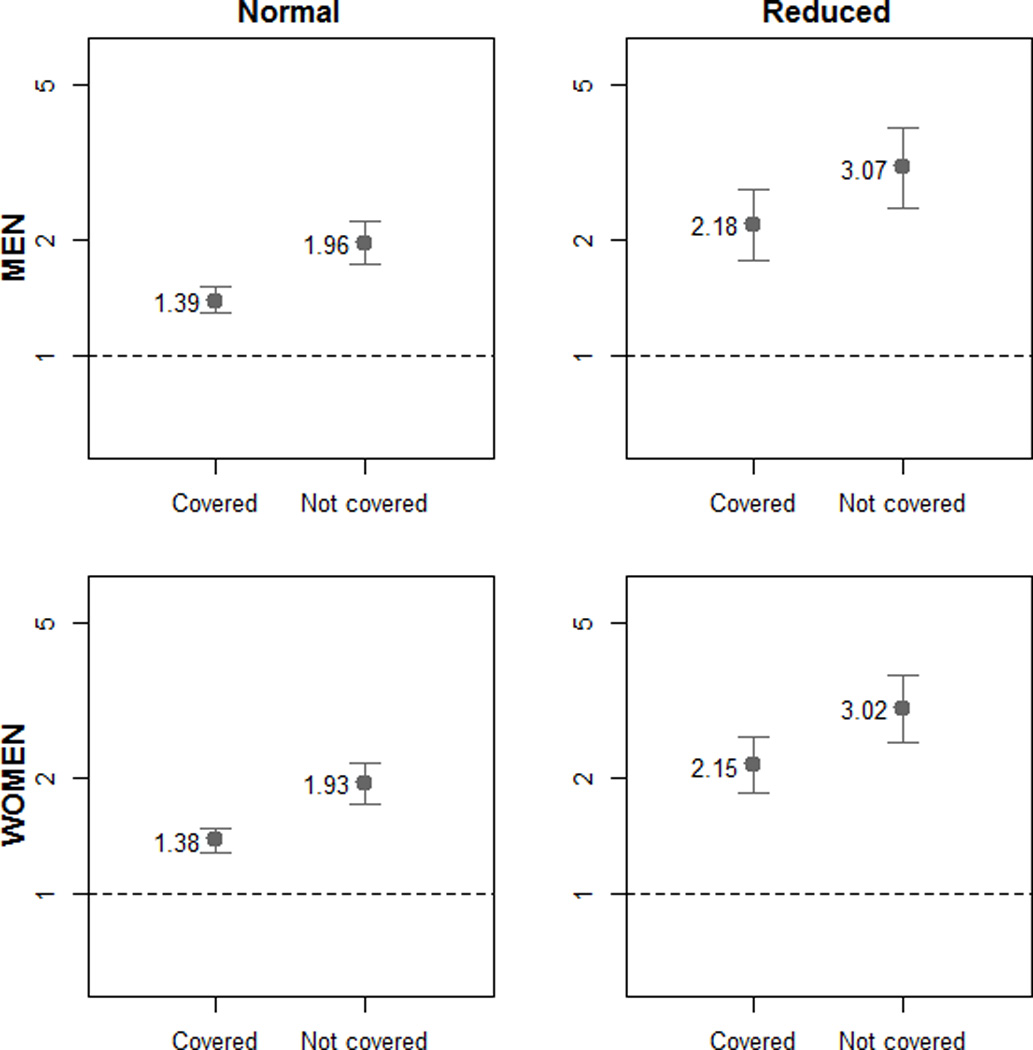
Results: Socioeconomic inequalities in the use of dental care services were higher in countries where no public dental care cover was provided than in countries where there was some degree of public coverage. For example, men with chewing ability from countries with dental care coverage had a RII of 1.39 (95%CI: 1.29-1.51), while those from countries without coverage had a RII of 1.96 (95%CI: 1.72-2.23). Women without chewing ability from countries with dental care coverage had a RII of 2.15 (95%CI: 1.82-2.52), while those from countries without coverage had a RII of 3.02 (95%CI: 2.47-3.69).
Conclusions: Dental systems relying on public coverage seem to show lower inequalities in their use, thus confirming the potential benefits of such systems.
Keywords: dental health care; public coverage; socioeconomic factors.
© 2013 John Wiley & Sons A/S. Published by John Wiley & Sons Ltd.
Figures
Comment in
-
Countries with public dental care coverage have lower social inequalities in the use of dental services than countries without such coverage.J Evid Based Dent Pract. 2015 Mar;15(1):41-2. doi: 10.1016/j.jebdp.2014.12.001. Epub 2014 Dec 16. J Evid Based Dent Pract. 2015. PMID: 25666584
References
-
- Kwan S, Petersen PE. Equity, social determinants and public health programmes. WHO; 2010. Oral health: equity and social determinants. - PubMed
-
- Spencer J, Harford J. Inequality in oral health in Australia. In: Symposium: Is it Time for a Universal Dental Scheme in Australia? Australian Review of Public Affairs. 2007
-
- Marmot M, Bell R. Social determinants and dental health. Adv Dent Res. 2011;23(2):201–206. - PubMed
-
- Sisson KL. Theoretical explanations for social inequalities in oral health. Community Dent Oral Epidemiol. 2007;35(2):81–88. - PubMed
Publication types
MeSH terms
Grants and funding
LinkOut - more resources
Full Text Sources
Other Literature Sources
Medical
