


One size does not fit all in severe infection: obesity alters outcome, susceptibility, treatment, and inflammatory response
- PMID: 23786836
- PMCID: PMC4057102
- DOI: 10.1186/cc12794
One size does not fit all in severe infection: obesity alters outcome, susceptibility, treatment, and inflammatory response
Abstract
Introduction: Obesity is an increasingly common comorbidity in critically ill patients. Whether obesity alters sepsis outcome, susceptibility, treatment, and response is not completely understood.
Methods: We conducted a retrospective analysis comparing three group of septic shock patients based on the intervals of actual body mass index (BMI) in patients enrolled in the VASST (Vasopressin and Septic Shock Trial) cohort. Primary outcome measurement was 28-day mortality. We tested for differences in patterns of infection by comparing the primary site of infection and organism. We also compared the treatments (fluids and vasopressors) and inflammatory response, measuring adipose tissue-related cytokine concentrations (interleukin [IL]-6, monocyte chemotactic protein [MCP]-1, tumor necrosis factor [TNF]-α, and resistin) in plasma in a subset of 382 patients. Of the 778 patients in VASST, 730 patients who had body weight and height measurements were analyzed. Patients with BMI<25 kg/m2 (n=276) were grouped as a reference and compared to 'overweight' (25<BMI<30 kg/m2, n=209) and 'obese' (BMI>30 kg/m2, n=245) patients.
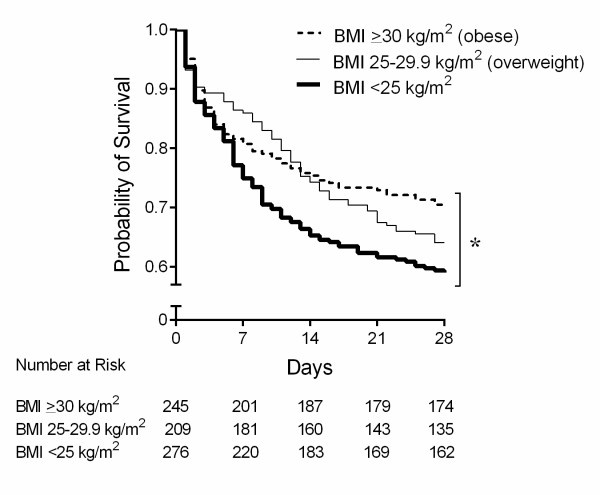
Results: Obese patients had the lowest 28-day mortality followed by overweight patients while patients with BMI<25 kg/m2 had the highest mortality (p=0.02). Compared to the patients with BMI<25 kg/m2, obese and overweight patients also had a different pattern of infection with less lung (obese 35%, overweight 45%, BMI<25 kg/m2 50%, p=0.003) and fungal infection (obese 8.2%, overweight 11%, and BMI<25 kg/m2 15.6%, p=0.03). Per kilogram, obese and overweight patients received less fluid during the first four days (p<0.05) and received less norepinephrine (obese 0.14, overweight 0.21, BMI<25 kg/m2 0.26 µg/kg/min, p<0.0001) and vasopressin (obese 0.28, overweight 0.36, BMI<25 kg/m2 0.43 µU/kg/min, p<0.0001) on day 1 compared to patients with BMI<25 kg/m2. Obese and overweight patients also had a lower plasma IL-6 concentration at baseline (obese 106 [IQR 34-686], overweight 190 [IQR 44-2339], BMI<25 kg/m2 235 [IQR 44-1793] pg/mL, p=0.046).
Conclusions: Overall obesity was associated with improved survival in septic shock and differences in pattern of infection, fluids, and vasopressors. Importantly, the magnitude of inflammatory IL-6 response is muted in the obese.
Figures


Comment in
-
Separating wheat from chaff: examining the obesity paradox in the critically ill.Crit Care. 2013 Jul 12;17(4):168. doi: 10.1186/cc12798. Crit Care. 2013. PMID: 23890365 Free PMC article.
References
-
- Harrington G, Russo P, Spelman D, Borrell S, Watson K, Barr W, Martin R, Edmonds D, Cocks J, Greenbough J, Lowe J, Randle L, Castell J, Browne E, Bellis K, Aberline M. Surgical-site infection rates and risk factor analysis in coronary artery bypass graft surgery. Infect Control Hosp Epidemiol. 2004;17:472–476. doi: 10.1086/502424. - DOI - PubMed
Publication types
MeSH terms
Substances
Grants and funding
LinkOut - more resources
Full Text Sources
Other Literature Sources
Medical
Miscellaneous
