Randomized Controlled Trial
. 2014 Jan;22(1):232-42.
doi: 10.1002/oby.20518. Epub 2013 Sep 10.

An 8-month randomized controlled exercise trial alters brain activation during cognitive tasks in overweight children

Affiliations
Randomized Controlled Trial

An 8-month randomized controlled exercise trial alters brain activation during cognitive tasks in overweight children

Cynthia E Krafft et al. Obesity (Silver Spring). 2014 Jan.

Abstract

Objective: Children who are less fit reportedly have lower performance on tests of cognitive control and differences in brain function. This study examined the effect of an exercise intervention on brain function during two cognitive control tasks in overweight children.

Design and methods: Participants included 43 unfit, overweight (BMI ≥ 85th percentile) children 8- to 11-years old (91% Black), who were randomly divided into either an aerobic exercise (n = 24) or attention control group (n = 19). Each group was offered a separate instructor-led after-school program every school day for 8 months. Before and after the program, all children performed two cognitive control tasks during functional magnetic resonance imaging (fMRI): antisaccade and flanker.

Results: Compared to the control group, the exercise group decreased activation in several regions supporting antisaccade performance, including precentral gyrus and posterior parietal cortex, and increased activation in several regions supporting flanker performance, including anterior cingulate and superior frontal gyrus.

Conclusions: Exercise may differentially impact these two task conditions, or the paradigms in which cognitive control tasks were presented may be sensitive to distinct types of brain activation that show different effects of exercise. In sum, exercise appears to alter efficiency or flexible modulation of neural circuitry supporting cognitive control in overweight children.


Figures

FIGURE 1
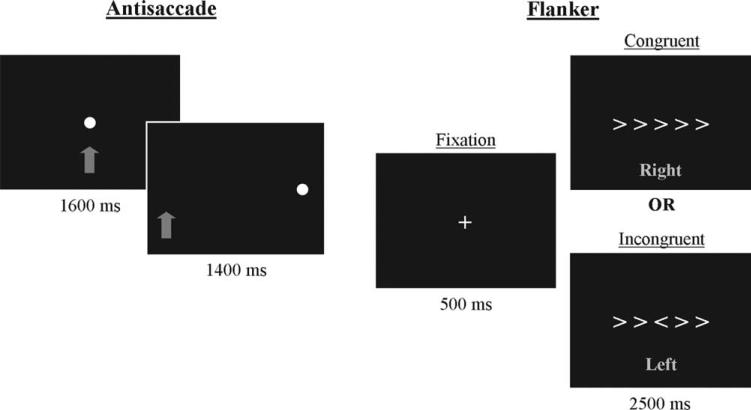
FIGURE 1
Antisaccade and flanker trials. In the antisaccade task, the participant was instructed to fixate on the cue when it was in the middle of the screen. When the cue appeared at a peripheral location, the participant was to look to the mirror image location (opposite side of the screen, the same distance from center). The arrow did not appear on the screen; in this figure it is used to indicate the correct eye position. In the flanker task, the participant was instructed to fixate on the cross. When the symbols appeared, the participant was to identify the direction of the central symbol and pressed a button with the corresponding hand. The text did not appear on the screen; in this figure, text indicates the correct response hand.
FIGURE 2
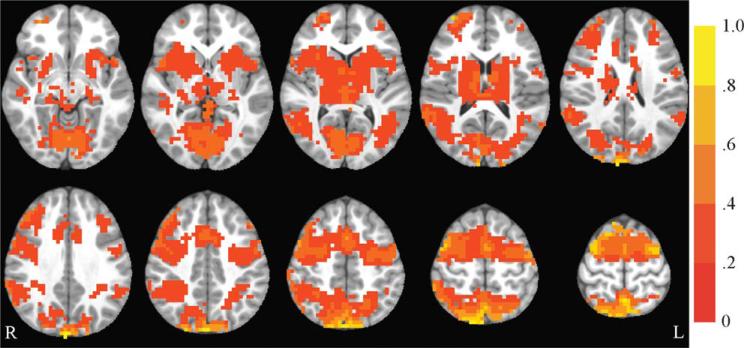
FIGURE 2
Antisaccade activation at baseline. Axial slices (top left z = 28 through bottom right z = 64, spacing = 8 mm) displaying significant antisaccade-correlated activation across all participants at baseline. The background anatomical image is the pediatric template that was used during alignment and is shown using radiological convention. Scale indicates percent signal change.
FIGURE 3
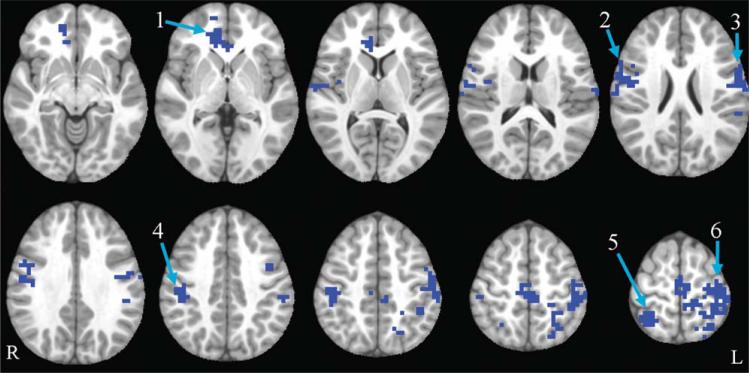
FIGURE 3
Antisaccade group by time interaction. Axial slices (top left z = –8 through bottom right z = 64, spacing = 8 mm) displaying significant group by time interactions in the antisaccade task. All clusters shown are blue, indicating that the exercise group decreased and the control group increased. The background anatomical image is the pediatric template that was used during alignment and is shown using radiological convention. Numbers correspond to labels in the first column of Table 3
FIGURE 4
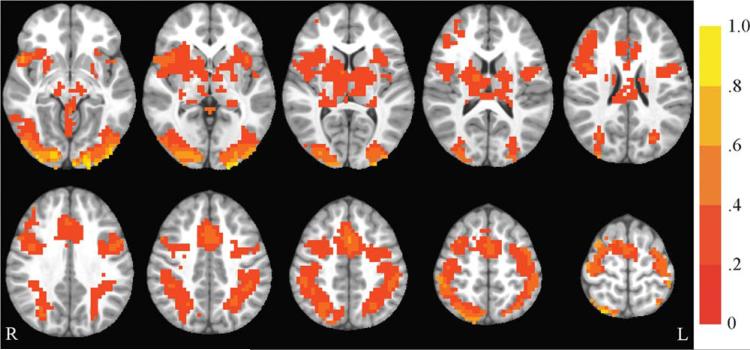
FIGURE 4
Incongruent vs. fixation activation at baseline. Axial slices (top left z = –8 through bottom right z = 64, spacing = 8 mm) displaying significant activation for the incongruent vs. fixation contrast across all participants at baseline. The background anatomical image is the pediatric template that was used during alignment and is shown using radiological convention. Scale indicates percent signal change.
FIGURE 5
FIGURE 5
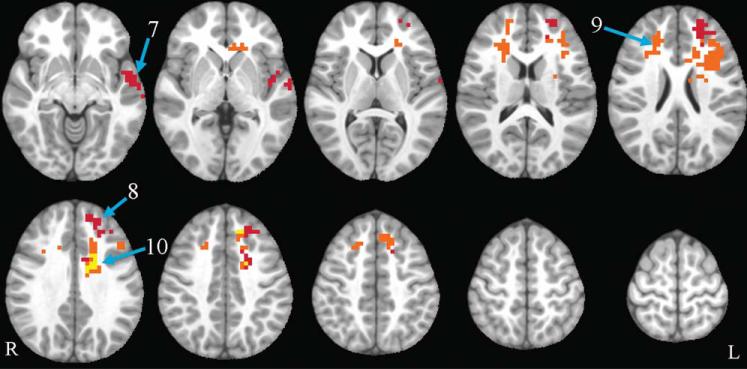
Flanker group by time interactions. Axial slices (top left z = –8 through bottom right z = 64, spacing = 8 mm) displaying significant group by time interactions in the incongruent vs. fixation and incongruent vs. congruent contrast. All clusters shown are warm colors, indicating that the exercise group increased and the control group decreased. Red corresponds to incongruent vs. fixation, orange corresponds to incongruent vs. congruent, and yellow shows areas where the two contrasts overlap. The background anatomical image is the pediatric template that was used during alignment and is shown using radiological convention. Numbers correspond to labels in the first column of Table 3.

References

    1. Ogden CL, Carroll MD, Kit BK, et al. Prevalence of obesity and trends in body mass index among US children and adolescents, 1999–2010. JAMA. 2012;307:483–490. - PMC - PubMed
    1. Tomkinson GR, Olds TS. Secular changes in pediatric aerobic fitness test performance: the global picture. Med Sport Sci. 2007;50:46–66. - PubMed
    1. Taras H, Potts-Datema W. Obesity and student performance at school. J School Health. 2005;75:291–295. - PubMed
    1. Davis CL, Cooper S. Fitness, fatness, cognition, behavior, and academic achievement among overweight children: do cross-sectional associations correspond to exercise trial outcomes? Prev Med. 2011;52:S65–S69. - PMC - PubMed
    1. LeBlanc MM, Martin CK, Han H, et al. Adiposity and physical activity are not related to academic achievement in school-aged children. J Dev Behav Pediatr. 2012;33:486–494. - PMC - PubMed

Publication types

LinkOut - more resources