


Spatial scales of genetic structure and gene flow in Calochortus albus (Liliaceae)
- PMID: 23789059
- PMCID: PMC3686183
- DOI: 10.1002/ece3.566
Spatial scales of genetic structure and gene flow in Calochortus albus (Liliaceae)
Abstract
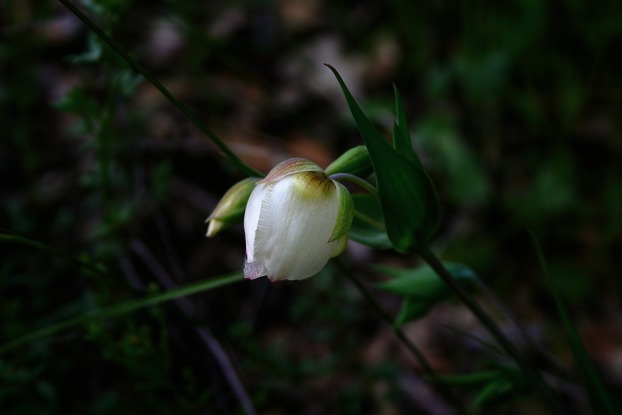
Calochortus (Liliaceae) displays high species richness, restriction of many individual taxa to narrow ranges, geographic coherence of individual clades, and parallel adaptive radiations in different regions. Here we test the first part of a hypothesis that all of these patterns may reflect gene flow at small geographic scales. We use amplified fragment length polymorphism variation to quantify the geographic scales of spatial genetic structure and apparent gene flow in Calochortus albus, a widespread member of the genus, at Henry Coe State Park in the Coast Ranges south of San Francisco Bay. Analyses of 254 mapped individuals spaced 0.001-14.4 km apart show a highly significant decline in genetic identity with ln distance, implying a root-mean-square distance of gene flow σ of 5-43 m. STRUCTURE analysis implies the existence of 2-4 clusters over the study area, with frequent reversals among clusters over short distances (<200 m) and a relatively high frequency of admixture within individuals at most sampling sites. While the intensity of spatial genetic structure in C. albus is weak, as measured by the Sp statistic, that appears to reflect low genetic identity of adjacent plants, which might reflect repeated colonizations at small spatial scales or density-dependent mortality of individual genotypes by natural enemies. Small spatial scales of gene flow and spatial genetic structure should permit, under a variety of conditions, genetic differentiation within species at such scales, setting the stage ultimately for speciation and adaptive radiation as such scales as well.
Keywords: Endemism; parallel adaptive radiations; spatial genetic structure; species richness.
Figures


References
-
- APG. An update of the Angiosperm Phylogeny Group classification for the orders and families of flowering plants: APG III. Bot. J. Linn. Soc. 2009;161:105–121.
-
- Bullock SH. Comparison of the distribution of seed and parent-plant populations. Southwest. Nat. 1976;21:383–389.
-
- Chung MM, Gelembiuk G, Givnish TJ. Population genetic variation and phylogeography of endangered Oxytropis campestris var. chartacea and relatives: arctic-alpine disjuncts in eastern North America. Mol. Ecol. 2004;13:3657–3673. - PubMed
-
- De-Lucas AI, González-Martínez SC, Vendramin GG, Heuertz M. Spatial genetic structure in continuous and fragmented populations of Pinus pinaster Aiton. Mol. Ecol. 2009;18:4564–4576. - PubMed
LinkOut - more resources
Full Text Sources
Other Literature Sources
