


ΔJunD overexpression in the nucleus accumbens prevents sexual reward in female Syrian hamsters
- PMID: 23790091
- PMCID: PMC3894818
- DOI: 10.1111/gbb.12060
ΔJunD overexpression in the nucleus accumbens prevents sexual reward in female Syrian hamsters
Abstract
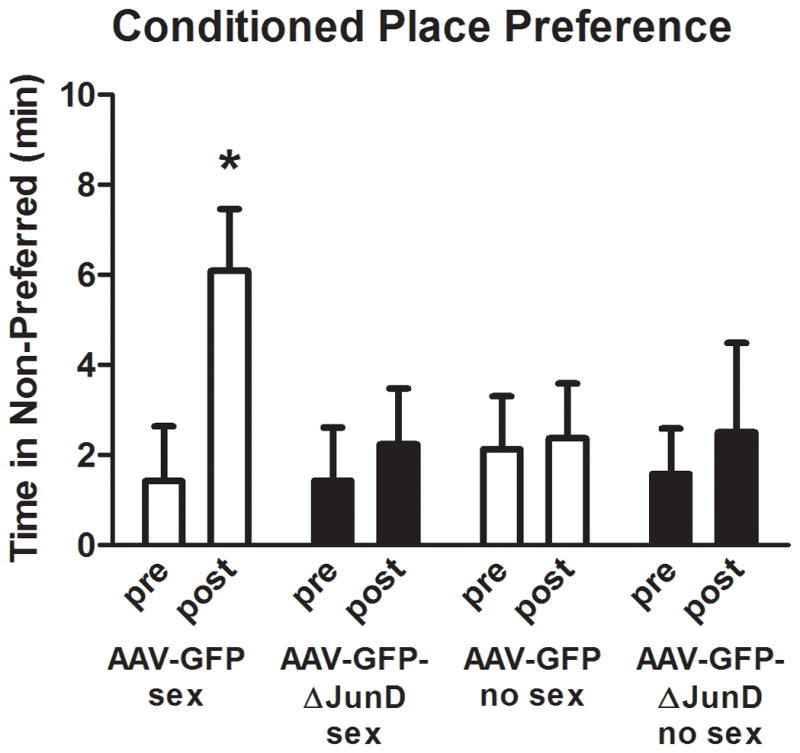
Motivated behaviors, including sexual experience, activate the mesolimbic dopamine system and produce long-lasting molecular and structural changes in the nucleus accumbens. The transcription factor ΔFosB is hypothesized to partly mediate this experience-dependent plasticity. Previous research in our laboratory has demonstrated that overexpressing ΔFosB in the nucleus accumbens of female Syrian hamsters augments the ability of sexual experience to cause the formation of a conditioned place preference. It is unknown, however, whether ΔFosB-mediated transcription in the nucleus accumbens is required for the behavioral consequences of sexual reward. We therefore used an adeno-associated virus to overexpress ΔJunD, a dominant negative binding partner of ΔFosB that decreases ΔFosB-mediated transcription by competitively heterodimerizing with ΔFosB before binding at promotor regions on target genes, in the nucleus accumbens. We found that overexpression of ΔJunD prevented the formation of a conditioned place preference following repeated sexual experiences. These data, when coupled with our previous findings, suggest that ΔFosB is both necessary and sufficient for behavioral plasticity following sexual experience. Furthermore, these results contribute to an important and growing body of literature demonstrating the necessity of endogenous ΔFosB expression in the nucleus accumbens for adaptive responding to naturally rewarding stimuli.
Keywords: Adeno-associated virus; conditioned place preference; delta FosB; plasticity; sex.
© 2013 John Wiley & Sons Ltd and International Behavioural and Neural Genetics Society.
Figures
References
-
- Bradley KC, Boulware MB, Jiang H, Doerge RW, Meisel RL, Mermelstein PG. Changes in gene expression within the nucleus accumbens and striatum following sexual experience. Genes Brain Behav. 2005a;4:31–44. - PubMed
-
- Bradley KC, Haas AR, Meisel RL. 6-Hydroxydopamine lesions in female hamsters (Mesocricetus auratus) abolish the sensitized effects of sexual experience on copulatory interactions with males. Behav Neurosci. 2005b;119:224–232. - PubMed
-
- Bradley KC, Mullins AJ, Meisel RL, Watts VJ. Sexual experience alters D1 receptor-mediated cyclic AMP production in the nucleus accumbens of female Syrian hamsters. Synapse. 2004;53:20–27. - PubMed
Publication types
MeSH terms
Substances
Grants and funding
LinkOut - more resources
Full Text Sources
Other Literature Sources
Miscellaneous
