


Measuring "waiting" impulsivity in substance addictions and binge eating disorder in a novel analogue of rodent serial reaction time task
- PMID: 23790224
- PMCID: PMC3988873
- DOI: 10.1016/j.biopsych.2013.05.013
Measuring "waiting" impulsivity in substance addictions and binge eating disorder in a novel analogue of rodent serial reaction time task
Abstract
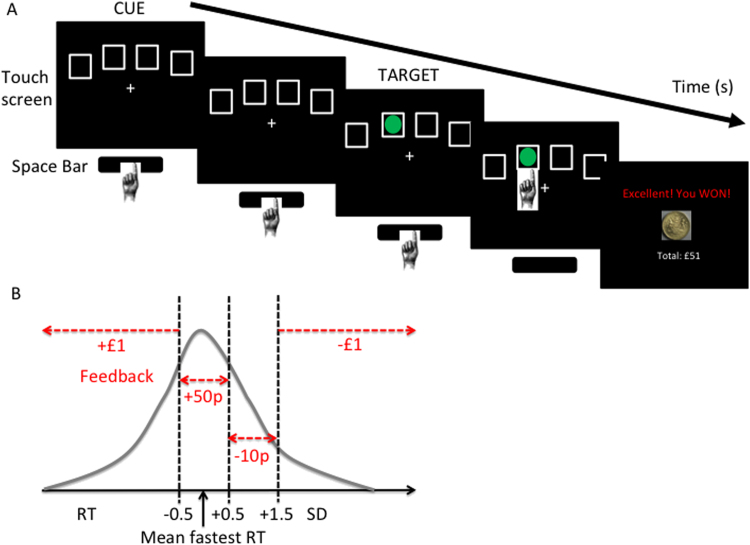
Background: Premature responding is a form of motor impulsivity that preclinical evidence has shown to predict compulsive drug seeking but has not yet been studied in humans. We developed a novel translation of the task, based on the rodent 5-choice serial reaction time task, testing premature responding in disorders of drug and natural food rewards.
Methods: Abstinent alcohol- (n = 30) and methamphetamine-dependent (n = 23) subjects, recreational cannabis users (n = 30), and obese subjects with (n = 30) and without (n = 30) binge eating disorder (BED) were compared with matched healthy volunteers and tested on the premature responding task.
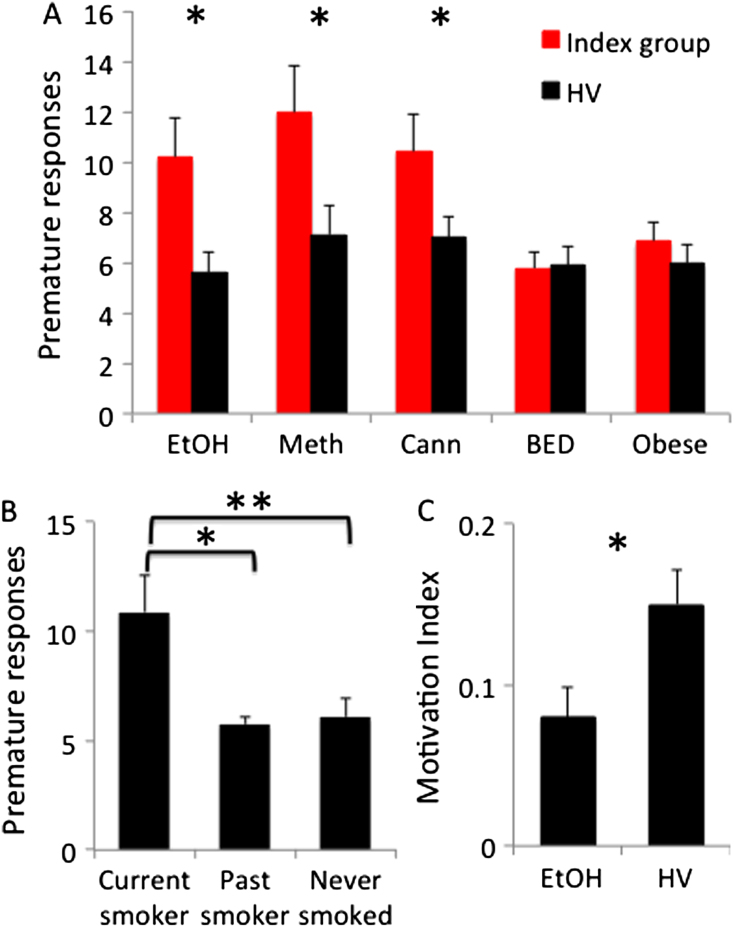
Results: Compared with healthy volunteers, alcohol- and methamphetamine-dependent subjects and cannabis users showed greater premature responding with no differences observed in obese subjects with or without BED. Current smokers exhibited greater premature responding versus ex-smokers and nonsmokers. Alcohol-dependent subjects also had lower motivation for explicit monetary incentives. A Motivation Index correlated negatively with alcohol use and binge eating severity.
Conclusions: Premature responding on a novel translation of a serial reaction time task was more evident in substance use disorders but not in obese subjects with or without BED. Lower motivation for monetary incentives linked alcohol use and binge eating severity. Our findings add to understanding the relationship between drug and natural food rewards.
Keywords: Binge eating; impulsivity; motivation; obesity; premature responding; substance use disorders.
Copyright © 2014 Society of Biological Psychiatry. Published by Elsevier Inc. All rights reserved.
Figures
References
-
- Robbins T.W. The 5-choice serial reaction time task: Behavioural pharmacology and functional neurochemistry. Psychopharmacology (Berl) 2002;163:362–380. - PubMed
-
- Robbins T.W., Gillan C.M., Smith D.G., de Wit S., Ersche K.D. Neurocognitive endophenotypes of impulsivity and compulsivity: Towards dimensional psychiatry. Trends Cogn Sci. 2012;16:81–91. - PubMed
-
- Perry J.L., Carroll M.E. The role of impulsive behavior in drug abuse. Psychopharmacology (Berl) 2008;200:1–26. - PubMed
-
- Dalley J.W., Everitt B.J., Robbins T.W. Impulsivity, compulsivity, and top-down cognitive control. Neuron. 2011;69:680–694. - PubMed
-
- Dalley J.W., Laane K., Theobald D.E., Pena Y., Bruce C.C., Huszar A.C., et al. Enduring deficits in sustained visual attention during withdrawal of intravenous methylenedioxymethamphetamine self-administration in rats: Results from a comparative study with d-amphetamine and methamphetamine. Neuropsychopharmacology. 2007;32:1195–1206. - PubMed
MeSH terms
Grants and funding
LinkOut - more resources
Full Text Sources
Other Literature Sources
Medical
